
Alain Platel created this production at the invitation of his good friend and mentor Gerard Mortier. C(h)oeurs refers to both hearts and choirs. The production premiered in 2012 at Teatro Real Madrid and struck the audience like a thunderbolt. At that time, the production was created against the backdrop of the Arab Spring, the banking crisis and the protest of the Indignados (Spanish for the outraged). Platel questioned the cultural-ethical substrate of our society. Now he deemed it high time for an update. Together with the dancers, the Choir and Orchestra of Opera Ballet Vlaanderen, he investigates in his engaged manner an image of a world that appears even more tense and ominous than a decade ago, with long shadows of tragedy. He connects hope and despair from the past with those who today in different countries and places on this planet hope for peace, justice and righteousness.
Gesamtkunstwerk
Platel has achieved a stunning level of perfection in this production: dramaturgy, image, sound and dance bend to his vision and relate to each other like an umbilical cord to the world. The scenario is like an echo chamber in which injustice continues to resonate. He chose music by Verdi and Wagner. Both lived in the 19th century also in turbulent times and gave voice with their music to progressive nationalism. The subtle ambiguity of the music as a mediator between the material and spiritual, the sustainable and fragile, the temporary and the eternal, the individual and the group is sublime. Choir and dancers are complementary, complement each other. A choir is par excellence the musical constellation in which the individual voice merges into the larger whole. The dancers are body and limbs, cry, animal, unconscious, intimacy. The choir is voice, word, discourse, people, outside world. On stage stand 70 performers. Through the mass, the whole hits you and finds its way to your heart.
Staging
When the curtain rises, at the front right of the stage stands a solitary figure
in a white dress to knee height with her back to the audience, head down caught in a spotlight. Above the shoulders hands come into view. Fingers that carefully scan the space like feelers. An individual in the big world. Gradually the entire stage comes into light. An immense space surrounded by transparent slats. In the back a stage-wide staircase of six steps on which the choir positions itself: the masses, the people. They sing the overture to Lohengrin by Wagner. Later fragments from Tannhäuser and Die Meistersinger von Nürnberg also sound. The produced number of decibels from choir and orchestra, the force of the numbers emphasizes the vulnerability of the individual even more. Dropwise a couple of dancers appear on the stage. They have something in their mouth. A bit (for control), a gag (silencing)? The image evokes all sorts of associations. To the sound of fanfare and trumpet blasts, the solitary figure pulls extremely slowly, almost imperceptibly the cloth over her shoulders. You look at an anonymous naked body. Meanwhile, the full ballet company stands on the stage in a cluster clinging together. They shudder, tremble, traumatized figures and let the gag fall from their mouths. Some also seek comfort in each other's arms. Images of distress. A poignant scene. They open their mouths and the sound of a siren rings out.
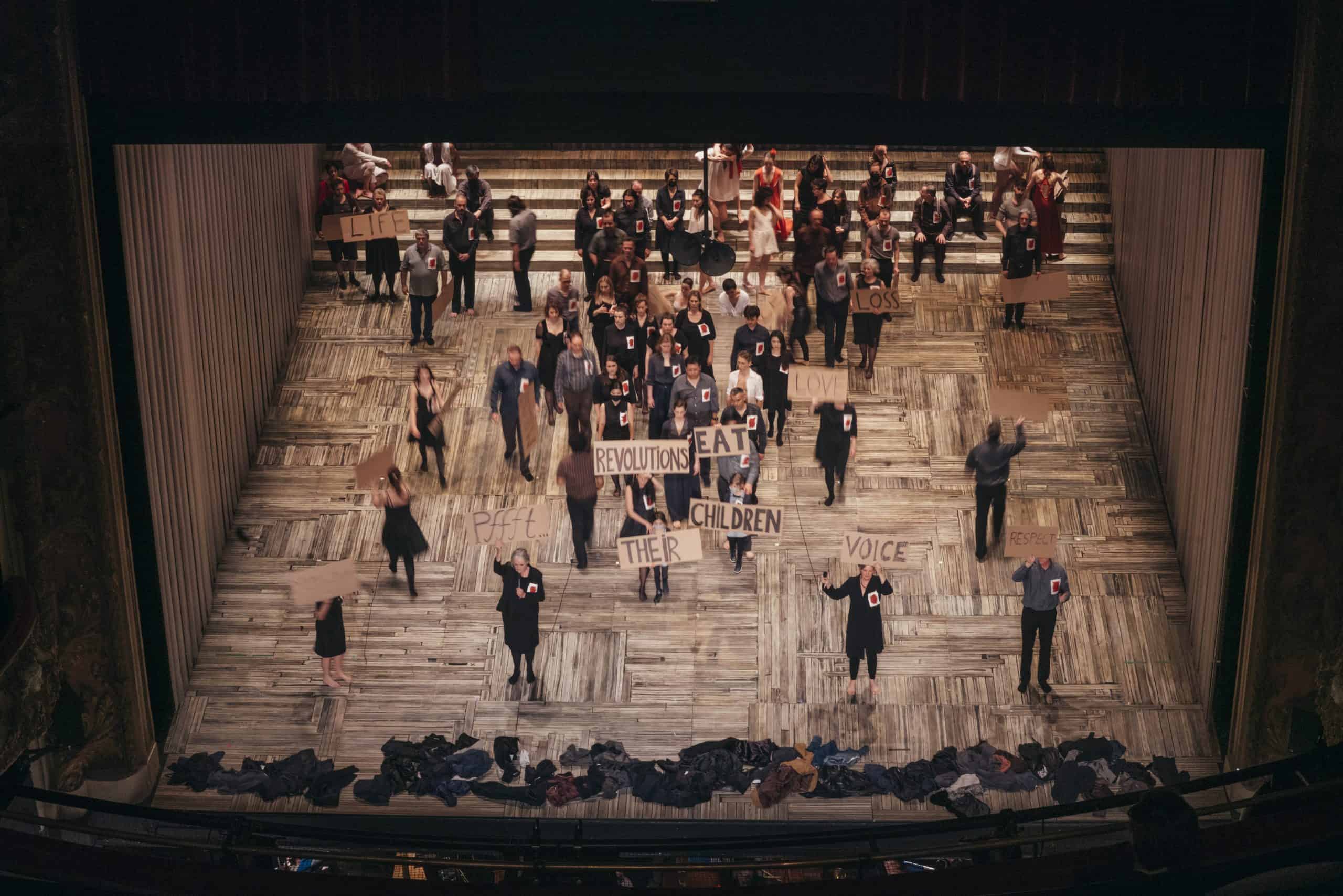
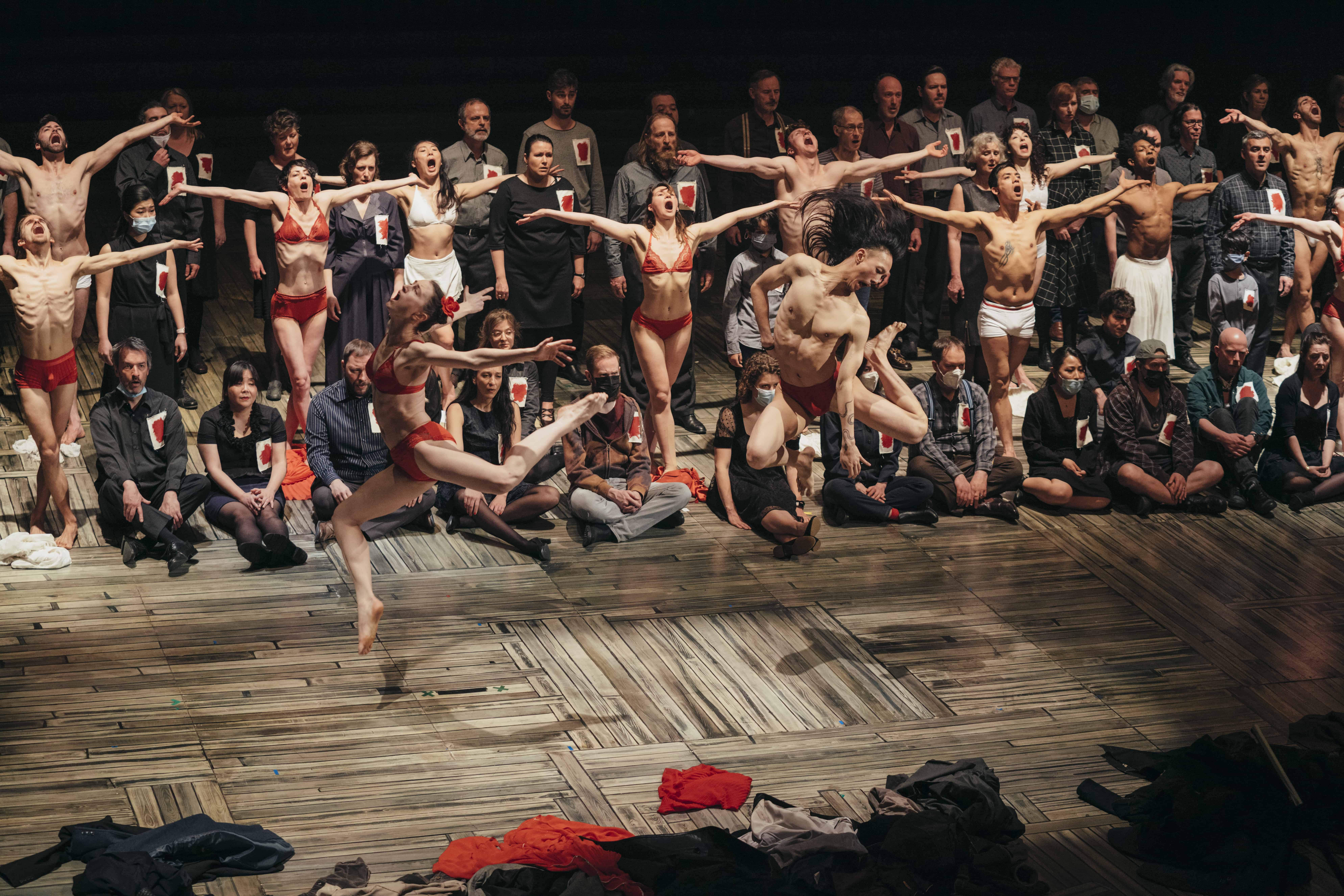
In a march, like a tidal wave, the choir moves forward, everyone removes his/her jacket or coat. At chest level hangs a white piece of linen with a large red spot on it. Platel also integrates the Slave Chorus -Va Pensiero- from Nabucco by Verdi. An imperial song that has become part of collective memory. A choral song that has already been performed thousands of times and does not become hollow through repetition. On the contrary. Each time it gains meaning through current events. Now everyone associates it with Putin's frightening hunger for power and the heroic resistance of the Ukrainian people. The choir does not stand there as a monolithic block, but also plays the scene. While they stand scattered across the stage and sing, the members of the ballet stand among them with mouths wide open. A wordless scream. Or with the fist in front of the mouth, silenced like many peoples today.
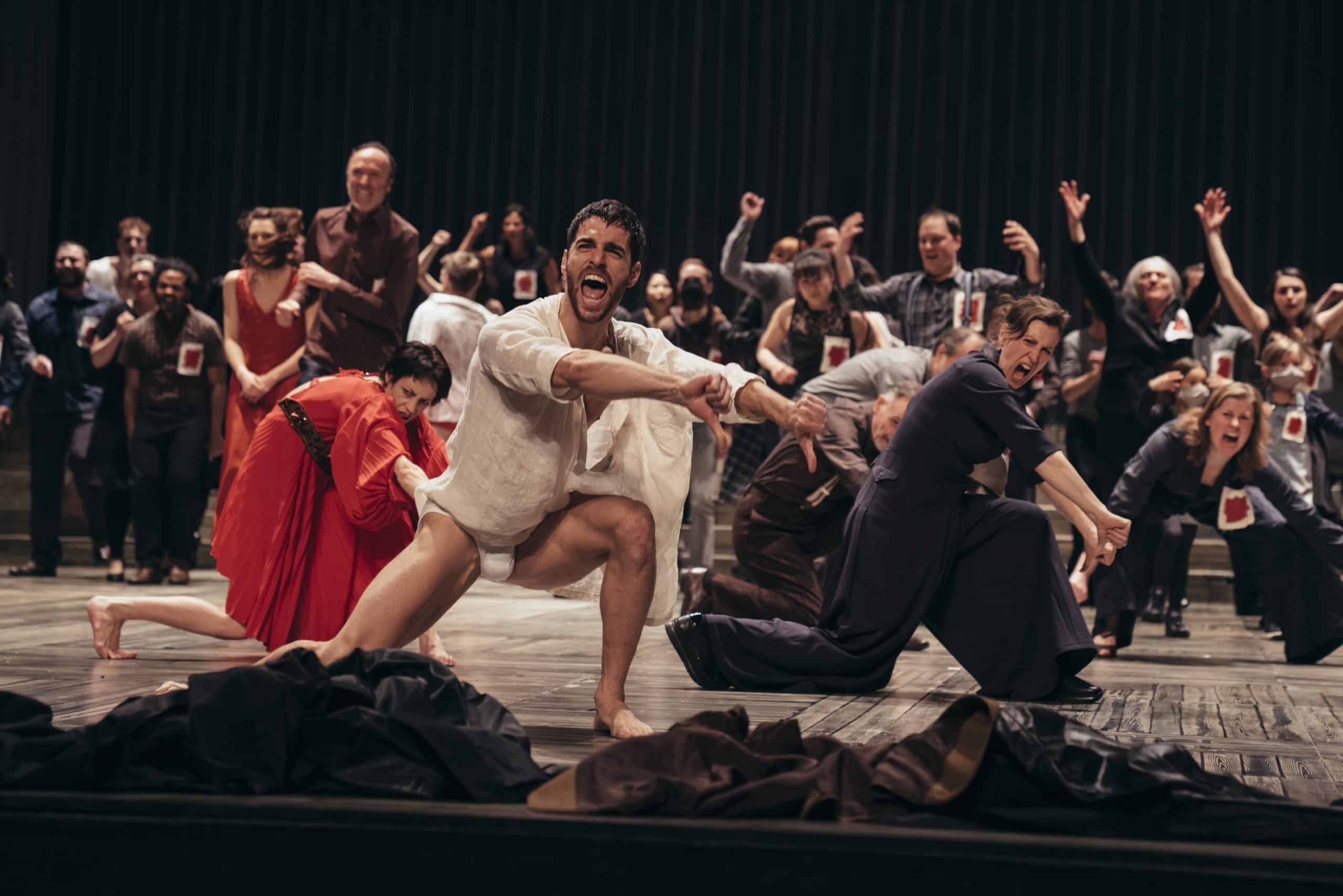
The dancers create a trembling air current and emotional turbulence. Emotion that takes physical form. The choir also joins in the movement. At one point a Haka scene is visible, impressive, combative. The shared movement language is not far-fetched at all, even simple upon analysis, but all the more powerful for that.
Phasing
Platel also shows how the individual can be swept up in the masses, how euphoria arises. Energy bursts from the stage. Rising up against the system. In a collective protest, shoes are catapulted away (Egyptian revolution). Yellow and blue flags, the colours of Ukraine, are swung overhead in a round dance, which sparked spontaneous applause from the audience. You feel the power of the double energy: a masterfully beautiful interweaving of the music of Wagner and Verdi in a refined harmony of sounds. Composer Steven Prengels connected the various choral works together, resulting in a varied soundscape.
At one point, the towering lamellae are pulled upward, a battery of spotlights descends on a solitary figure. The voices of the choir suddenly ring out from the balconies. They retreat and unleash chaos behind the scenes, banging on the hall doors, creating an uncanny feeling. How must the victims of pogroms and assaults feel?
The stage image is again as at the beginning. Between the lamellae, dancers fall from the stairs. Revolutions exact victims. The choir watches between the lamellae: the intimidated, silent, fearful masses. The question is posed: "Who am I?" You exist only through the eyes of another. Creation is defined as a miraculous mathematical accident! When the choir takes possession of the stage again and the Dies Irae from Verdi's Requiem rings out, two small boys are reluctantly and somewhat roughly pushed to the front. A prolonged moment of silence follows, a silence that speaks volumes. The rhythm of a heartbeat is heard. Life and survival. Pressing questions are asked: "Are you prepared to die out of love for another, for your country?" It is a coming and going of choir members introducing themselves. Figures from the nameless masses who are given a name and a face. Meanwhile, placards are described and shown: Respect, Defenceless, Freedom, Love, Health, Fraternité, Redistribution, Water, Peace, Disarming… Meaningful slogans in this time. In a final phase of this scene, a sentence is assembled from loose words: "Revolutions eat their children." The two small boys are the victims and are respectfully lifted above the heads, passing from hand to hand in a long funeral procession. Images that evoke connotations.
In the next sequence, the dancers of Ballet Vlaanderen regain full attention in beautiful duets. In an impressive mating dance, they writhe and twist around each other, while the choir watches sitting down.
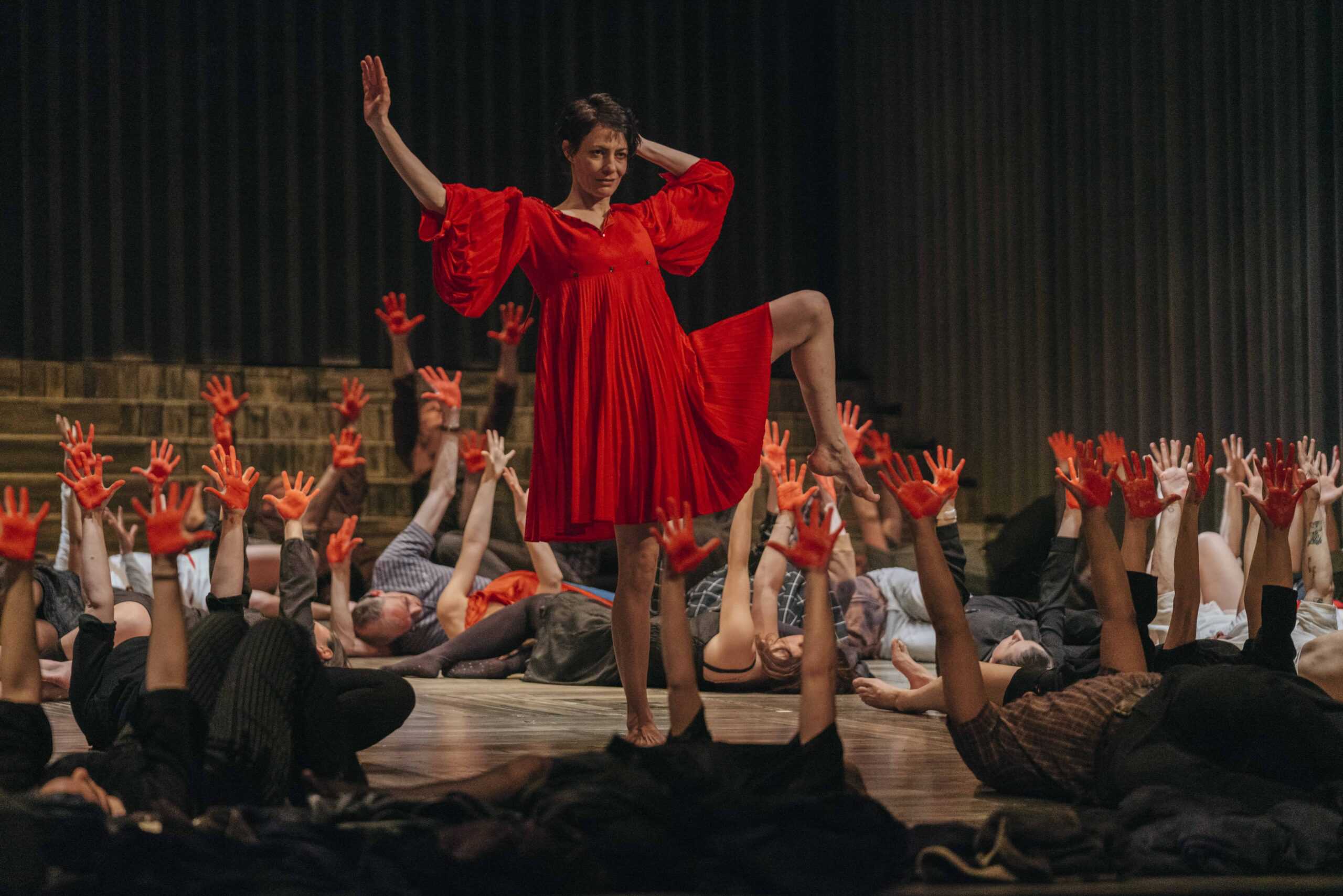
Shortly thereafter, the choir folds in on itself and is followed by a deafening silence. Everyone spontaneously lies on the ground criss-cross. It looks like an enormous battlefield. Upper arms with hands clenched as fists stick upward. It looks like an enormous field of broken branches. Some dancers dart playfully through them. Give here and there a push against an arm that, like reeds in the breath of the wind, folds back. Suddenly all the hands open, blood-red in colour like the red poppies on the battlefield. Whereupon the poem 'In Flanders Fields' immediately resonates in your mind.
In the final phase of the performance, those red hands provide a haunting finale.
Teamwork
Conductor Alejo Pérez communicates in an intimate, subtle manner with the musicians and manages to generate energy and intimacy. Choir leader Jan Schweiger performed wonders. For the musical arrangement and soundscapes of Steven Prengels, nothing but praise. The young dancers of Ballet Vlaanderen: impressive.
A haunting beautiful performance that grabs at the throat and provides the viewer with sensations for which one scarcely finds expressions. A polyphonic work about disarray, the devaluation of all humanity. But in this performance there are also stepping stones towards awareness, towards cautious light in the darkness. It is a plea for social cohesion. A gripping and cathartic emotional experience for both the choir members, the dancers, the musicians and the audience. A cathartic moment, also a moment of reflection on what is happening in the world. Not only visually and aurally an unparalleled performance. It touches both the heart and the mind. A masterful performance, signed: Alain Platel.
Final Remarks
Opera Ballet Vlaanderen is a hybrid house in full development. A performance with all the talent from its own ranks: choir, orchestra, ballet. While there was initially considerable hesitation and scepticism about the merger, that has now been erased. It has become a particularly strong entity. A success story pure and simple.


Production: Opera Ballet Vlaanderen
Concept, direction and staging: Alain Platel
Musical direction: Alejo Pérez
Choir direction: Jan Schweiger
Dramaturgy: Hildegard De Vuyst & Jan Vandenhouwe