
It does good when a quality newspaper like De Standaard devotes extensive attention to early music. Unfortunately, that happens far too rarely. The sector has grown over the past decades into a mature cultural ecosystem, but rarely makes it into the general media, unless a major name or a special event hits the news. For that reason alone, the recent article on the "seven trends" of this festival summer deserves praise.
At Klassiek Centraal we have been trying to fill that gap for years. In recent weeks, introductory articles have already appeared on Laus Polyphoniae in Antwerpen and the MA Festival in Brugge. Soon to follow is an extensive report from Brugge, where we are allowed to follow behind the scenes for a day, while Laus Polyphoniae will also be covered extensively. The Festival Oude Muziek Utrecht also remains a fixed reference point. The attention that De Standaard is now giving to these festivals can only benefit the sector.
The seven trends that the author distinguishes are recognizable and largely correct. Yet they deserve some nuance and supplementation. Because much of what is presented as "new" today is in reality the result of a development that began decades ago.
No longer a museum piece? That has been the case for a long time.
According to De Standaard, early music is no longer a museum piece. That's true, but this evolution is far from recent.
Suppose historical performance practice had stalled in the seventies. We could still, and sometimes still do, enjoy beautiful interpretations by pioneers like Gustav Leonhardt, Nikolaus Harnoncourt, Frans Brüggen, Philippe Herreweghe, Sigiswald Kuijken or Paul Van Nevel. But the question is whether the early music world today would still have the same vitality if it had ended there.
It is precisely those pioneers who laid the foundations. They reconstructed instruments, studied manuscripts, developed performance practices and proved that early music could be much more than a romantic interpretation of centuries-old scores.
Their greatest achievement may not even be musical, but cultural and economic. They created a fully-fledged industry. I use the word "industry" deliberately, not in a negative sense, but in the economic meaning of the word. Around early music emerged a network of festivals, educational institutions, ensembles, researchers, instrument makers, record labels and concert organizations that today provides work for thousands of people and creates considerable cultural added value.
Precisely because those foundations are so solid, the current generation can afford a certain artistic freedom, although it remains hard work.
Research and creativity strengthen each other
The author rightly notes that performers today increasingly start from research without completely submitting to it. This is an enrichment of historical performance practice and a logical next step.
Those who know the sources and techniques thoroughly, sense and master them, also dare to be creative with them. New reconstructions, forgotten manuscripts and fragmentarily transmitted repertoire today often form the starting point for concerts that are both historically grounded and artistically adventurous.
The same applies to the second trend where the human being is central.
Whereas the first generation primarily wanted to understand the composer and context, the current generation tries above all to discover the person behind the music. As a result, programs increasingly appear around lesser-known composers or completely forgotten music. Often you leave such a concert with the conviction that you have heard something exceptional, even though you had never heard of the composer or the music before the concert. This proves that early music enriches its identity and continues to evolve.
The canon grows, it does not shrink
The broadening of the canon (a difficult word for "the classical repertoire") is hardly surprising either.
Lassus, Monteverdi, Bach and Händel fortunately remain the beacons of the repertoire. But in the meantime, dozens of researchers have combed through Europe's archives. Manuscripts that gathered dust for centuries are now re-edited, studied and performed.
That may well be one of the greatest achievements of historical performance practice: not only performing well-known masterworks, but saving thousands of pages of music that would otherwise be forgotten forever.
Festivals no longer sell concerts, but experiences
Another trend that De Standaard rightly identifies is the evolution of festivals into total experiences.
Today, concerts rarely stand alone. Lectures, exhibitions, city walks, meetings with artists, workshops and gastronomic activities increasingly form part of the same story.
Incidentally, this is not an exclusive characteristic of early music. Anyone visiting a film festival today, discovering a museum or even attending a major pop festival like Tomorrowland, notices the same evolution. Visitors seek experience, depth and contextualization.
Improvisation has never gone away
The fifth trend I personally found the least surprising. After all, improvisation has been part of music since the Middle Ages. Medieval monody, early polyphony, Renaissance music and even the Baroque assumed that a performer did more than simply reproduce notes.
What is changing today is the way musicians deal with incompletely transmitted material. From their historical knowledge, they reconstruct missing voices or build around a few preserved lines a complete musical architecture. This requires not only imagination, but especially enormous expertise.
Early music looks to today
Perhaps the most striking development is that early music is increasingly seeking connection with contemporary issues.
There are beautiful examples of this.
I think, for example, of Christina Pluhar, who in a recent program used migration routes across the Balkans as inspiration. Her starting point was the tragedy of dozens of migrants who were found dead years ago in a truck in Austria. That story evolved into a musical program in which early music took on contemporary meaning. That kind of project shows how historical music today can regain social relevance.
Yet there is also a tension here.
Those who follow the discussions between Paul Van Nevel and Björn Schmelzer of Graindelavoix (I gladly refer here to the wonderful podcasts "de Uil van Minerva" by Johan Geerts) will notice that the old contradiction still exists. How far can you go in updating early music? Can you project contemporary philosophies or societal ideas onto repertoire that originated centuries ago?
That debate is healthy and extremely interesting. So bring it on!
Old and new are not mutually exclusive
The last trend describes how contemporary compositions are increasingly performed alongside early music. That seems to me a particularly positive development. Perhaps that is even the greatest achievement of the early music world, because after all, early music was once new music itself.
By re-studying, analyzing and understanding centuries-old scores, contemporary composers find inspiration. Early music provides fresh oxygen to new creations and work for today's composers. This demonstrates how alive this music still is.
What I still want to add
Yet I missed some important observations in the article.
First of all, the enormous growth in quality. Forty years ago, everyone knew the same handful of top ensembles. Today there are dozens of ensembles at international level. Young singers, instrumentalists and conductors also reach an artistic standard that would have been barely conceivable a few decades ago.
This growth naturally also has a downside. The supply has become so large that ensembles must increasingly distinguish themselves. Perhaps that partly explains why festivals are constantly seeking new angles. And yes, sometimes they come up with "forced" programmes
I also observe an opposite movement. While festivals are experimenting fully, I increasingly hear concert audiences longing for the great monuments of the repertoire. Bach, Monteverdi, Lassus and Händel continue to exert enormous appeal. The success of the specialized Bach in De Stad festival demonstrates that unmistakably. (By Stad I of course mean Antwerpen)
Innovation is necessary. But the traditional masterworks also deserve their place. I am convinced that finding the balance between the two will be the greatest challenge for tomorrow's festivals, not least budgetarily.
Early music has come of age
Anyone who reads the seven trends of De Standaard carefully will notice above all how mature the early music world has become. Historically informed performance practice has evolved from a pioneering movement into an international network of musicians, researchers and festivals that is firmly anchored both artistically and economically.
The pioneers laid the foundations. The current generation builds on that. And the next generation will undoubtedly do that differently again. Because ultimately, early music was never really old. It was once new itself.
And that is precisely why it continues to ask new questions today, tell new stories and inspire new music. That may well be the most beautiful trend of all and the reason that every early music concert is a veritable discovery.
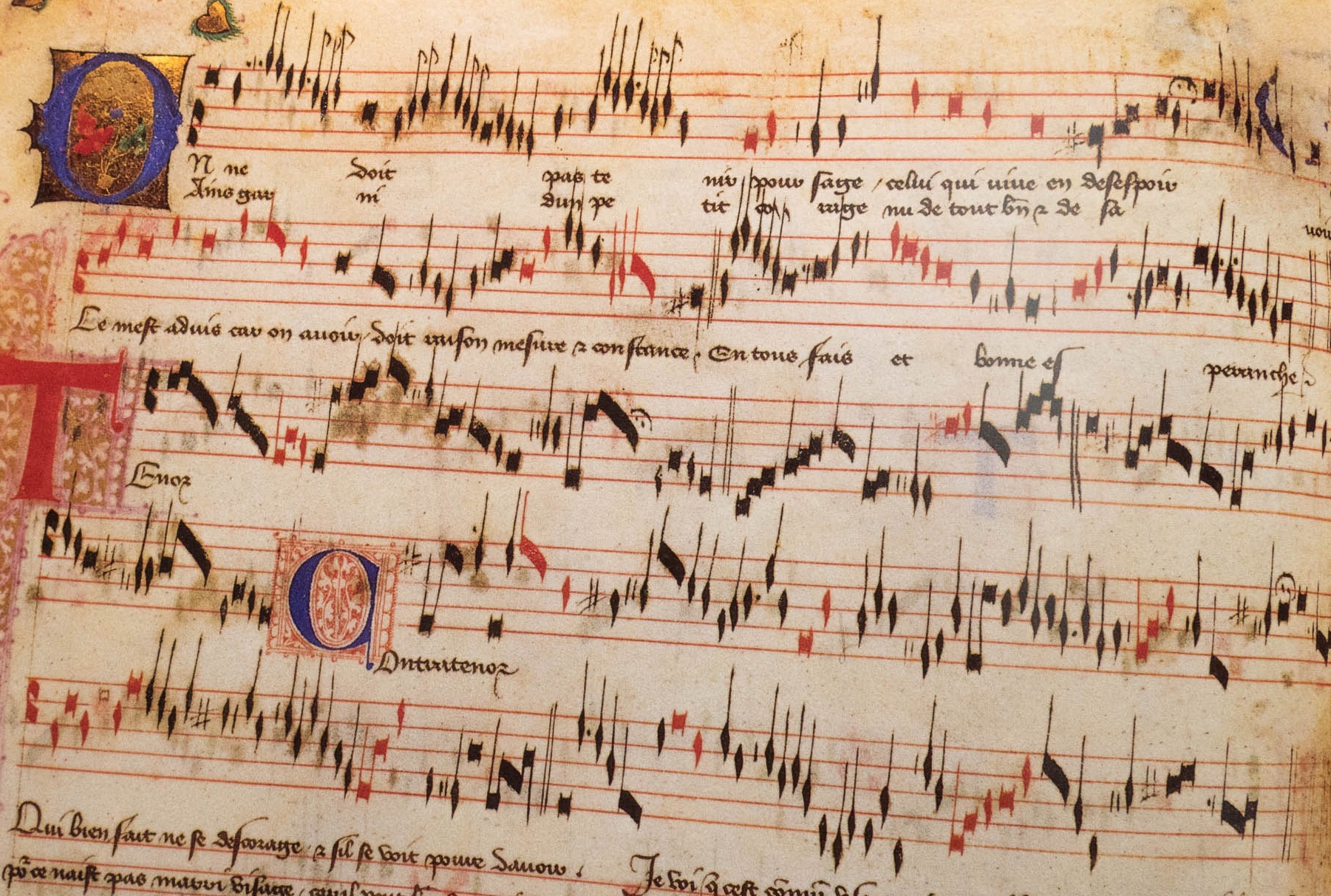
photo: (c) manuscript finder