
Passion season is once again behind us, countless orchestras, choirs, soloists and conductors have exerted themselves over the past months to rehearse and perform especially the two most famous passions, the Mattheüspassion and the Johannespassion by Johann Sebastian Bach, but also completely unknown works were featured.
On Good Friday, Klara (the Flemish classical radio station of the VRT) broadcast the Mattheüspassion by Bach. It was a performance conducted by Sigiswald Kuijken with La Petite Bande in a presentation by Bart Stouten. Whoever knew Bach's passions 'simply' or (still) did not know them and listened, at any rate learned (very) much.
A so-called 'soloistic' performance has many proponents and opponents. Personally, I am not a great fan of the soloistic performance, but I am not necessarily against it, although I rather follow the position of Ton Koopman who favours orchestra, soloists and choir. But well, to each his own taste and vision. Both parties have arguments that are strongly defensible, rather than refutable. A fortunate circumstance that allows everyone the opportunity to enjoy or participate (and thus also enjoy) a performance as he/she prefers it.
As long as the overwhelming content, the rich texts of both passions, come into their own. That is of tremendous importance. Certainly the role of the evangelist cannot be underestimated. If you have an evangelist who sings his text with emphasis, the passion takes on a much more profound content and meaning, then it changes, whether it is the Mattheüs or the Johannes, in musical depth. It goes more through bone and marrow than an ordinarily beautiful musical performance.
Johannespassion by Hildebrandt Consort
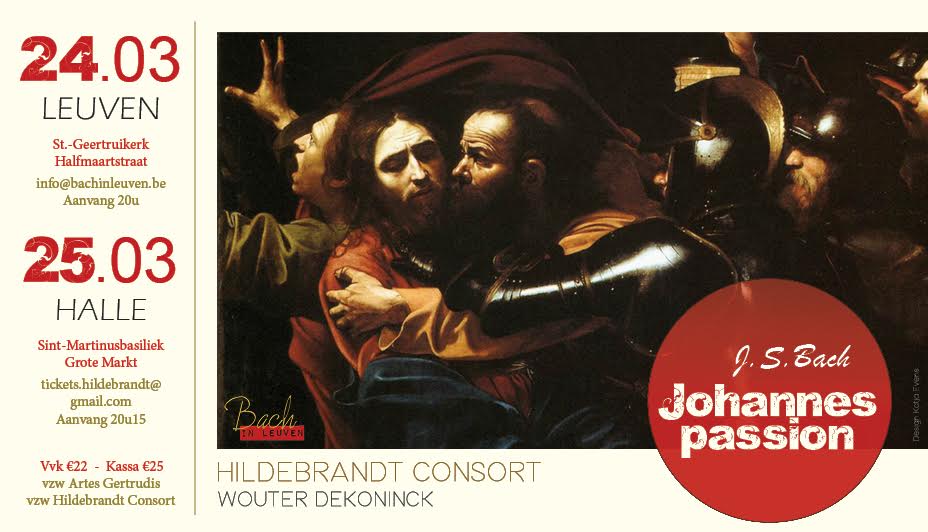
So I come to the performance of the Johannespassion by the Hildebrandt Consort conducted by Wouter Dekoninck. I listened in the Sint-Geertruikerk in Leuven. A church in an environment that is inspiring in itself with the remaining abbey buildings and that lovely small béguinage – where have those days gone when it was a slum area?
It was a mistake on my part to sit in the front row. I rarely do it, I'd rather not, and the reason why became clear to me once more. You hear the part of the musicians you are sitting directly in front of much louder than the others, so the balance is out of equilibrium and that is not the fault of the performers' positioning, but my fault for sitting at the side of the front row. Yes, I make mistakes too... But I won't complain too much, I heard everything, the instruments, the soloists, and especially the evangelist. He did what he had to. Interpreting the text literally, acting, declaiming and singing very purely with great emphasis on the syllables where it was required to further accentuate the drama. What a strong role the audience heard! Yes, for a second time in a number of years I heard an evangelist again who knew where the content and the music find each other as rarely happens. Bach's genius thus comes more to the fore.
Remember the name of this tenor: Lothar Blum. He gave this passion such an ideal approach that I cannot shake the impression that he also, unconsciously, virtually completely determined the musical line. The soloists held themselves somewhat more soberly than we are used to and I suspect this is precisely because of the soloistic setting where the singers are both soloist and choir singer. Here my doubts about such a setting gain the upper hand once more, pardon me. However, this does not at all mean that the performance in this or that respect was not musically justified, quite the opposite. It was gripping at moments, sharpened your insight into Bach's work, made you at times suffer with what Jesus experiences. A non-believer could have been converted that way. Perhaps it did happen, I'll leave that in between. I have not been completely converted to the soloistic performance, but if I say I did not enjoy every second of it, I lie.
May that unknown passion become part of the repertoire!
Few of you will have heard of the Italian composer Gaetano Veneziano (1655-1716). Once I heard something of it on the radio and I think I discussed a work by him on some cd or other, a number of years ago. Please don't ask me which cd, I don't remember anymore. And have you heard of Antonio Lola (1643-after 1715)? Neither had I, until Leonardo Garcia Alarcon programmed works by both composers and brought them in renewed world premiere at the Palais des Beaux-Arts in Brussels.
As usual, he could rely on his young Millenium Orchestra – don't think I regret that Klassiek Centraal gave it a Golden Label Debut, on the contrary, I am even more convinced that it was the right choice – and the Choeur de Chambre de Namur with their own soloists and as an extra the soprano (better say this than countertenor or altus) Valer Sabadus, Francisco Javier Manalich Raffo (tenor) and the baritone of 'the house' Philippe Favette.
The largest part for the soloists falls to the evangelist, just as with Bach, but know that Bach was born at the moment when the twenty-year-old Gaetano Veneziano composed this passion in Naples. The passion also does not have the somewhat operatic character of many German passions, including those of Bach. It is much more oratorio and less elaborated with lengthy arias.
Conductor Alarcon tells us, an hour before the concert, more about this passion and the two composers on the program. We learn that the older Scarlatti applied for the same position as the young Veneziano who was awarded the post. It created rivalry and Scarlatti also wrote a passion to prove who was actually the best. But unfortunately, Scarlatti came across as old-fashioned, still clinging too closely to Monteverdi and thus very early baroque and somewhat late renaissance. The young Veneziano, on the other hand, was modern and that turned out to appeal more. Perhaps he was also much more attractive and that played a role too, but we can only guess about that.
Be that as it may, Alarcon did not conduct research into these scores himself. Nevertheless, we know that he likes to have his nose in old scores to bring things back to light, but this time it was someone else who had already dusted off the scores, namely the Liège musicologist and harpsichordist David Glückmann (virtually completely unknown in Flanders). He approached Leonardo Garcia Alarcon in 2014 via Facebook (which happens more often these days) asking whether he was interested in a couple of older baroque works he had found in Naples in a library, where they had been lying undisturbed for a couple of centuries or so. Alarcon looked at a few pages and immediately knew what he had to do. Glückmann reassembled the 200 pages, which were rather messily mixed up, and Alarcon further refined them. Once everything had been put back together into a coherent whole, rehearsals could begin.
It would not stop at just that passion, for from Antonio Nola came a Stabat Mater and it turned out to fit beautifully with the passion. A concert program was ready immediately. Alarcon whispers in my ear that Nola composed more than 2,000 works and that not a single one has been recorded to this day. He will also claim this premiere, because yes, the Stabat Mater by Nola and the passion by Veneziano will be released on CD. The recordings are being made in Versailles.
Choir, orchestra and soloists performed to the best of their ability and that best ability is top-notch. I can only express praise and praise and more praise. What a beautiful evening I got to enjoy together with my elderly mother (who unfortunately fell at home late that same evening, but fortunately suffered no fracture or anything else, she is doing well now!). You should know, although it has nothing to do with the concert itself, that my mother, ever since I discovered Mozart, Beethoven and Wagner as a toddler, but also Händel, Haydn and Vivaldi, was my listening ear and encouraged me throughout my life to continue with 'the music'. Even then, as a small boy, I would comment on the music and performances on why they were good or not good enough. And it's still that way, only now I don't just tell her anymore...
Just as with the performance of the Johannespassion, the evangelist also stood out here with his impeccable interpretation. The story was easy to follow even though I don't know Latin (the text is in Latin). But Valer Sabadus is more than just an evangelist for this passion. He has a beautiful voice color, soft, full, carrying, charming, and he combines this with brilliant technique and especially with a musicality that makes him world-famous – his career is in full gallop – and will make him the successor to Andreas Scholl. The voice is different and yet you immediately have to think of that emotion that Scholl always brings forth. Graceful, stylish, elegant and refined. That is how you can describe Sabadus's singing. You must (yes, must!) definitely go and listen if you get the chance and let me know if I gave you wrong advice.
Two new repertoire works by until recently forgotten composers. They are back on the agenda and I quietly suspect, given the more than 2,000 works by Antonio Nola, that we will certainly hear much more from him, and also from Veneziano, in a renewed world premiere. Will you come listen in that case?
- WHAT: Johannespassion and Mattheüspassion by J.S. Bach, Passio del Venerdi Santo by Gaetano Veneziano, Stabat Mater by Antonio Nola
- WHO: conductor Leonardo Garcia Alarcon, Valer Sabadus (soprano in the role of evangelist), Francisco Javier Manalich Raffo (tenor in the role of Christ) and Philippe Favette (baritone in the role of Pontius Pilate), Choeur de Chambre de Namur and Millenium Orchestra
- WHERE & WHEN: Johannespassion: Sint-Geertruikerk, Leuven, 24.3.2018 and Veneziano/Nola: BOZAR, Henry Le Boeufzaal, Brussels, 28.3.2018
- PHOTOS: mt
- [embed]https://www.facebook.com/laurent.brunner.3/videos/418402051918221/[/embed]