
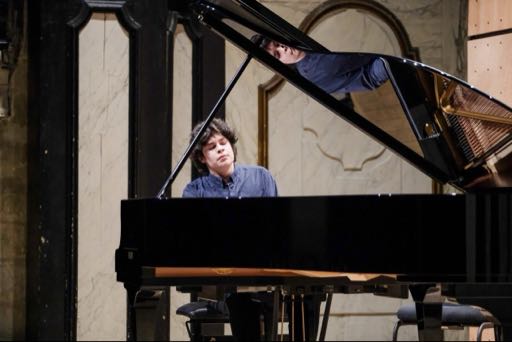
With a convincing first prize at the Cantabile competition 2025, the 17-year-old pianist Bill Dewispelaere not only confirmed his exceptional talent, but also a remarkable musical maturity. The victory feels to him less like an endpoint than as an incentive to grow further. "It is a confirmation that hard work and lots of practice bear fruit," he says. "But what really makes this competition special for me are the laureate concerts. Playing regularly in front of an audience is essential: that's how you build stage experience and learn to deal with tension."
Doubt is by no means foreign to Dewispelaere. Quite the opposite, in fact. "When studying new pieces, I often feel stressed and afraid that I won't have enough time." Yet that uncertainty gradually transforms into confidence. In the weeks before the final of the Cantabile competition, he felt the turning point approaching. Through intensive collaboration with his teacher Aaron Wajnberg, everything fell increasingly into place. "I felt that I would give a good performance. Though a competition is always stressful. But it's precisely that tension that makes live performances so magical."
That mindset also translates into his playing. Dewispelaere is not afraid to take risks, even if that brings small imperfections with it. "In the final, I sometimes played extremely softly, without losing my tone. If you listen carefully, you hear something rough here and there, but that's unimportant. The point is that you play the way you feel the music."
Rachmaninov as musical driving force
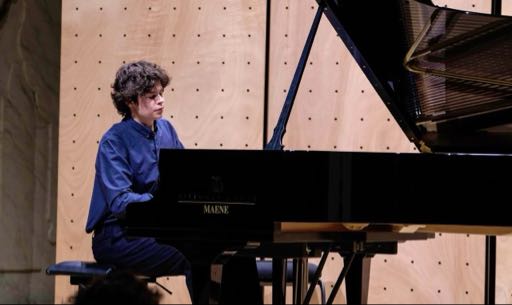 It is no coincidence that Bill Dewispelaere chooses Rachmaninov's First Piano Concerto for the Laureate Concert of the Cantabile competition on Saturday, March 28 at deSingel. From his first encounter with this composer, he felt deeply drawn to his musical world. "The drama, the melancholy, the heaviness – that touched me immediately." Rachmaninov has been a constant in his musical development for years. In 2020, he was a Rachmaninov laureate finalist at the same Cantabile competition, and at twelve, he already played the first movement of the Second Piano Concerto, inspired by Sokolov's legendary interpretation.
"I have a Russian soul when it comes to music," he says without hesitation. Rachmaninov, Scriabin and Prokofiev are among his favorite composers. Especially Rachmaninov's First Piano Concerto has a special meaning for him. "It is full of youthful energy, yet at the same time deeply emotional. It can be rough and lyrical at the same time. It's a shame that this concerto is less well-known than the Second and Third, because for me you hear the real Rachmaninov here."
An interpretation as a snapshot
When studying a major concerto, a first interpretive idea quickly emerges. "I try to hold onto that as much as possible," Dewispelaere explains. "But you always have to make compromises. There are endless details you can keep refining, but you must not lose sight of the bigger picture."
He also realizes that no interpretation is ever definitive. "If I play this concerto again in ten years, it will certainly be better, but even then there will be things I'm not completely satisfied with. A performance is always a snapshot. I'm now seventeen; when I'm twenty-seven, I'll play it differently. Interpretation is an evolution, depending on the hall, the piano and the audience."
Technique in service of music
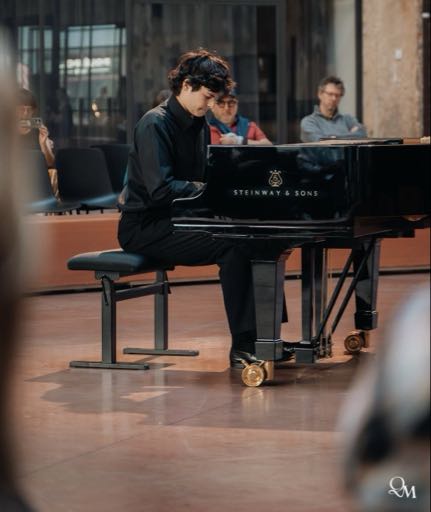 Although technique plays an important role in his study work, Dewispelaere never considers it as an end in itself. "In the beginning, I attach great importance to technique, but working exclusively technically is, in my opinion, not a good approach. Technique is a means to achieve a greater musical whole." Only later does the focus shift to the great arcs of tension and the architecture of a work, from the first to the last note.
Notably, he makes no distinction between preparing for an exam or for a competition. "I approach it in the same way. In both cases, I feel free. Stress is always there, but that's human."
A crucial role in his development is played by his first teacher, Aaron Wajnberg. "I started with him when I was seven. We have a very strong bond; he is one of my best friends. I can talk to him about anything. He has shaped me and knows me through and through as a pianist." For the past three years, Dewispelaere has also been working with Nikolaas Kende.
Life beyond the keys
Combining an intense musical trajectory with school at Onze-Lieve-Vrouwecollege plus in Antwerp proves not to be an insurmountable problem for Dewispelaere. Thanks to his artist status, he can rely on flexibility. "I am allowed to be absent for ninety half days with justification. The school management is very open-minded." The support goes even further than administrative flexibility: "The headmistresses Cécile Veraert and Hilde Buysrogge had come to the final of the Cantabile competition without me knowing it. That says a lot about the bond we have."
Music remains a constant even outside the piano. "I actually listen to music almost all the time. That's how I discover new works that I might want to play myself later." Besides that, he enjoys food, series and films, and admits to scrolling a bit too much as well. However, he doesn't engage with genres other than classical. "I can't listen to any other genre for longer than two minutes."
Outlook
For the coming years, major works are on his wish list: the Sonata by Liszt, the piano concertos and sonatas by Prokofjev, the sonatas and concertos by Beethoven – and, he adds with a laugh, "I should actually play more Chopin."
What music means to him can ultimately be summarized quite simply. "Through music – and piano music in particular – I can express myself. It's how I can best show who I am. You can't know me if you don't know me as a pianist. Music means everything to me."