
 Golden Label Opera & Musical Theater – The original version of Don Carlos, as Giuseppe Verdi truly intended it, was what the Opéra de Wallonie chose. It lasts 4 hours and 30 minutes, quite a long time and that deters people. Even in Verdi's time, cuts were eagerly made. The result is that a whole series of versions exist, because virtually every opera house intervened in its own way.
About the opera house in Liège
The friendly atmosphere, the human warmth and the family character are in themselves something that distinguishes the Walloon opera house from most others. Everything revolves around providing as much Beauty as possible to the audience. And what a success with the complete version of Don Carlos!
Stefano Mazzonis di Pralafera is not only the director of the house, which you might call an extension of Italy, he is an artistic jack-of-all-trades who is driven and chooses as uncompromisingly as possible for pure opera, the story and the music as the composer and librettist once intended it. That has become a great rarity and is even viewed somewhat condescendingly in the opera world. However, the audience, the artists and the entire team of staff are more than once in agreement with the vision of the management, and that is very appealing. It makes it much more pleasant for the musicians, set builders, costume department and so on to work. It gives ample satisfaction and a sense of deep artistic involvement. Just talk to singers after yet another production that fits like a glove on a pig with the music and story, and also talk to singers after such an 'old-fashioned show' in Liège…
Four hours and three quarters flew by
"We present the opera in full", was the motto of Stefano Mazzonis who immediately took on the direction himself. Good for extra attention, because it rarely happens that the complete opera is performed anywhere. It is, among other things, for this reason alone a good thing that this performance is filmed and broadcast on February 14 this year. As far as I'm concerned, it should be released on DVD.
With operas that run long, sometimes the attention of the viewer/listener can flag a bit. Sometimes you even long for the end. Understandable. Equally understandable is that this was not at all the case here. The whole thing is constructed so strongly on every level that you only realize how long the opera lasted when you look at your watch: "Hey? Is it really already that late?"
What did the audience hear and see that provoked such enthusiasm?
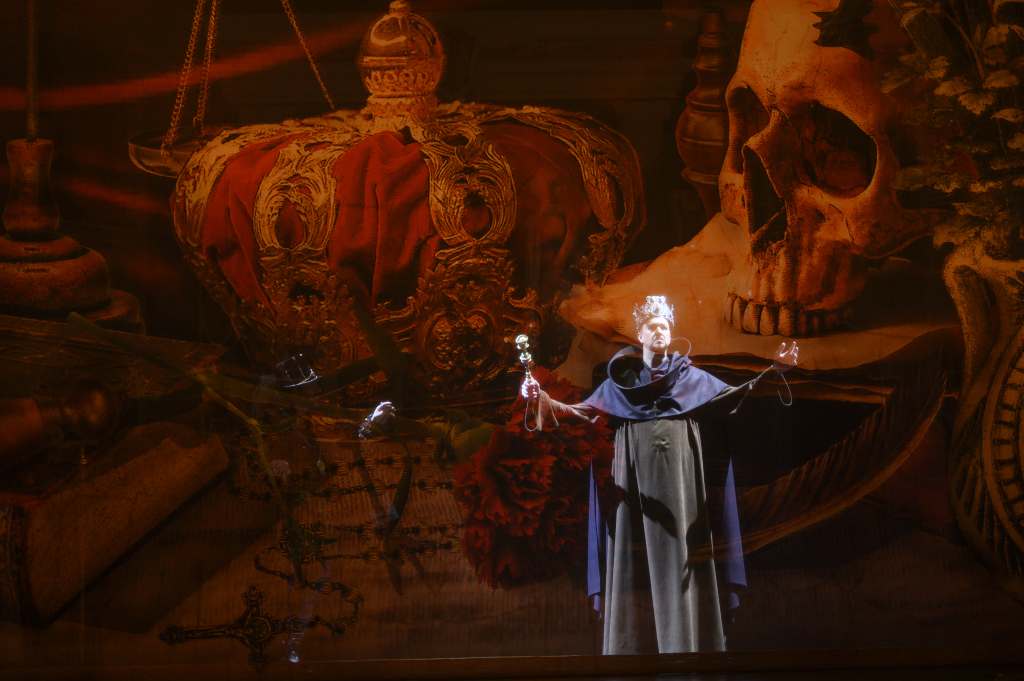
The eye was continuously delighted with the beautifully detailed costumes of the great nobility from the 16th century, the time of the Spanish Habsburgs and Philip II. Plenty of Renaissance, and you see that too in the sets, which look like they were cut straight out of a Spanish palace from that era. The common people are dressed as they were, soberly. With careful use of lighting, every scene, whether it takes place in the forest, the chapel or the palace garden, is given color and accents. The theatrical element in this opera is abundant, and yes, of course the splendor of the aristocratic life of that time inspires. It comes alive on stage.
Don Carlos, the son of Philip II, is engaged to the daughter of the French king with whom his father is at war. To settle the peace, the French king does not give his daughter to Don Carlos, despite the engagement, but to his father, who thereby greatly increases his realm and influence in Europe. Elisabeth de Valois will be his third wife. The young couple, who have just explained their desire for each other at great length and fantasized about their future, must learn this news in the forest of Fontainebleau. A cold shower. It would be one of the reasons why a great rivalry and hatred arose between father and son.
History tells us that Don Carlos, the heir to the throne, was not very well mentally and that he died under still unexplained circumstances at the age of 23. That ambiguity is also strongly evoked in this opera, right at the end, when Don Carlos steps into the opening sepulcher of Emperor Charles V, his grandfather.
Verdi and his librettists Camille du Locle and Joseph Méry (inspired by the play Don Carlos, Infant von Spanien by Friedrich Schiller), shy away from nothing to highlight the dictatorial traits of Philip II. The Spanish Inquisition and the oppression of the Flemings and Brabanters, together with the love story between Don Carlos and Elisabeth on the one hand and the loyal friendship between Carlos and Rodrigue, the Marquis of Posa, on the other, are the red thread running through the story. The latter makes it clear to Carlos how the noble people of the Low Countries are subjected to violence and does everything to convince Carlos to come to Flanders to end the oppression. History teaches us that this was probably also attempted by Carlos, but Philip II sent the Duke of Alva, with all the consequences, and Carlos suddenly found 'death somewhere'. Everything but glorious is the history of the possibly religiously and megalomaniacal Philip II, who felt strengthened and encouraged in everything by the very harsh repression of the all-powerful Grand Inquisitor.
The oppression by the inquisition comes to life on stage. You see how the heretics, dressed in a fool-like robe in cages being driven past the Escorial, the megalomaniac abbey palace of Philip II, and how other heretics pull and push the carts while being whipped by soldiers and the people spit on them. They are part of the coronation festival where flag-wavers add color to this macabre spectacle. On the small stage of the Liège opera house you think it impossible, but Mazzonis pulls it off: you have the impression of witnessing a very grand event from very close by. It makes the audience silent, you feel the people thinking and experiencing emotions.
Singers / actors move
Such a strong story with this kind of direction requires not only an excellent orchestra and choir – and both excelled. Never before have I heard the orchestra, where I had made some remarks earlier, perform better. It could stand comparison with all other major opera houses. Top! Conductor Paolo Arrivabeni was in full force and one bundle of inspiration. Given that, together with everything happening on stage, it cannot but have given the singers an extra charge of artistic adrenaline to perform even better.
Let's go through the list. Don Carlos was sung by American tenor Gregory Kunde. What a voice, what an interpretation! He was simply the young, honest, loyal king's son and could move, but other voices would move as well. Italian bass Ildebrando D'Arcangelo delivered an impressive, characterful Philip II. The carrying dark commanding voice, his piercing gaze… And then there was that poor Elisabeth de Valois, the woman who would never be allowed to know true love. Although soprano Yolanda Auyanet was ill, she sang this loving role with great dedication. A performance that deserved extra applause! The treacherous and too late repentant princess Ebola, who will betray Don Carlos, Elisabeth and his friend out of jealousy, was perfectly performed by Kate Aldrich who was a guest at the Opéra Royal de Wallonie / Liège for the first time.
Anyone who delivered a role that you must rightfully call world-class was Lionel Lhote as the Marquis of Posa. The duet where he and Don Carlos swear the oath of friendship and then his death scene, you can place in my view among the greatest performances you ever had the privilege to witness. You are, so to speak, petrified when the bloodthirsty Grand Inquisitor sings his deadly words full of commanding demands. Roberto Scandiuzzi, bass, is hard to imagine in another role. The smaller roles are also each filled very beautifully, more or less modestly, but not at all inappropriately as it should be.
A special word of appreciation is deserved by this opera house because in almost every production it deploys people from the margins of our society and thus involves them in the whole and gives them dignity. It is a particularly beautiful gesture of humanity.
What happened to me, I don't know yet, but I could not and cannot shake the impression that this opera production was about the most beautiful I ever experienced. Our colleague Matthias De Bel was equally speechless and after the applause he told me: "Actually, I never saw a better opera". That's how you also heard that impression confirmed in the corridors. A Golden Label Opera & Musical Theater Nomination is therefore more than justified.
- WHAT: Don Carlos, opera by Giuseppe Verdi to a libretto by Camille du Locle and Joseph Méry
- WHERE & WHEN: Opéra Royal de Wallonie, Liège, premiere January 30, 2020
- WHO: direction: Paolo Arrivabeni - Orchestra and choir of the Opéra Royal de Wallonie – direction: Stefano Mazzonis di Pralafera – sets: Gary Mc Cann – costumes: Fernand Ruiz – lighting: Franco Marri – choir direction: Pierre Iodice
- VOICES MAIN ROLES: Gregory Kunde, Ildebrando D'Arcangelo, Yolanda Auyanet, Kate Aldrich, Lionel Lhote, Roberto Scandiuzzi
- IMAGE MATERIAL: © Opéra de Wallonie
[embed]https://youtu.be/OWbsMcJmcxI[/embed]
[embed]https://www.youtube.com/watch?v=ou10iiL20Jk[/embed]
[embed]https://www.youtube.com/watch?v=vBf4mZhqTNo[/embed]