
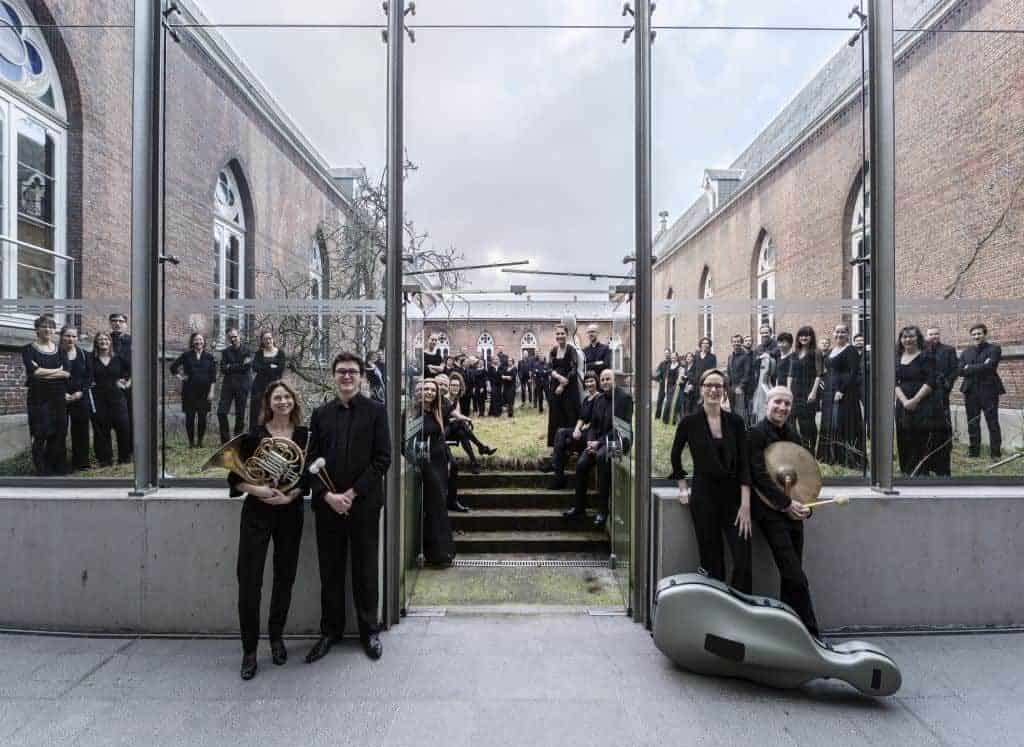
Pierre Bleuse meets Symfonieorkest Vlaanderen. A musical piece by Roussel, waltzing towards the audience, in delightful atmospheres. Jakob Koranyi is then tender-soft verticality. Haydn on cello. By Mozart the Symphony no. 41. This piece was completed by Mozart in the summer of 1788.
The opening comes with a brilliant story. It is by Albert Roussel, composer and sailor. With his neoclassical Sinfonietta it is traveling to the previous century. The truly 'classical' period is found with the two stars Haydn and Mozart. The works presented are Haydn's Cello Concerto in C major and Mozart's Symphony no. 41, nicknamed "Jupiter".
Old music, Bleuse's perspective
One of Bleuse's objectives is to reconcile the audience (and the music) with each other. According to the conductor, our interest in music from the past would have grown to eventually end up in what he calls a quasi-museum world. Bleuse believes that we have cut ourselves off from our guides, composers and creators. Thus we find that contemporary music has unfortunately become a niche music that interests only a handful of people.
Bleuse brings a new twist to the musical experience by taking the audience on a journey through different centuries. He also gives solo musicians from his orchestra the opportunity to perform. Pierre Bleuse thus attempts to give talented young musicians orchestra experience.
Pierre Bleuse has been appointed music director of the Ensemble Intercontemporain (EIC), a formation of solo musicians, specialized in the interpretation and dissemination of works from the twentieth century to today.
His focus is on musical creations. He looks forward to meeting new orchestras. And to continue his musical journey.
The artists
"Language but no words." Jakob Koranyi surprises with words that moved me. Bam. There he goes then. Like thunder that keeps rumbling in the high mountains. One line makes you think and brings you to your senses. With his instrument, a cello from 1756, he also knew how to charm. The solo started strong. It made me realize how much more luxurious, and cheerful and richer the interplay of all the players together is. Koranyi received a warm welcome from the audience, and made an impression, with techniques, and feeling and refinement.
With the arrival of Koranyi, the Symfonieorkest Vlaanderen fades into the background for a moment. The cellist is in the spotlight. And there stands another great man next to him on the stage. It is Pierre Bleuse. Conductor, music director and champion of new music... A man on his way to becoming one of the most fascinating and sought-after conductors in the world. The symphony orchestra, in the shadow of a giant, with childlike, nonchalant - and yes - delightfully played notes.
Final note
The whole of collaborating musicians is fine to experience. From my observation I dare to say that there was cohesion. The music went across the hall and mingled the guests with the musicians group. The intermission resembles somewhat the minutes produced with golden locks, a smile and a gesture from the brass section. I found the rest stop too bustling to enjoy a refreshment. I experienced feelings including; rushed, bypassed, confined, rejection, awkward, loneliness, fear, doubt, hopelessness, from unfulfilled needs, when the theater house urged back to take a seat in the hall.
I would recommend this cultural activity, because of its refinement, to more than those who came, and to less than everyone. The evening was to be enjoyed in a provincial town. The provincial rows suggest: somewhat slightly too ambitious for Deinze's cultural center, the Leietheater.
- WHAT: Pierre Bleuse conducts Mozart
- WHEN: Friday June 10 8 p.m.
- WHERE: Leietheater Grote Zaal
- WHO: Jakob Koranyi [cello], Symfonieorkest Vlaanderen conducted by Pierre Bleuse
Also to be seen on June 19 in Roeselare: tickets & info