
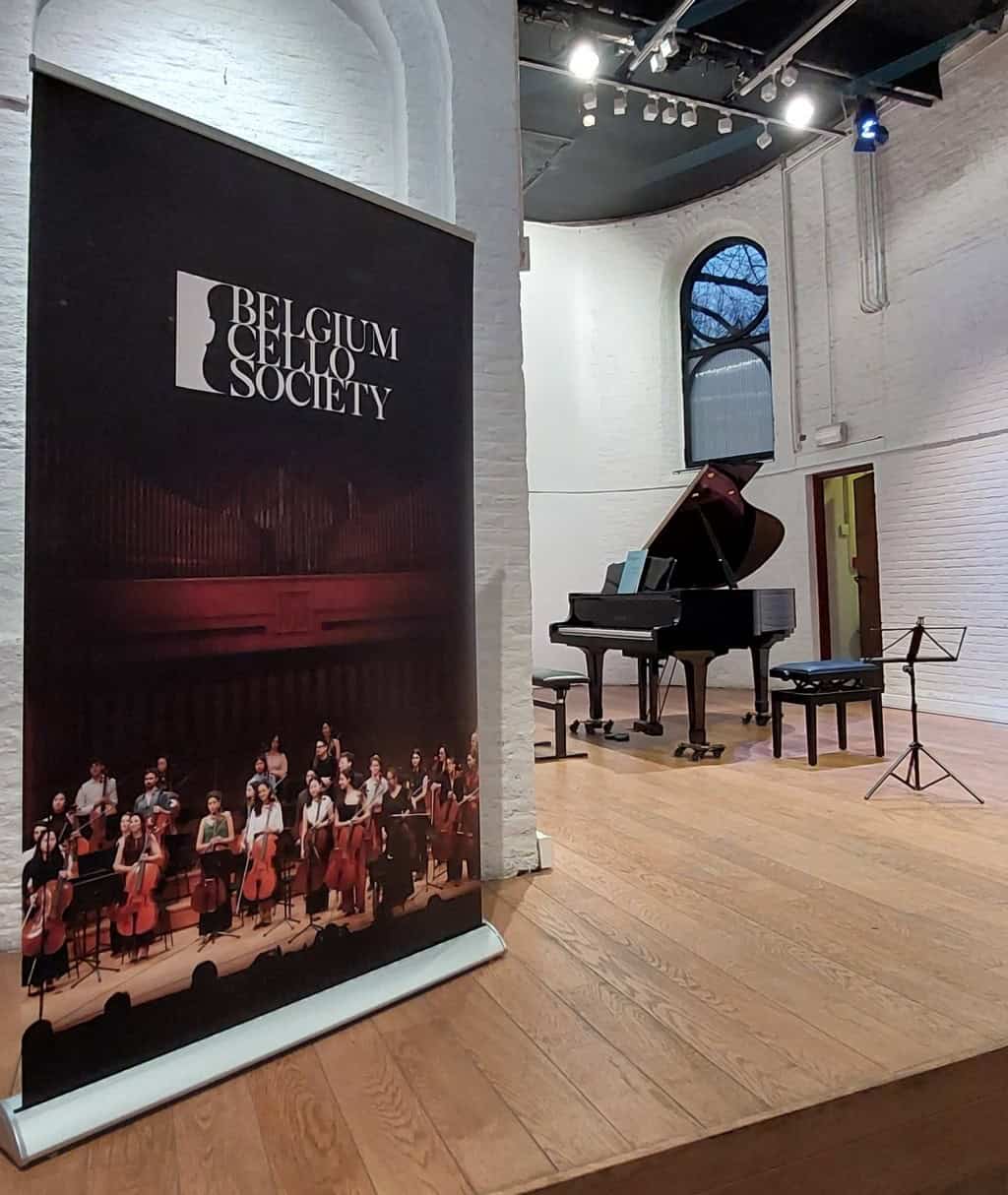
This year the Queen Elisabeth Competition is dedicated to the cello and we see how the music world is busy with preparations. The Fontenelle & Sanlidag performance was held under the auspices of the Belgium Cello Society (BCS) and honors the concerts where award-winning artists are brought to the stage.
On behalf of the BCS, Han Bin Yoon introduced the musicians and the repertoire, emphasizing the love and passionate efforts to bring the cello to the attention of the public.
The second laureate of the International Cello Competition Buchet 2020, Pierre Fontenelle, a versatile artist who masters a broad range of cello compositions, taught himself cello from the age of eleven in Seattle. He is now a teacher at the IMEP (Namen) and continues to closely follow contemporary musical developments in America. Fontenelle chose to play on his Ruggieri cello from 1690. An instrument with a velvety tone that he considers better suited for romantic repertoire and for small ensembles in intimate spaces like we had in the Boondaelkapel. Fontenelle also plays a Vuillaume cello from 1860 that provides a fuller sound and was donated by the Koning Boudewijnstichting.
Cansu Sanlidag, a solo pianist known for her expressivity, began her music studies at the age of seven in Turkey, after which she further studied at the Royal Conservatories of Bergen, Brussels and subsequently in Vienna. During her solo recitals throughout Europe she is praised for precision and touching performances. She shows interest in unpublished Ysaÿe works for violin and piano, performs as an accompanist at master classes and is working on a solo album for Pavane Records. This time she played on a Yamaha piano.
Ludwig van Beethoven's – 12 Variations on "Ein Mädchen oder Weibchen", WoO 46 – written in 1796 at the beginning of Romanticism, based on Mozart's Papageno aria from Die Zauberflöte. Beethoven's personality is expressed here in an early form, innovative in the variations, which he approaches and provides with a refreshing meaning. His innovative harmonization bewildered the music world upon its appearance; his composition, initially controversial, was convincingly valorized and masterfully interpreted by our performers.
A piece that explores the full possibilities of the cello is Pampeana no. 2, op. 21 by Alberto Ginastera (1916-1983). Inspired by love for his Argentine homeland and the popular struggle for freedom, he transferred this fiery passion into a cello-piano duo that makes high demands on technique and expression. Through much vibrato and scherzo, the use of crescendo/diminuendo dynamics, forte-fortissimo intentions, accompanied by a moving piano that lends jazz sonority, the artists fed our imagination. Through the instrumental duet, the pampas scream, cry, speak and sing, and bring other voices to silence.
The repertoire continued with Nikolai Myaskovsky (1881–1950). A composer of Polish descent, but in military service in Russia, who studied with Rimsky-Korsakov, became friends with Prokofjev and met other composers. The Cello Sonata no. 2 in A minor, op. 81 is dedicated to the great cellist Matislav Rostropovich who played it with Svjatoslav Richter at the piano. This piece saved Myaskovsky from politically imposed cultural censorship and accusations of elitist formalism. Fontenelle, who has a fondness for this piece and was assisted by Sanlidag, found resonance with the audience.
The journey continued to the Ballade in D minor, op. 3 no. 1 by Josef Suk (1874-1935). The piece took us into the reveries of late Romanticism, impressive in its elegant, mysterious interpretative manner.
The final moment was reserved for the sublime Cello Sonata in D minor by Frank Bridge (1879-1941), an English composer, violist and conductor. The outbreak of WW I caused a trauma that led Bridge to distance himself from traditional Romanticism and turn to modern expression. During the listening, valued rapture arose, attuned to the experimental interests of the musicians.
The audience responded enthusiastically to this cultural gift, which the artists thanked with an encore: Bifu/Briesje by Japanese composer Somei Satoh, (1947°). A deep meditative mood enveloped the listeners as broad bows and a fleeting undulating piano sound merged.
Fontenelle's playing pleasure was remarkable, also thanks to the closely coordinated accompaniment of the pianist. Sanlidag developed a keen sense for the playing nuances of her stage partner. She anticipated the intentions of the cellist and contributed considerably to the success of the performance. We noticed a close interaction between cello and piano, which expressed aesthetic vision. This testifies to a competence we like to see on stage and which – hopefully – will bear fruit for a long time to come.