
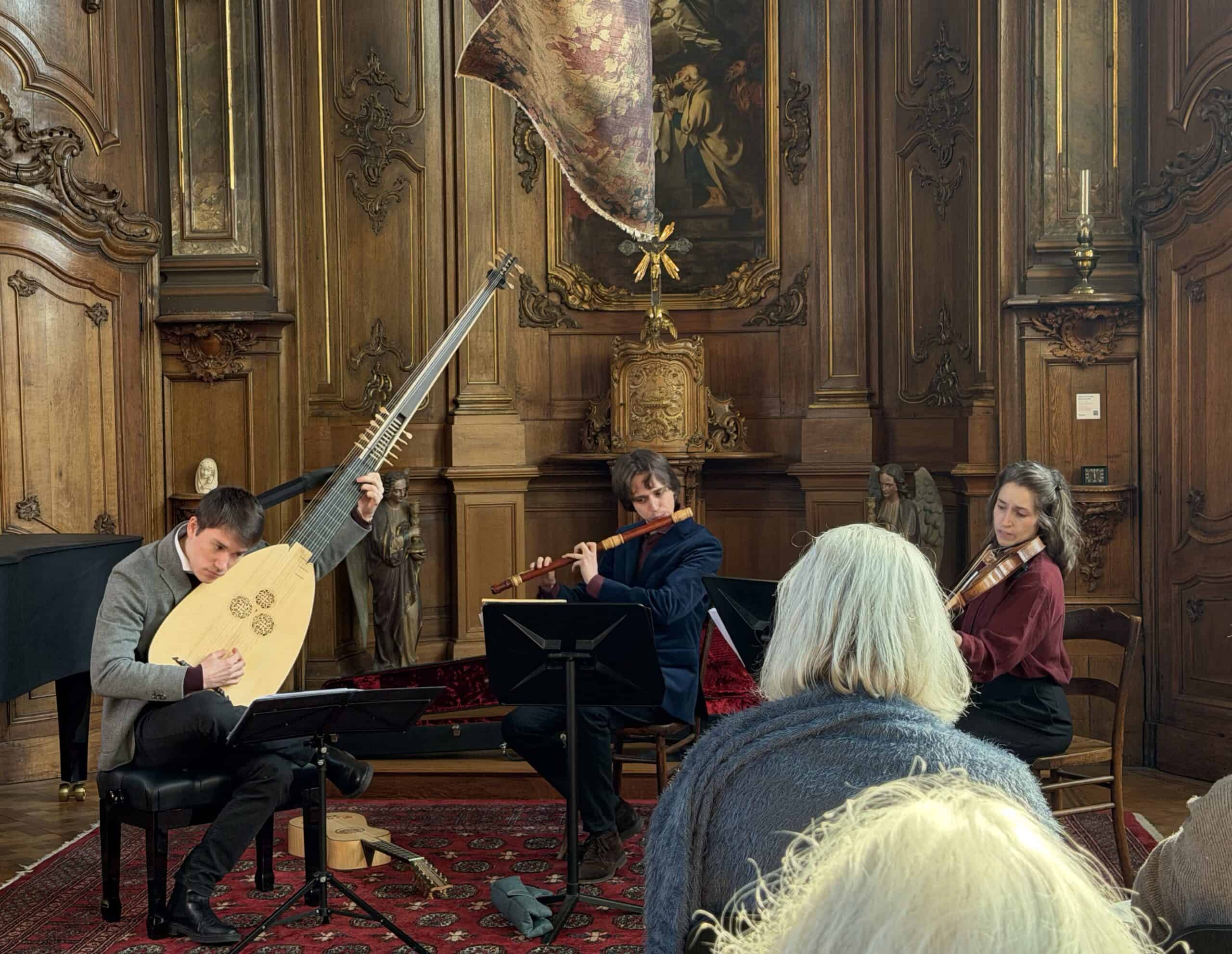
On Sunday, March 1st, at eleven o'clock, Musica Gloria gave a matinee concert at the Hollands College in Leuven in the series 'Pulcheria' that gave the late morning a special intensity. A programme unfolded that seamlessly combined refinement and liveliness. Time and again we look forward with great expectations to the concerts of Musica Gloria, because this ensemble not only puts together surprisingly thoughtful programmes, but also performs them with a rare combination of passion, stylistic feeling and communicative power.
With the suite and trio no. 2 in G minor by Marin Marais, a mood of restrained intensity was immediately created. The traverso of Beniamino Paganini sounded smooth and singing, with a natural breathing that gave direction to every phrase. Elise Dupont responded on violin with an elegant, finely articulated line, sometimes velvety soft, then again with incisive clarity. Beneath this, Thomas Langlois on theorbo and baroque guitar wove a warm, resonant foundation that not only supported but also actively gave colour. The music breathed and moved organically. The audience followed captivated and rewarded the finale with warm applause.
The suite in A minor by Robert de Visée, entrusted to Langlois alone, brought a moment of stillness. The theorbo filled the space with an intimate yet rich sound, in which every ornament gained meaning. The dance movements unfolded with natural suppleness, without emphasis. It was music that seemed to grow from silence and return to silence. The tension remained palpable until the last note had faded, after which the applause sounded noticeably more intense.
With Les caractères de la danse by Jean-Féry Rebel, a playful, almost theatrical energy was released. The succession of dance forms received a lively and sharply profiled realisation in the hands of the ensemble. Rhythmic accents, subtle contrasts and sure-footed phrasings made for a performance that was both light-footed and precise. Here you could hear how well the three musicians had rehearsed together. The enthusiasm in the hall noticeably increased.
In the sonata no. 3 in D by Joseph Bodin de Boismortier traverso and violin merged in a refined dialogue. Paganini and Dupont played with a natural accord, their lines flowing intertwined or playfully set against each other. The theorbo gave the whole a lightly dancing foundation. The sound image was clear, transparent and at the same time warm. The music radiated a vital freshness that perfectly matched the character of a Sunday morning concert.
The Passacaille from Armide by Jean-Baptiste Lully formed an impressive climax. The repeating bass gained a firm, supporting force under Langlois' hands, above which flute and violin built an ever richer weave of variations. The dramatic arc was carefully measured and culminated in a powerful finale that spontaneously elicited loud and prolonged applause.
The sonata and trio no. 8 in D by the lesser-known Jacques Christophe Huguenet concluded the programme with festive clarity. The ensemble playing was energetic and yet controlled, with a visible joy in playing that also reached the audience. After each movement the applause grew warmer and more enthusiastic, until it culminated in a grateful ovation at the end.
What made this matinee so special was not only the technical mastery, but especially the inspiration with which Musica Gloria shaped this music. Their performances testify to a love for the repertoire, attention to detail and a deep insight into style and character. In the Hollands College, that was again tangible. This was a late morning in which baroque music sounded like living art, direct and convincing, and in which audience and performers visibly found each other in a shared musical experience.