
Grand Opera as a Gripping Drama
Rossini's Guillaume Tell combines the historical reality of the freedom struggle of the Swiss cantons with the legendary figure of the resistance fighter Willem Tell, who shoots an apple off his son's head. Opéra Royal de Wallonie presents a sober yet atmospheric production. From scene to scene, the right emotional impact is conveyed. It makes the long performance into a gripping and compelling whole.The opera with which Rossini closed his opera oeuvre is a real oddity. Rossini wrote Guillaume Tell in Paris in French and immediately aimed it at the Grand Opéra, the genre that was rising in Paris at that moment with composers such as Halévy and Auber. That certainly does not mean that he denied his bel canto style. We also get delightful melodies here that demand the utmost from a singer, for instance the duet between Guillaume Tell and Arnold, the aria Sombre forêt by Mathilde or Asile héréditaire by Arnold – perhaps one of the best-known arias of this opera, which the general public mainly knows from the overture.
Nineteenth-Century Opera Fresco
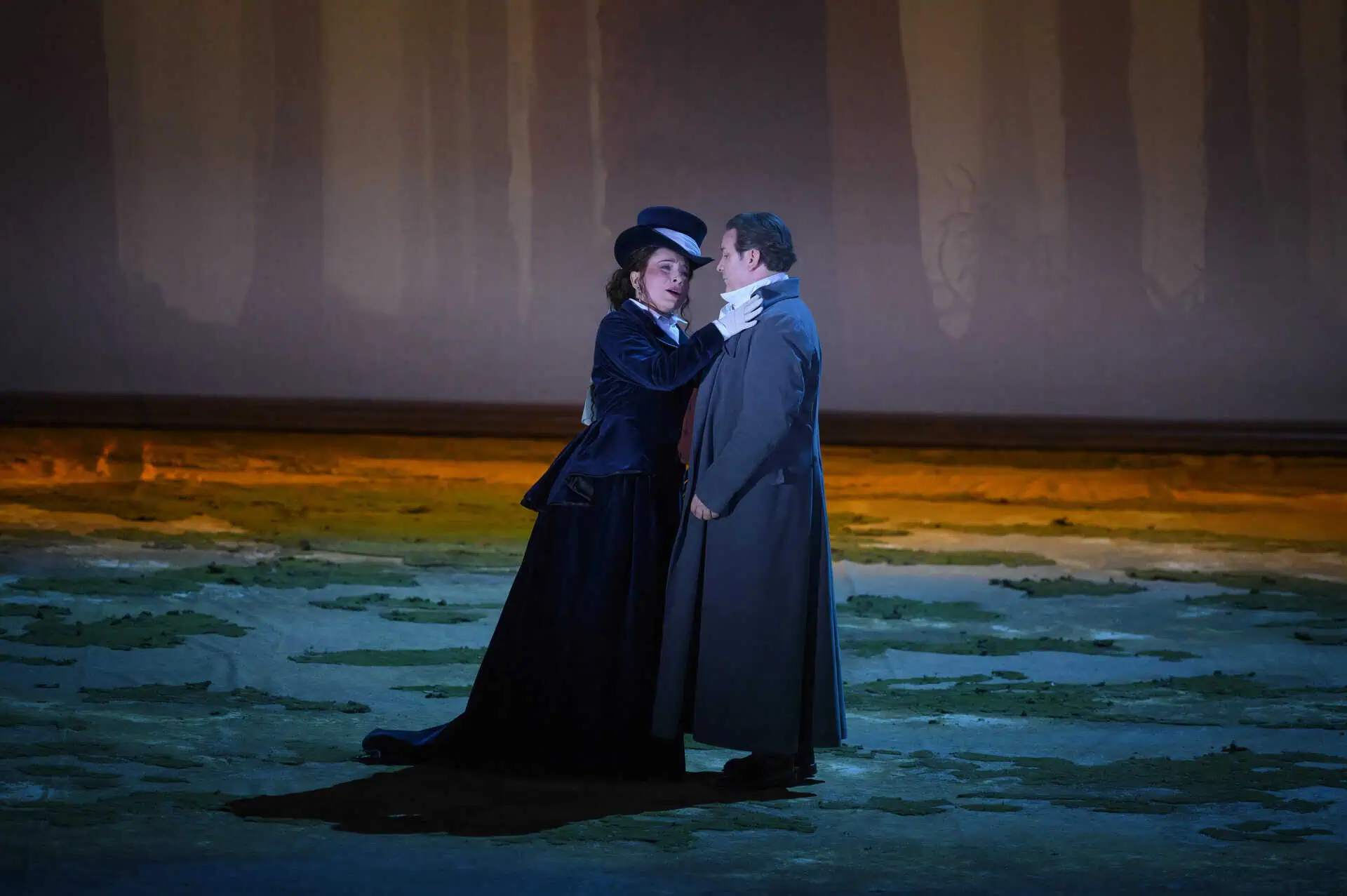
Director Jean-Louis Grinda, who was artistic director in Liège from 1996 to 2007, opts for a dark setting but also makes it clear that nature plays a major role in this opera. The stage consists of a large room with black walls, symbolizing the captivity of the rural community in the Swiss canton Uri. At the beginning of the opera, the word "Liberté" is written on the back wall in blood-red letters. The fierce struggle of the rural community against the oppressor is immediately clear. The circle is completed when at the end, after the difficult struggle and the legendary victory of Guillaume Tell, those letters appear on the canvas again, now as a sign of liberation. The black back wall is replaced by beautiful images that evoke nature at the Four Cantons Lake: forests and streams and in the final act, as an apotheosis, a magnificent mountain landscape. The beautiful costumes place the story in the nineteenth century, the period in which national revolutions dominated the Italian opera scene.
From the first act onwards, the staging sharply focuses on the contrast between rural idyll and politically tinged intrigue. The second act sharpens the problematic love between Arnold and Mathilde. The third act offers downright frightening images. The militant occupiers who watch the people from viewing windows have fascistic traits and the Habsburg soldiers who chase the residents go about like perpetrators of violence. The suggestion of brutality grips at the throat. The scene builds nicely towards the famous legendary shot of the apple and when Tell is then captured after all, the actual happy ending follows with the death of the tyrant Gessler in the fourth act, against a beautiful mountain landscape and once again the – now justified – slogan: Liberté.
Refined Vocal Art
With Guillaume Tell, Rossini composed a bel canto opera with the grand allures of a grand opéra. This latter stylistic feature is found especially in the extensive choruses which are performed with great verve in the Opéra Royal de Wallonie. But the bel canto requirements for the soloists are also excellently fulfilled. The ORW succeeded in engaging some of the best-known singers for the leading roles in this production. Starting with Nicola Alaimo, who is not singing Guillaume Tell for the first time, and who sang the role not only with a firm and warm voice but also gave an authoritative and charismatic presence. John Osborn has also sung Arnold several times before (and recorded it on CD). He sang with a clear light tenor voice and had no difficulty with the dizzying high notes. His great aria in the fourth act "Asile héréditaire" was thus greeted with loud applause. His love was absolutely credible, as was his despair over the social dilemma in which he finds himself. His beloved Mathilde was portrayed by Salome Jicia, an ideal soprano for the role, who had already been heard more in ORW in bel canto roles. Her flowing lyrical lines simply take the listener along from her beautiful "Sombre forêt" but she remains equally steady-voiced where dramatic power is required. The other roles were also excellently cast, and we would still like to mention the impressive Gessler of the young Inho Jeong.
Conductor Stefano Montanari had some difficulty getting the orchestra going at first, but once underway, he found the appropriate tone for every aspect of the opera, the local color, the lyrical love tone and the combative spirit.
Overall, the performance of this beautiful and, due to its demands, not so frequently performed Rossini opera was definitely a great success.