
It was something to look forward to: this production of I Puritani at the Opéra Royal de Wallonie. The opera by Vincenzo Bellini offers belcanto at its finest, and music director Speranza Scappucci inspired great confidence. Not only because she is Italian-born and bred and familiar with the repertoire, but especially because an additional press release emphasized the seriousness with which she approached Bellini's score: no cuts in her production. It turned out to be a very long evening, but that was not one second too much.
I Puritani is the tenth and last opera Bellini composed. He wrote the opera on commission from the Théâtre Italien in Paris under the protective eye of Gioacchino Rossini. Rossini was no longer composing operas at that time, but he was nevertheless a major figure in Parisian musical life. Bellini died a few months after the premiere, not quite 34 years old.
I Puritani is a somber story against a historical backdrop: the struggle in 17th-century England between the Puritans (followers of Cromwell) and the Stuarts. The Puritan governor Gualtiero Walton has promised his daughter Elvira to Riccardo Forth. But she is in love with Arturo Talbot, a Stuart supporter. At the urging of his brother Giorgio Walton, Gualtiero gives permission for the marriage to Arturo and provides Arturo with a safe passage. Arturo first uses it to help Enricchetta, the imprisoned queen, escape. Elvira believes her beloved has abandoned her for another woman and loses her mind. Upon his return, Arturo recognizes Elvira's love song and explains everything to her. He is captured and condemned to death. But Cromwell wins the victory and grants the Stuarts amnesty. Elvira regains her senses and the couple can be reunited.
Sober direction in visual spectacle
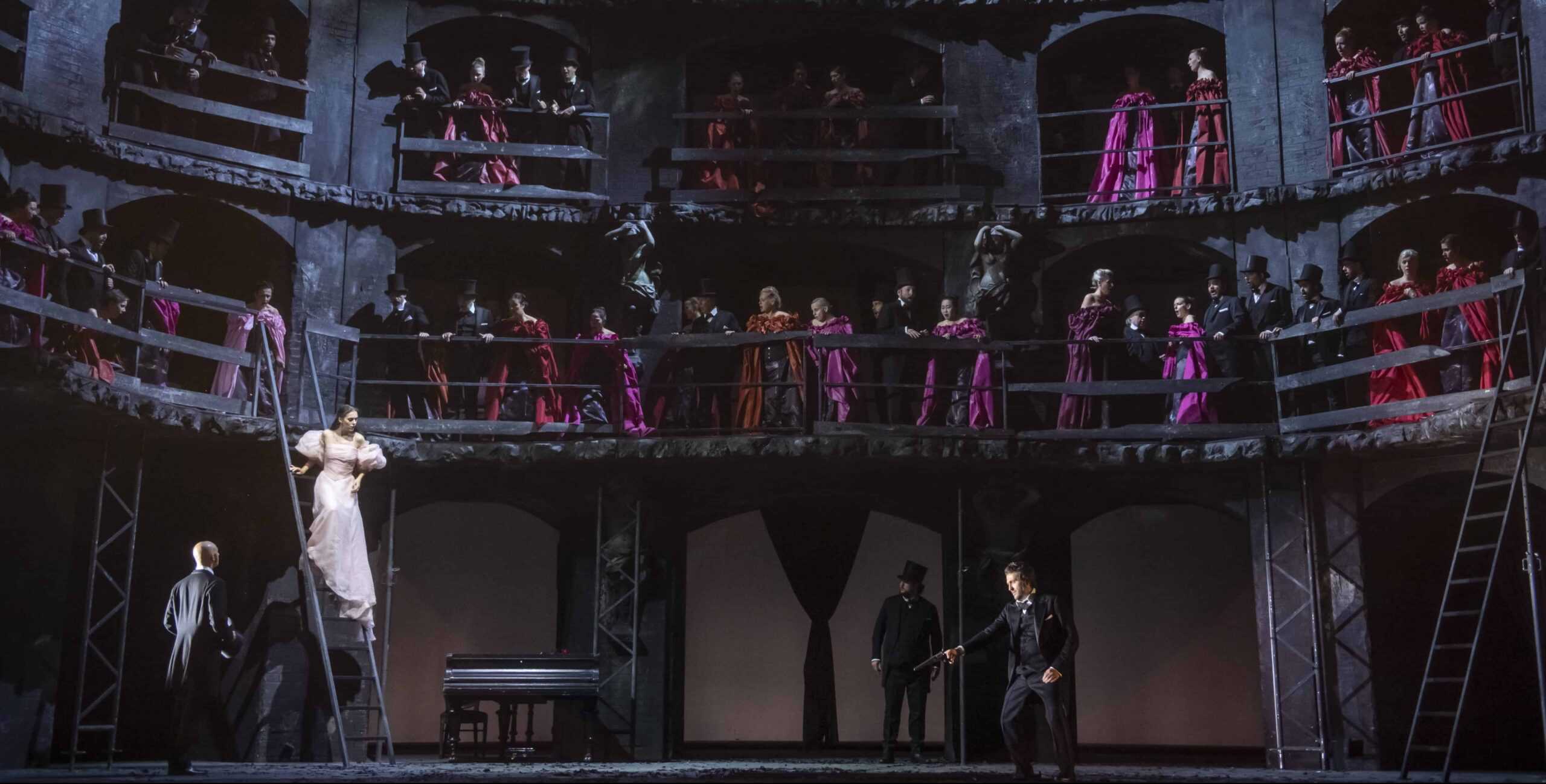
I Puritani is not Bellini's dramatically strongest opera, so a production must be convincing to remain engaging. On the other hand, the emphasis lies mainly on the vocal performances of the soloists. Vincent Boussard's staging certainly responds to the somber and almost continuously ominous content of the work. The set (Johannes Leiacker) is a dark gray, almost black castle wall with boxes where now protagonists, then groups of chorus members have a place. Boussard has of course provided very refined costumes. Elvira's wedding dress with veil (to hide Enrichetta) is visually stunning haute couture. The direction of the characters is sober but illustrative of the story. Both the rivalry in love and the political conflict situation are clearly played out. The role of the grand piano on stage somewhat escapes me – except as a visual effect of the mirror reflection of the piano. An image for the blindness of the surroundings at Enrichetta's liberation?
Among the singers, the lovers Elvira-Arturo carry the production. Both have passages with murderously high notes and they sing them brilliantly! Arturo makes his entrance in the opera in such a "box," which immediately frames him beautifully in a prominent place, as the one both Elvira and the audience are waiting for. Lawrence Brownlee sings his vocal entrance A te o cara so beautifully that he immediately commands all attention. After a first verse, this introduction aria transitions into a quartet and is supported by the chorus. It is not only one of Bellini's most beautiful melodies, but immediately one of the highlights of the production, which elicited overwhelming applause. With her first great aria Son vergin vezzosa, Zuzanna Marková displays her chattering coloratura artistry, which she confirms later in the great mad scene in the second act (O rendetemi la speme) with a beautifully sung cabaletta (Vien diletto). She also acts convincingly in a traumatic state of shock. Scappucci conducts her orchestra with great feeling, which accentuates the sadness of the whole. From that perspective, we can only cheer that the conductor has the duet in the third act Vieni fra queste braccia performed in its entirety. Brownlee's tenor voice, reaching into the soprano register, shines brilliantly in it and leads via his lovely aria Credeasi misera to an overwhelming triumph of the opera. Among the other singers, mezzo Alexise Yerna particularly stood out in the short role of Enrichetta. The bass Luca Dall'Amico as Giorgio sounded somewhat woolly and not very precise. A pity, especially in the important duet with Elvira in the first act. Mario Cassi was a convincing rival as Riccardo Forth.
Although the orchestra started the short prelude to the opera somewhat weakly, it is clear that Scappucci, with her strong commitment, has brought the orchestra to a fine performance. Both the fragments full of melancholy and sadness and the more militant passages (Suoni la tromba) are skillfully played. The chorus did not always excel in precision. A pity, because there are quite a few beautiful interventions by the chorus in this opera.
At the beginning of the performance, intendant Stefano Mazzonis di Pralafera proudly announced that the production was being recorded for many television stations. He kindly requested that his production be applauded enthusiastically, as international promotion for his house. His request was rightfully answered. It is a pity, however, that the Opéra Royal de Wallonie does not start such an extremely long performance at an earlier time. A production that does not end until around midnight is certainly a heavy burden for many spectators – who often travel from far away to Liège…
- WHAT: Vincenzo Bellini (1801-1835) | I Puritani
- DIRECTION: Vincent Boussard
- WHO: Lawrence Brownlee, Zuzanna Marková, Mario Cassi, Luca Dall'Amico, Alexise Yerna, Zeno Popescu, Alexei Gorbatchev, Sofia Pintzou (actress)
- ORCHESTRA: Orchestre, Choeurs Opéra Royal de Wallonie conducted by Speranza Scappucci
- WHERE: Opéra Royal de Wallonie, Liège
- WHEN: Saturday 22 June 2019
- PHOTO: © Opéra Royal de Wallonie-Liège