
Poignant song cycle about the suffering of refugees, past and present
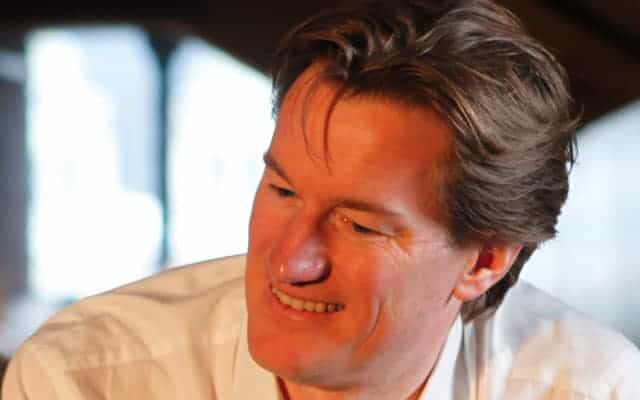
"I'm approaching fifty and now more than ever want to know where I stand, what do I want with my music. I don't have much time left to waste. And I knew: all the superfluous must go. That's how I wrote it, straight from the heart," composer Jeroen D'hoe told during the introduction at Flagey at the premiere of his "Songs for the Crossing".
Those songs sounded that way in the concert hall too. Stripped of excess. And incredibly beautiful. With Brussels Philharmonic, soprano Hanne Roos and the Vlaams Radiokoor in starring roles. He was given the commission by Flagey director Gilles Ledure. That was in 2015, at the height of the refugee crisis. Ledure put D'hoe in touch with Stefan Hertmans. To the four poems that Hertmans distilled from the war memoirs of his "Oorlog en Terpentijn" book, he added two more about the consequences of that other crisis that surprised and bewildered Europe. With those six poems, in an English translation, the composer set to work on his song cycle.
Almost sweetly and very poetically orchestrated, the title song "The Crossing" opens. Idyllic, as the Mediterranean usually looks, but not for those who make such crossings. When the word "death" is sung in the second verse, you immediately hear that the story of the woman with her child in the refugee boat is not so idyllic and the cruelties flash across the orchestra. For the conductor, the score was—as always—sacred, but D'hoe himself made dozens of adjustments during rehearsal days to prevent the text from being overshadowed by too heavy orchestration. That was a remarkable collaboration, conductor Jun Märkl said.
He not only succeeded in that beautiful orchestration, but made the cycle into a subtle experience, full of laments and sublime tenutos. The fourth song, "The Flight", is about soldiers who want to flee across the Ijzer. He wrote it a capella, for the choir alone, positioned on both side balconies. Almost fighting, they compete with each other, until in an icy ending the "roar falls silent in their pounding hearts" as it says in the text they sing.
The fifth song "The Raft" is without a doubt the highlight of the cycle, despair at its peak. Its execution is technically very refined and emotionally gripping. The conductor expected something aggressive for a piece about war but, as he said afterwards, what I found was something "remarkable 'lost in space', slow and tender, a remarkable interpretation of war." My cycle does not want to evoke war, it's not illustrative, said D'hoe. It is horizontal music, horizontal like the shot-flat polder landscape around the Ijzer valley was then and like the flat-bombed urban landscape is now that the "refugees" left behind.
Composer Jeroen D'hoe can measure himself with the best in the field: contemporary tonal but especially accessible music that can move. And you sometimes hear his beloved Americans resonating in it. For him too, this work seems to be a "crossing", that of a composer who has crossed the line of his doubts and found the musical foundation he was looking for.
Yet one more thing. Brussels Philharmonic played in the pre-programme an arranged version of Debussy's piano work "En Blanc et Noir", also linked to the war, and Ravel's "La Valse" from 1919, a deconstruction of the Viennese waltz written as a farewell to an era. And it was very pleasant to hear such a brilliantly orchestrated work performed in a brilliant way as well.
- WHAT: Songs for the Crossing by Jeroen D'hoe
- WHO: Brussels Philharmonic conducted by Jun Märkl, Hanne Roos, soprano, Vlaams Radio Koor
- WHERE: Flagey, Brussels on 15.12.2017
- PHOTO: Jeroen D'hoe