
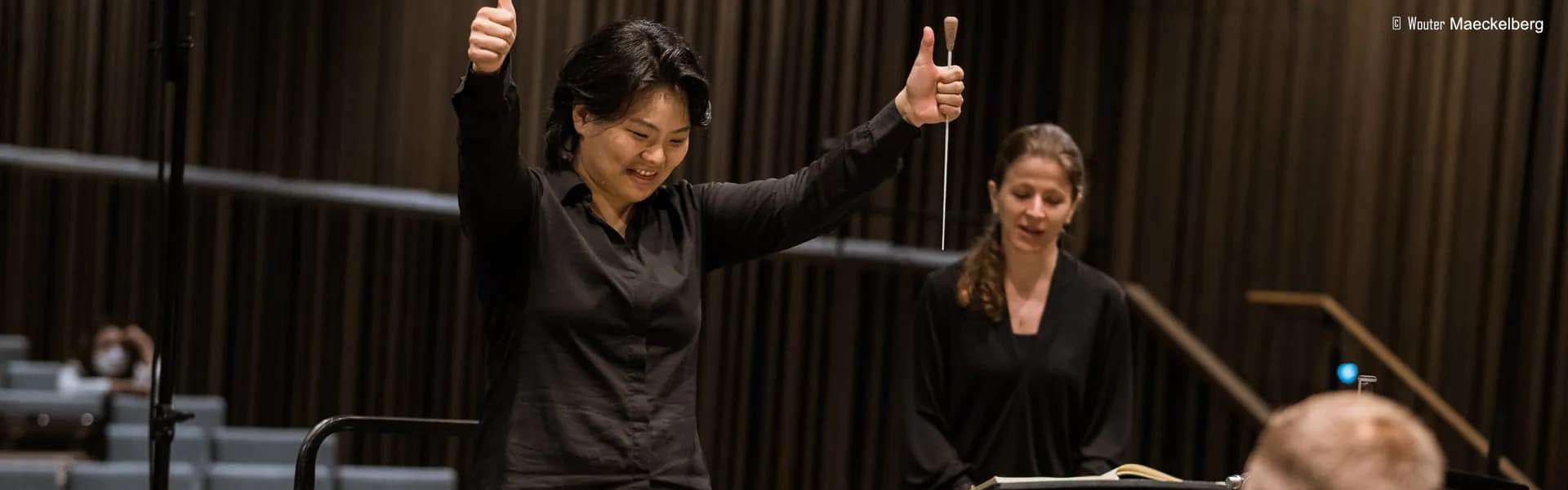
With young conductors at the helm, the Symfonieorkest Vlaanderen and the Spectra ensemble want to give several young talents the opportunity to work with both ensembles in both contemporary works and the First of Brahms. A Chinese woman, an Italian and a Brit are allowed to conduct Spectra and the SOV. All three have already built an impressive track record, we read in the program notes. Before the interval, works by Frank Nuyts, Annelies Van Parys and Jean-Luc Fafchamps are on the program, performed by the Spectra ensemble conducted respectively by the Chinese Chunyi Zhao, the Italian Marco Crispo and the Brit Mathew Rhodes. For this session, the three young conductors were not coached by the chief conductor Poska, but by professor Christian Ewald from the Hanns Eisler Musikhochschule in Berlin.
Scores
One by one, the young conductors come onto the stage with their score under their arm. I wonder whether the small experienced ensemble really needs a conductor, thinking about it when the three are bent over their scores more than looking at the musicians. In terms of coordination, these are also very different pieces. Nuyts' Five Penny Beats & The Seven Beats Itch seems like recreational music that is not difficult on the ear at all. The Fragrances by Annelies Van Parys, on the other hand, sounds like underwater music, in which an alto flute suddenly bellows like a lost manatee. The work Lettre Soufie: Sh(in) by Fafchamps seems like a long lamenting lamento.
After the interval, the familiar repertoire takes the stage, Brahms' First Symphony. Last weekend the SOV already performed this symphony in this hall with the Czech conductor Jiří Rožeň. So I have a point of reference and can compare the two performances. What does a conductor do? What is the role of a conductor? Questions that have simple answers, but on the other hand are not so easy to answer.
Strange profession
Conductor is a very strange profession. Of the hundred musicians who sometimes stand on stage, the conductor is the one who produces no sound himself. Moreover, he is the one who earns the most with his silent profession. A conductor beats time. That is the basis, a necessary but not a sufficient condition to speak of a conductor. To make that beat visible to each orchestra member, the conductor sometimes uses a baton, but not always.
A conductor can impose certain tempos, a certain interpretation on the orchestra. On the other hand, an orchestra always has its own sound and tradition, developed with often many conductors over many years. A better answer to the question of the function and usefulness of the conductor is the conductor who as a personality can inspire the orchestra, can enthuse them, can give energy. "He can electrify the orchestra," was once said of the young star conductor Zubin Mehta.
Ronald Zollman
Perhaps you have to have experienced it yourself as an orchestra musician to know what a conductor can do, how he can shape the sound of an orchestra, how he can bend a melody or a musical phrase to his will. I experienced it at a young age when I played as a violinist in the student orchestra of the Brussels conservatory in 1982. I was seventeen. The conductor was Ronald Zollman, then still a young thirty-something and professor of orchestral conducting.
I will never forget his first beat of Tchaikovsky's Fourth. It was as if he could shape the music in the air around him. It was as if he could hold a wild ride of a four-in-hand in check. It is very difficult to put into words what the man could convey to the musicians and how. Of course, gestures play a major role, but also something mental, an energy with which he inspired us students. Meanwhile, Zollman is past seventy, has had a great international career behind him and continues to conduct, among other things as chief conductor of the Pilsen Philharmonic in the Czech Republic. Zollman always had a small score on the podium, a pocket score, which he sometimes barely looked at while conducting. Many conductors do it without a score, especially with familiar repertoire such as Brahms' First of this evening.
A leader or an accompanist
The young conductors alternate again. The Brit Rhodes begins with the first movement, the Italian Crispo conducts movements two and three, the Chinese woman conducts the finale and she does so with her whole small body. If I had been sitting in the orchestra, I would have preferred to see the Italian in front of me, he seemed the most upright. You can move, gesticulate, but you can also wave your arms too much, as the Chinese woman does. All three have a score in front of them, at which their gazes are fixed too often. A conductor does not need to know every note in the score. He must be able to indicate the big lines and sometimes accentuate small details.
Is a conductor a leader? He is much more a coordinator who holds things together like a coachman his four-in-hand. Above all, the conductor is a listener who hears every detail, who notices when the second clarinet or third horn plays a wrong note. Often that requires no broad gestures or grand gesticulation. Last year, the 86-year-old Zubin Mehta stepped in front of an orchestra again, the youth orchestra of the Buchmann Mehta Academy in Tel-Aviv. His energetic beats, his heroic gestures of old, he has lost, but the essence remains. With minimal movements and a glance, he guides the youthful orchestra through Brahms' Fourth. A lesson in humility, a lesson that conducting is more listening, motivating, accompanying and steering with often minimal movements.