
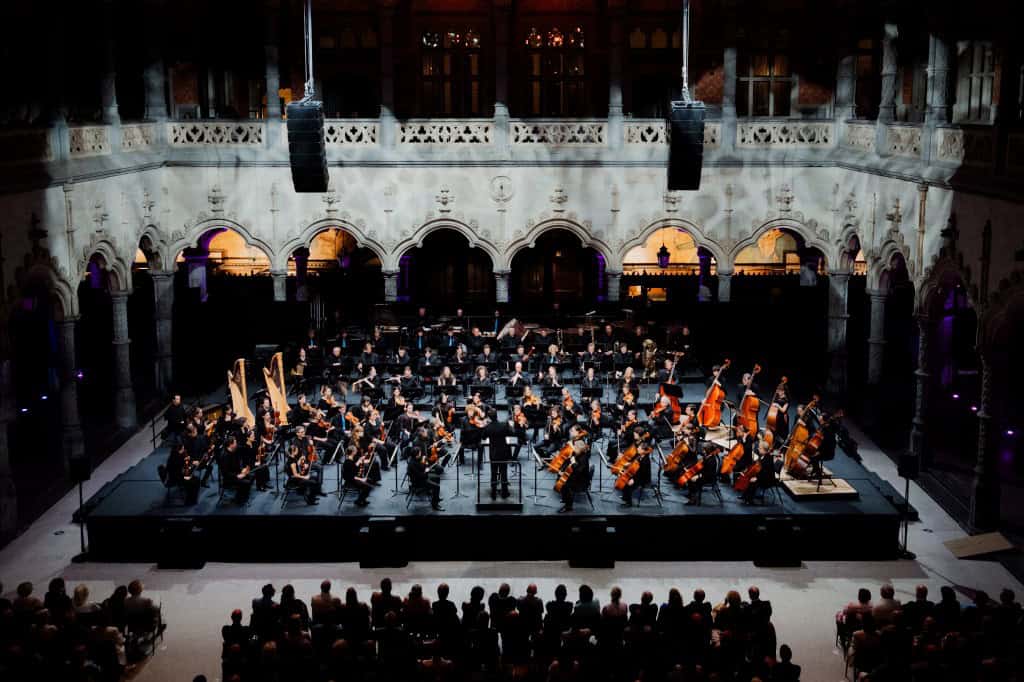
The third concert of the Antwerp Spring Festival took place in the Handelsbeurs — the festival's permanent concert venue. Although the building was not originally designed as a concert hall, it remains a special place to experience music. The monumental space and its history create a unique, slightly estranging atmosphere time and again. The theme of the evening was: 'The enchantment of the Stabat Mater'.
The programme was structured in four distinct sections: Fratres by Arvo Pärt, the Drei geistliche Gesänge by Alfred Schnittke, the world premiere of Veni Sancte Spiritus by Pēteris Vasks and, as a finale, Pergolesi's Stabat Mater. Four works, four approaches to spirituality — and yet one continuous thread: quietude.
The opening struck the right note immediately with a compelling Fratres. Pärt's music is immediately recognizable through its simplicity and repetitive character, without ever falling into emptiness. He calls his style "tintinnabuli", Latin for 'little bells'. Fratres exists in various versions; this evening we heard the one for strings and percussion — a new experience for me. The excellent Mechelen ensemble Casco Phil, conducted by Benjamin Haemhouts, delivered an inspired and profound interpretation, built from a fragile pianissimo, although that was occasionally disrupted by a noisy air conditioning unit. The theme of 'quietude', the red thread running through the programme, became tangible here immediately. The tone was set. The audience concentrated.
Without interruption, the programme moved on to Schnittke. His Drei geistliche Gesänge sounded like restrained prayers, sober yet charged. The Flemish Radio Choir kept it deliberately modest: no grand gestures, but a warm, compact choral sound that gave the music its full weight. Where Schnittke had often sought to push boundaries earlier, here he seemed to fold everything back towards its essence. The result was vulnerable and honest. That introspection found a logical continuation in the world premiere of Vasks. Veni Sancte Spiritus departs from an ancient Gregorian text, originally used during Pentecost liturgy and, for example, at papal inaugurations. The incantatory text invokes the Holy Spirit to bring inspiration.
Vasks wrote his first music under the communist regime, which left little room for religious expression. Yet for him, music and spirituality remained inseparably connected. After his father's death and the end of communism, he developed an extensive religious oeuvre, for which he received the European Church Music Prize in 2022. The now eighty-year-old composer began this work five years ago. Although clearly rooted in religious tradition, the introduction emphasized that the piece reaches beyond mere liturgy.
The piece unfolded slowly and cinematically, almost like a landscape revealing itself through mists. No great dramatic peaks, but rather a constant breathing, a search for balance, a stillness of nature, with closed eyes between heaven and earth — a place without clear contours, but with a strong inner peace. It seems as though Vasks has deliberately focused on the cadence and meaning of the words of this sequentia, and it is precisely that sensitivity that gives the composition extra depth. Moreover, the power lies in the fact that the spiritual is not imposed, but remains open to interpretation. At the same time, he holds up an uncomfortable mirror to the world. In various interviews, he calls upon the world to come to its senses again.
The choir and orchestra brought this world premiere with visible pleasure and conviction, but above all with a striking ease. The choir sang in a relaxed and natural manner, almost effortlessly, while the orchestra — with an unprecedented, also visually perceptible expression — painted the musical landscapes. Everything seemed to flow organically into each other, without weak moments or breaks in the tension. The musical 'film' ran uninterrupted and maintained its enchanting grip from beginning to end.
Then followed what presenter Vicky Versavel called the highlight of the evening: Pergolesi's Stabat Mater. This medieval Latin hymn expresses Mary's sorrow at the crucifixion of Jesus and invites the listener to share in that pain. Pergolesi — who died far too young — was nothing less than a kind of rockstar in his time: wildly popular, influential and omnipresent. In this work he constantly balances between devotion and drama, between prayer and something that feels almost operatic. It remains surprising every time to hear this music on modern instruments. Those familiar with historical performances must recalibrate their internal compass for a moment. At the same time, every performance has its own power and significance, and here too it was worthwhile to maintain that openness.
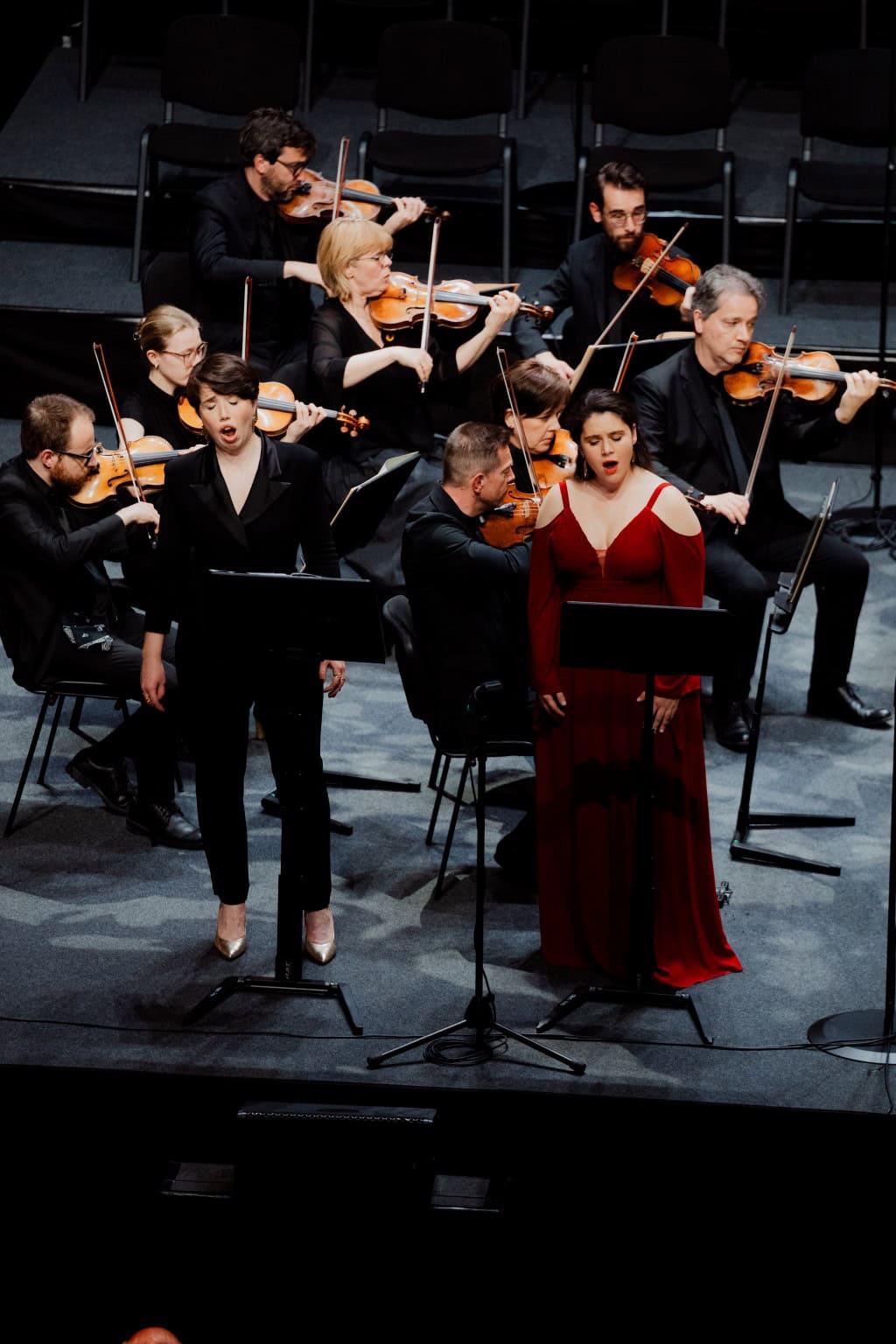
The soloists, French Marie-Juliette Ghazarian and Portuguese Camila Mandillo, performed the work with conviction. Ghazarian — officially a mezzo-soprano, but with a strikingly deep, almost alto-coloured voice — formed a beautiful contrast with the bright soprano of Mandillo. There were pronounced highlights, passages that truly captured the heart. At the same time, some parts sounded somewhat flat, as if the tension was not always fully exploited. Precisely the moments when both singers truly grew towards each other — almost crawling into each other's voices — were particularly powerful and could have occurred more often. With their operatic background, they could have furthermore ventured further in both the musical and formal interpretation. It was precisely there, in that extra layer of expression, interaction and daring, that this performance could have gained more strength. Their performance and that of the other artists was more than fairly rewarded with a standing ovation from the enthusiastic audience. The minutes-long applause felt like a release after a concert that was entirely devoted to stillness.
Those who missed this special evening will fortunately get a second chance. You can attend this concert again on Thursday, April 30, 2026 in Mechelen Cathedral, as part of the Lunalia Festival. The concert will also be broadcast live on Klara.