
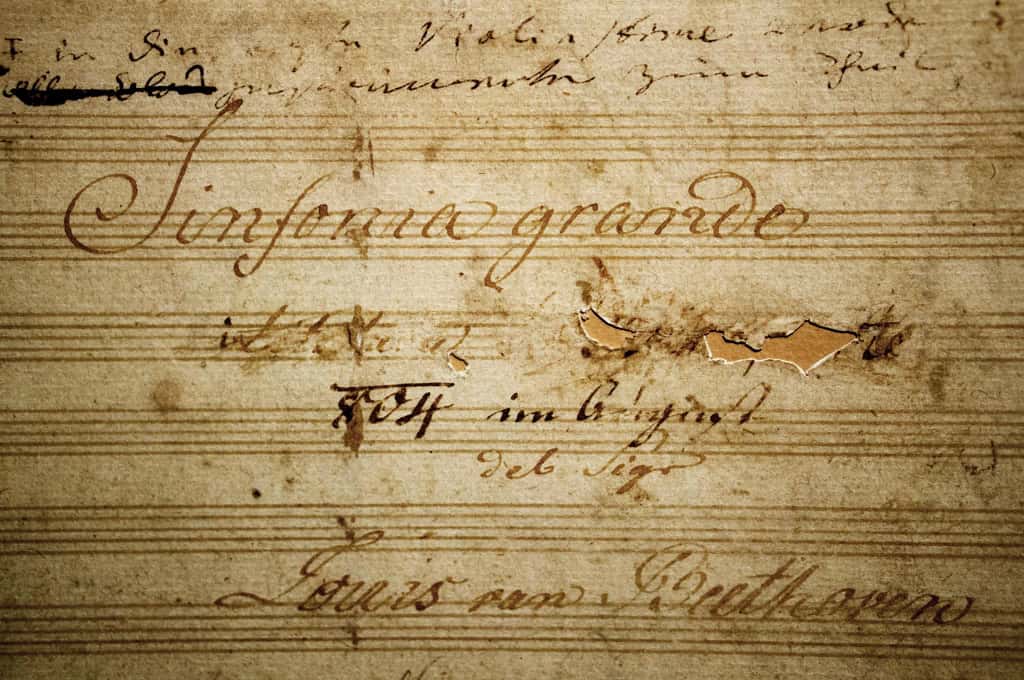
On Wednesday, December 3, 2025, the Orchestre des Champs-Élysées and Collegium Vocale Gent filled the Henry Le Boeuf Hall at Bozar in Brussels. Philippe Herreweghe led his ensemble first through Beethoven's Symphony No. 3, the Eroica, that inevitable turning point where the classical world felt Romanticism knocking at the door.
After the intermission, the choir took their places for Cherubini's Requiem in C minor, a work rarely found on music stands but one that strikes all the more forcefully with its restrained tragedy and spiritual depth. The combination of both works proved intriguing: the heroic breath of the Eroica alongside the hushed intensity of Cherubini. The audience, which filled Bozar to the rafters, felt that promise too. It was a unique opportunity to hear a milestone from the symphonic repertoire alongside an underrated masterpiece – and to experience both in the hands of Herreweghe, where history, sound, and emotion typically find each other infallibly.
Heroic Sounds and Revolutionary Ambition
The evening opened with the Eroica, a work that carries the grandeur and restless imagination of the young Ludwig van Beethoven (1770–1827) like no other. From the first chord of the Allegro con brio, you felt how Herreweghe set his forces to present Beethoven not as a monument, but as a living force. Everything flowed, everything streamed; the orchestra breathed as one organism. The period instruments gave the whole a transparency you don't hear every day: sharp rhythms, slender lines, timbres that reached the ear without detour. The dynamic contrasts were pronounced but never showy, as if Herreweghe didn't want to display the heroics, but simply let them emerge.
What struck me was how fresh and youthful Herreweghe's Beethoven remains. I have seen him conduct the Eroica before in Antwerp, also with larger ensembles, but while other conductors become more laborious or slower with the years, his approach becomes tighter, more lively, and this without losing his naturalness. At home, I still prefer a Furtwängler, but in the concert hall, this juvenile, almost revolutionary approach works wonderfully: Beethoven at the threshold of Romanticism, but not yet buried under sentimentality.
That smaller ensemble with authentic instruments also provided a wealth of details that quickly disappear in a more massive sound. In the first movement, for example, the six timpani strokes became a small event in themselves: not hurried markings, but colors, nuances, ideas. The timpanist, by the way, remained surprisingly inventive throughout the entire symphony – always slightly different, always apt.
The Marcia funebre sounded solemn, but never maudlin. On the contrary: in the long lines of the strings and the whispering accents of the woodwinds, you heard someone who clung to life, not someone who had already turned away from it. Herreweghe kept the tension taut, so the funeral march retained a strange sort of vitality, as if sorrow continually reminded us what life might have been. The Scherzo burst open with exuberance and enthusiasm. You saw the first violins nod to each other in musical pleasure. The brass – both horns and woodwinds – stood out for impeccable intonation. The three horns in the trio shone, and deservedly received warm applause afterward; their contribution noticeably lifted the whole.
In the finale, the Allegro molto, Herreweghe deliberately chose a certain rawness. Not sloppy, but unpolished in the best way: Beethoven close at hand, the man who was still in the midst of life, stubborn, energetic, visionary. The rhythmic motor ran free, the variation structure built itself into a compact, heroic arc in which tragedy and triumph went hand in hand. It was a symphony that smiled at life and sang it in all its refinements – with its swing, its faltering moments, its courage. An Eroica not cast in bronze, but in fire. And with that, Herreweghe laid an ideal dramatic foundation for what was to follow.
[caption id="attachment_48063" align="alignnone" width="667"]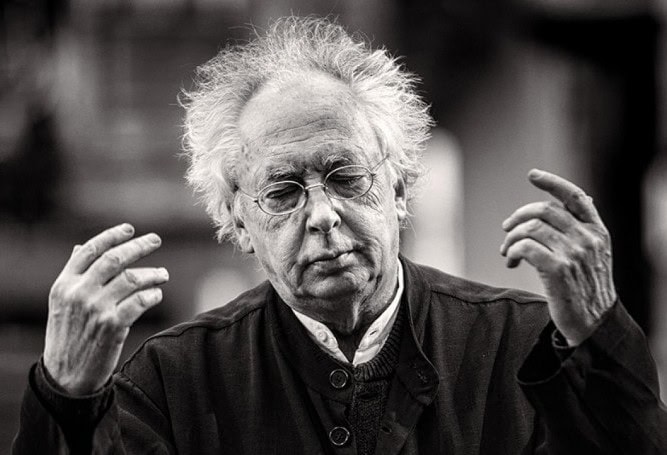 Philippe Herreweghe[/caption]
Solemnity, Introspection, and Romantic Expression
Luigi Cherubini (1760–1842) is still too often overshadowed by Mozart, Haydn, and Beethoven, but whoever truly listens to his music discovers a composer with an exceptional combination of rigor, dramatic power, and emotional depth. His oeuvre is built on an almost classical-architectural clarity, but within that formal precision glows an intensity that remarkably anticipates Romanticism. Cherubini thus forms a unique link between two stylistic periods: the logic and discipline of Classicism on the one hand and the emerging emotional expression of the early nineteenth century on the other.
The Requiem in C minor, completed in 1816 following a commission from the French authorities in commemoration of the execution of Louis XVI, is perhaps the most striking example of this. Cherubini deliberately wanted to avoid all associations with opera. No soloists, no theatrical arias, nothing that would distract the listener from the seriousness and spiritual weight of the text. This ascetic choice resulted in a score that was perceived as daring and dramatic at the time. Especially the Dies irae, with its unison brass opening that is abruptly interrupted by a drum stroke, must have struck the original audience like a hammer blow.
Yet the work enjoyed great success from its premiere. Not only the audience, but also fellow professionals (re)cognized its exceptional quality. Beethoven, Schumann and later also Brahms saw in Cherubini a master who knew how to combine contrapuntal mastery with emotional power. Beethoven would even have remarked that this Requiem would be his example, should he ever begin a requiem mass himself – a project that never materialized, though it is all the more symbolic that the work was indeed performed at his own funeral. In this Requiem, every contrapuntal line breathes with meaning; the structure remains consistently clear and classical, yet the dramatic weight elevates the whole to a new expressive world. The music is at once intellectually refined and directly emotional, a tension that explains Cherubini's unique place in music history and rightly makes him one of the great sources of inspiration for the Romantic era.
The Introitus immediately set the tone: a solemn, almost stern opening, yet steeped in subtle harmonic shifts that evoked a sense of hope and transcendence. Collegium Vocale Gent performed the work with perfect diction and the orchestra responded breathingly to every phrasing, making the texture both transparent and lively. Herreweghe let the historical instruments speak fully: the beginning, sustained by the deep strings, sketched an ideal atmosphere of humble supplication, as if rising from the depths of the soul. The Kyrie built further contrapuntally on this solemnity, with choir and orchestra complementing each other and sometimes contrasting in controlled fashion. Here sounded a musical dialogue between human vulnerability and divine majesty, always at the sharpest edge of interpretive precision, with intonation and balance that gave meaning to every phrase.
The Dies irae formed the dramatic heart of the performance. Cherubini's ability to combine power, threat and emotional urgency came unmistakably to the fore here. The choir sang with inexorable intensity; the orchestra supported with rhythmic precision, staccato accents and subtle percussion. The gong stroke at the beginning could perhaps have been somewhat more radical, but the threat was nevertheless palpable; restraint where it was needed, unbridled fury when the music demanded it. This performance once again proved that in this work Cherubini does not pursue theatrical force, but rather a musical incarnation of fear, judgment and mortality.
In the more introspective sections – particularly the Lacrimosa and Pie Jesu – Cherubini revealed his Romantic inclination: personal emotion, supplication, compassion. Choir and orchestra consistently found the right tone for the text, and Herreweghe emphasized the breathing and phrasing of every line. The music felt organic, alive, as if the Requiem were not a historical artifact, but a contemporary meditation on life, death and redemption. In Quam olim Abrahae, Herreweghe subtly accelerated the tempo without compromising the ensemble balance – true class!
The Agnus Dei and the closing Communio unfolded in a serene, meditative interplay, a prayer in sound. But the moment that truly touched the soul came with the Lux aeterna: a slowly rising glow from choir and orchestra, a sound that moved through the hall like a gentle yet irresistible current. The intensity was so pure, so moving, that shivers ran down the spine, an intensely musical moment of goosebumps that made every listener literally fall silent. When the final notes faded away, there hung a charged silence, breathtaking. The applause that erupted afterwards was great, genuine and entirely deserved.
Historically speaking, Cherubini's Requiem marks the transition from the classical elegance of Haydn and Mozart to the expressive power of early Romanticism. Under Herreweghe's direction, the Orchestre des Champs-Élysées, together with Collegium Vocale Gent, brought this balance between formal strictness and emotional intensity impressively to life. The ensemble listened carefully to each other, the historical instruments gave every phrasing brilliance, and choir and orchestra melted together into a sonorous, breathtaking experience that was both sharp-witted and passionate. This performance proved that Cherubini's Requiem is not a curiosity from music history, but a masterwork of timeless power: a work that unites heroism and devotion, strength and vulnerability, classical structure and Romantic expression in a single sound world.
When heroism and devotion reveal the soul of music
It was an evening in which Beethoven called the listener to ideals and strength, while Cherubini opened the door to introspection and humility. Under Herreweghe's direction, classical music became tangible and palpable: a living, breathing art form in which every note and every phrase told a story. Thus history, musical philosophy, historical sound and poetic power melted together into one unforgettable experience.