
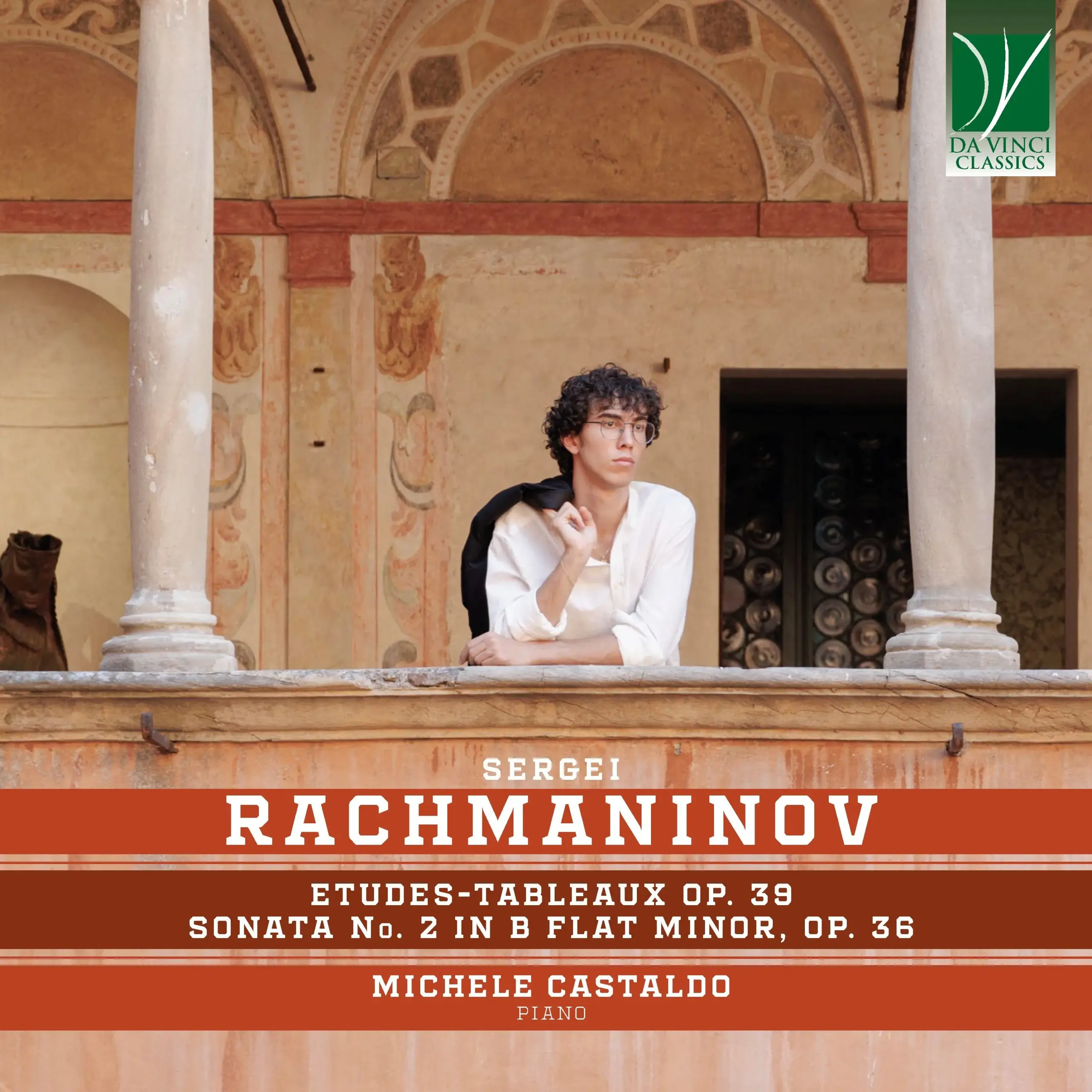
There are composers whose music never quite breaks free from the land they had to leave. Sergej Rachmaninov (1873-1943) is one of them. When you listen to his Études-Tableaux op. 39, you hear not just nine virtuosic character pieces, but the voice of a man who feels that a world is about to disappear. Opus 39 was created in 1916 and 1917, on the eve of the October Revolution that would change Rachmaninov's life forever. That historical tension seems to resonate through many of these pages: this is not salon music, but music that resists. Although Rachmaninov later entrusted Respighi with some images behind individual études when he orchestrated the cycle, he never made those programmatic indications public himself. The music had to ultimately speak for itself. It is that double layer, between technical inexorability and an almost physical longing for what is past, that makes this cycle one of the most demanding pages in the piano repertoire.
Michele Castaldo, born in 2005 and thus still very much at the beginning of his career, ventures onto that ambiguous territory on this cd and does so with a self-assurance that you wouldn't immediately expect from a pianist of his age. What stands out is that he doesn't succumb to the temptation to turn each étude into a demonstration of power – a temptation that is considerable in this repertoire for many pianists, because the score naturally invites spectacle. In the opening Allegro agitato, he lets the broken arpeggios breathe before he seeks out the climax, and when it comes, it feels earned, not imposed. There is a clear architectural sense evident in that development.
Especially in the second étude, where the Dies Irae motif – that phantom that haunts virtually Rachmaninov's entire oeuvre – nestles beneath a refined melodic line, Castaldo demonstrates a listening piano style: he lets the mourning whisper rather than scream. The emotional focal point of the cycle, the fifth étude (Appassionato), gets precisely the right mixture of fire and control. The music glows without derailing; the dramatic outbursts maintain direction and coherence, making the inner tension all the greater. Even in the technically most demanding pages, he opts for clarity over effect-seeking. In the sixth étude, with its threatening outbursts and the notorious "wolf" motif, you hear not only the orchestral power of Rachmaninov's piano writing, but also the individual voices hidden within it. His touch generally remains round and pithy: even in the heaviest chord passages, the sound retains a certain lyrical undercurrent.
Throughout the cycle, Castaldo convinces above all through his sense of coherence and his ability to hold together the many faces of this music. The fire that Rachmaninov places in these pages is decidedly present in him, without displacing the architecture. Only in the most powerful passages does the tone sometimes acquire a slightly sharper edge, as if the intensity stems more from the touch than from the resonance of the sound. It is a nuance within an otherwise impressive performance, especially for a pianist who is still so early in his development. The final études reveal another side of the same qualities. In the eighth and especially the ninth étude, he again demonstrates how convincingly he can build tension and movement. The closing march-like episode gets the necessary flair and dramatic energy; here his fiery approach works entirely in his favor. The music may shine, and Castaldo gives it that lustre without losing sight of the larger line.
After the concentrated miniatures of the Études-Tableaux, the perspective shifts to the Second Piano Sonata, opus 36. Rachmaninov revised this work in 1931 substantially because he found the original version from 1913 too verbose. Castaldo opts for the revised version and emphasizes the cyclic coherence of the sonata: recurring motifs become natural reminiscences within a larger musical story, making the three movements feel like one organic whole.
In the Second Piano Sonata too, Castaldo feels decidedly at home. The opening movement, Allegro agitato, has all the vehemence this music demands, but he keeps the tensions continuously under control, making the dramatic outbursts all the more convincing. Especially in the Non allegro he demonstrates his greatest qualities: he captures the introverted, almost hushed atmosphere of this middle section with a natural matter-of-factness and lets the melodies breathe without ever losing the tension. The music gets space to slowly unfold, so that the emotion grows naturally from the sound. The final movement, Allegro molto, also makes a strong impression. The constant alternation between impetuousness and lyricism culminates in a finale that radiates both power and warmth. The climax feels not like a virtuosic triumph, but like the natural crowning of a musical development that has been palpable throughout the sonata.
Compared with the great historical interpretations – the emotional overwhelming of Horowitz, the architectural rigor of Richter, or the refined color richness of Lugansky – Castaldo is still at a different stage of development. That final layer of life experience, in which even the silences between the notes gain meaning, still needs to mature further. But that is less a shortcoming than a promising growth point: this recording shows a young pianist who already has a remarkable grasp of both the larger lines and the emotional core of this repertoire. The recording itself also contributes to the convincingness of this release. The piano is recorded naturally and spatially, without excessive reverb or an artificially close feeling. This allows the different voices in Rachmaninov's often densely woven texture to remain clearly audible and gives Castaldo's nuanced dynamics all the space to unfold.
What ultimately makes this recording so worthwhile is not that it tries to surpass the established references, but that it shows a young pianist who takes the score seriously and presents his own, convincing vision against it. His sense of form, proportion, and timbre testifies to a remarkable musical maturity, while at the same time there is still room for further refinement and deepening. It is precisely this combination that makes this recording so fascinating: it shows not a finished endpoint, but a young artist who not only masters a great musical heritage, but is also slowly finding his own place within it.