
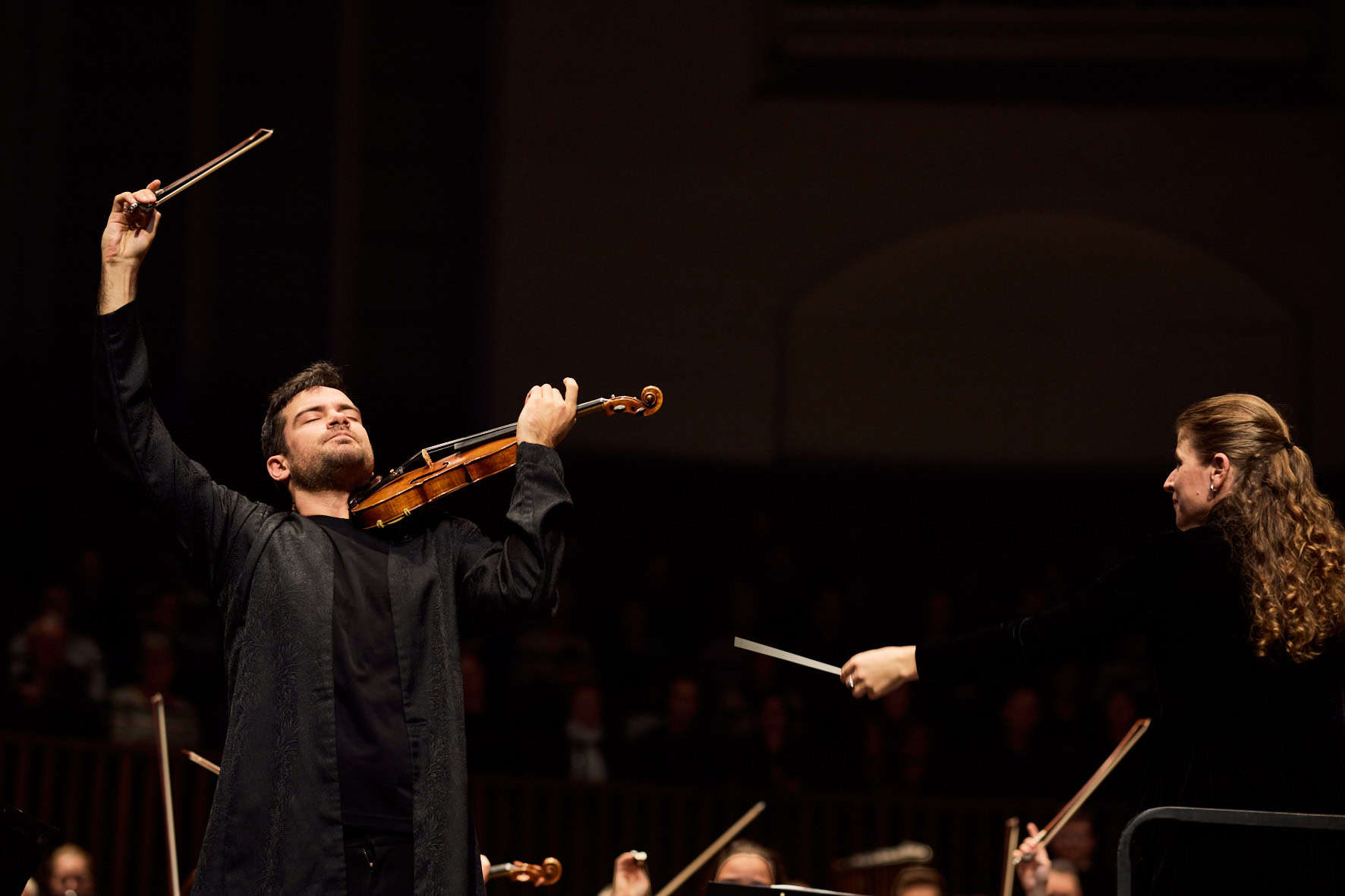
Marc Bouchkov at the Bijloke on 12 October and Vilde Frang at Concertgebouw Brugge on 19 October.
Elisabeth Competition
Since his appearance in the Elisabeth Competition in 2012, violinist Marc Bouchkov has built a major international career. On 12 October he performed the Brahms violin concerto at the Ghent Bijloke with the Symfonieorkest Vlaanderen. What a violinist, what a swing and dynamism! A golden violin tone, a refined vibrato that penetrates to the back of the concert hall even in the Bijloke. Even when he is not playing, he radiates enthusiasm and nods and sways along with the orchestra.
Violinist Bouchkov has a special bond with the Elisabeth Competition. Not only Marc in 2012, but also his father Evgueni won third prize in the great year 1989, when we became acquainted with the phenomenon Vadim Repin. Father Evgueni and son Marc, but that is not all. In 1963 his grandmother Zarious Schihkmoursaieva was also a laureate of the competition. Three generations! Marc Bouchkov was born in the French city of Montpellier to a Russian father and a Ukrainian mother, thus reconciling both countries within himself.
Overwhelming
If like many I came to the concert primarily to listen to top violinist Marc Bouchkov, after the intermission there is something else to come: conductor Kristiina Poska addresses the audience about the second symphony by Sibelius. In this symphony not only the dark sounds from the mysterious North, there are also light and warm sounds, because he wrote it in Italy. "Do not understand but feel this music," Poska advises us.
After the last note has sounded, I don't quite know what has happened to me. I have never heard Sibelius in such an overwhelming way. A call from the dark North, through which the melancholy of people who have too little sunlight occasionally pierces the northern lights.
Mammoth
The warm sound of the strings, alternated with the snorting of the brass players, the lashing of the horns, what a top orchestra the Symfonieorkest Vlaanderen has become under Poska's leadership. When I close my eyes I see a mammoth rising from the permafrost melted by climate change. The orchestra plays like an overwhelming creature that holds the audience in its grip until the last note. "This is our music," Poska impresses upon me when I chat with her briefly afterwards. Poska comes from Estonia, which is culturally and linguistically very closely related to Finland.
Kristiina Poska also signed the latest CD of the Symfonieorkest Vlaanderen, with Beethoven's second and third symphonies. There I hear once again to what level this orchestra has risen in recent years. A godsend for the Fleming that I am, with the Symfonieorkest Vlaanderen as my home orchestra in the Bijloke concert hall. A violinist who reconciles Russia and Ukraine within himself, an orchestra that plays divinely… Not bad to close this Great Reconciliation Day on Saturday 12 October.
Moved
A week later, another violin giant takes the stage, this time in the Bruges concert hall. Norwegian Vilde Frang has been an absolute top of the violin firmament for more than ten years. She was taken under the wing of Anne-Sophie Mutter at a young age and has performed with the greatest orchestras and conductors. The Elgar violin concerto is expertly introduced beforehand by musicologist Francis Maes. He urges us to listen to the intimate and fragile violin sound of Frang amidst the orchestral might.
[caption id="attachment_38166" align="alignleft" width="200"]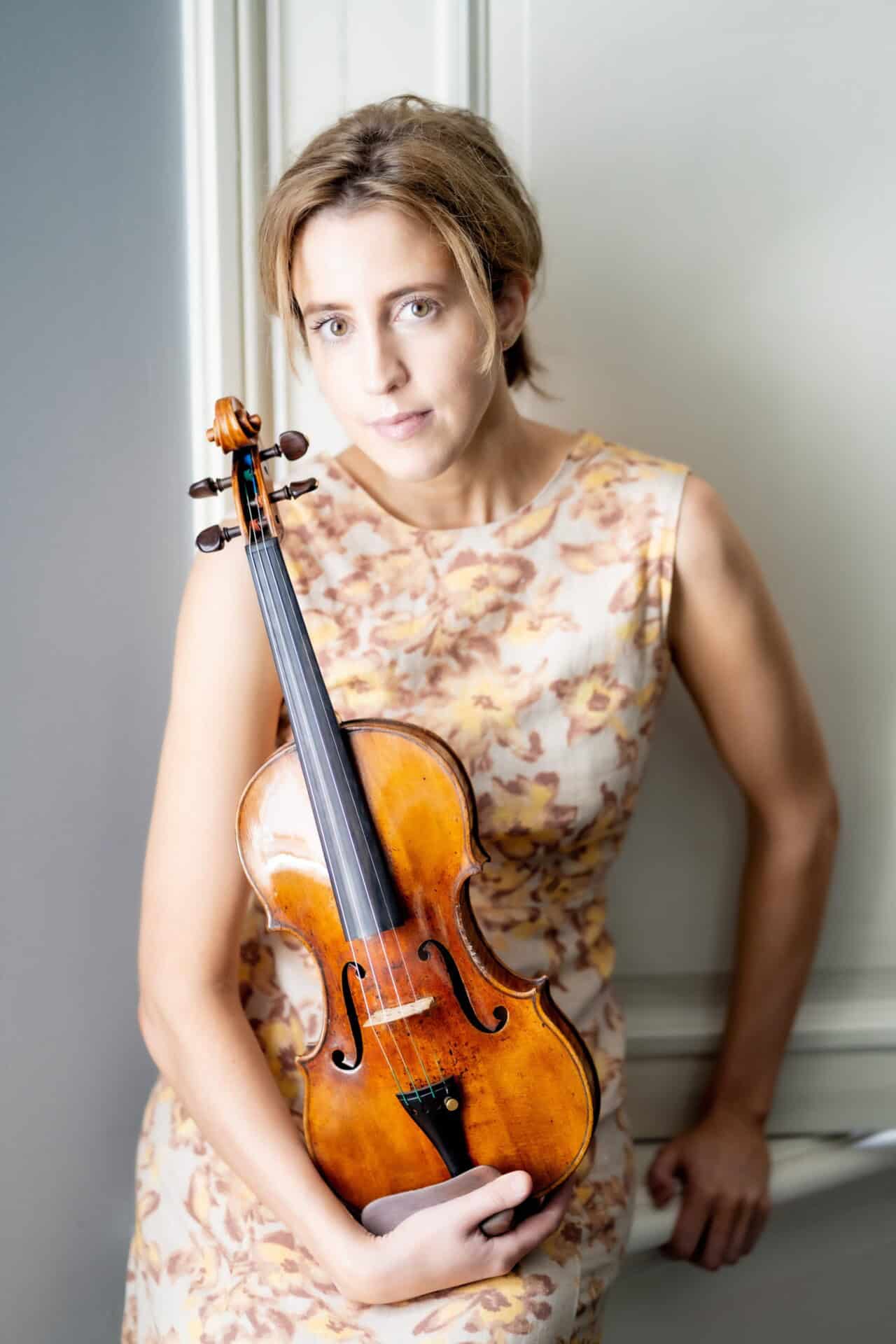 Marco Borggreve[/caption]
During the orchestra's introduction, Vilde Frang indeed stands on the stage with a somewhat lost look, violin and bow in her right hand. But once she starts playing, Vilde Frang performs the long and intricate concerto here and there in a restrained manner, in other passages wild and frank. A weak pun, but here too I was overwhelmed and especially moved by the lyrical and restrained passages.
At 38 she is a contemporary of the slightly younger Marc Bouchkov.
Without winning major competitions, she is a product of the so-called star system. In classical music there is no room for a hundred supertalents on the violin, although of course they do exist worldwide.
I was not a fan of hers, sometimes finding her somewhat ethereal or even manneristic in baroque and classical repertoire from Bach to Beethoven. But tonight she has won me over. These late Romantic works are her habitat, just as she also shines in concertos by Korngold or Benjamin Britten.
Second time Sibelius's Second
After the intermission, Sibelius's second symphony is on the menu again, so I can compare the Deutsches Symphonie-Orchester Berlin under the baton of British conductor Robin Ticciati with the Symfonieorkest Vlaanderen from last Saturday. The first thing that stands out is that this in Bruges is a true concert hall, as opposed to the converted hospital ward of the Bijloke.
During Sibelius's second symphony I understand what Poska meant when she said this is her music. Perhaps they play too positively or too idealistically, something is missing. You can hear it for example at the beginning of the second movement, with pizzicato from double basses and cellos. With this orchestra in Bruges there was a different dynamic in this and other passages, with which you can interpret Beethoven or Brahms, but which lacks restraint and darkness.
Wings and beaks
This large hall of the Brugge concert hall, which has been hosting the greatest orchestras, ensembles and soloists for well over twenty years, is not only a treat for the ears. The vertical elements behind the stage offer a colorful sight. At the top of the backs of the chairs are lines of verse from poems. On the two chairs in front of me it says "Some people look at the sky and see women with wings and men with beaks". Exactly what I experienced on these two concert evenings. In the coming nights I will dream of the wings of Vilde Frang and the beak of Marc Bouchkov.
After Sibelius' second symphony, the Deutsches Symphonie-Orchester Berlin plays as an encore the well-known Nimrod variation by Elgar. After the applause and the standing ovation, the orchestra members do something that only German musicians do, I think. They embrace each other as if world peace has arrived. Alle Menschen werden Brüder…