
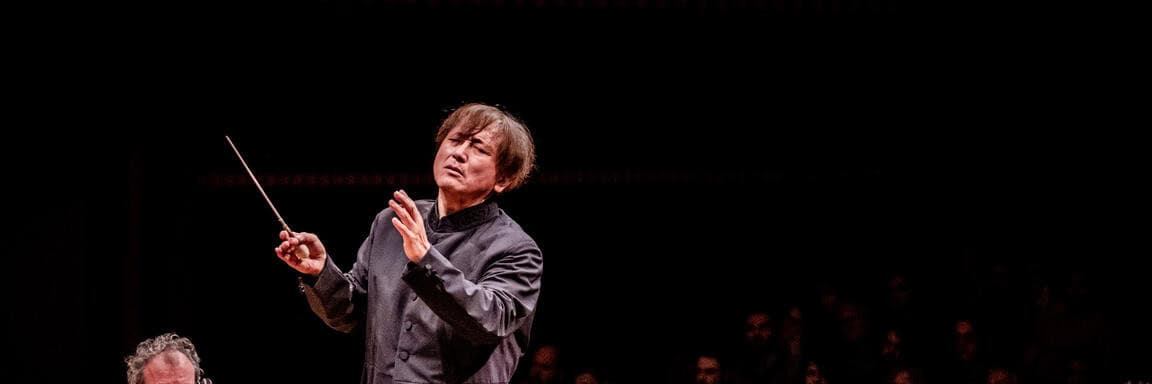
Sometimes a concert unfolds its own dramaturgy even before the first note sounds. So too on Saturday, March 21 in Flagey: a trajectory from stillness to exuberant expression, from the Japanese sound thinking of Toru Takemitsu (1930-1996) and Toshio Hosokawa (°1955) to the romantic world of Sergei Rachmaninov (1873-1943). Brussels Philharmonic brought a programme that chief conductor Kazushi Ono clearly held dear to his heart. Under his leadership, the orchestra demonstrated its versatility: with the same matter-of-factness it brought contemporary refinement and romantic expansion to life. What unfolded here was not merely a programmatic contrast, but a carefully constructed dramatic arc from within to without.
Silence as origin
With A Flock Descends into the Pentagonal Garden the evening opened as a slowly unfolding soundscape in which time seems to flow circularly rather than linearly. Toru Takemitsu departs from the principle of "ma": the charged emptiness between sounds. The score consists of sound fields that appear and disappear like natural phenomena. Fragments in woodwinds, strings and percussion form no classical thematic development, but a play of colour and resonance. Takemitsu invites an almost meditative listening attitude.
Ono gave this seemingly free material a clear structure. By connecting phrases and carefully steering transitions, a clear dramatic arc emerged. Transparency remained intact: beneath the stillness, movement remained palpable. Strings allowed their tone to dissolve into space, low registers added a soft resonance. Striking was how individual sound gestures – often brief and fragile – nonetheless suggested an underlying continuity. Not a haze, but a concentrated sound space in which each sound found its place.
A sound that grows and disappears
In Genesis by Toshio Hosokawa, that principle took on a pronounced dramatic dimension. The work unfolds as a process of emergence and transformation: the violin does not stand opposed to the orchestra, but grows out of it and ultimately returns to it.
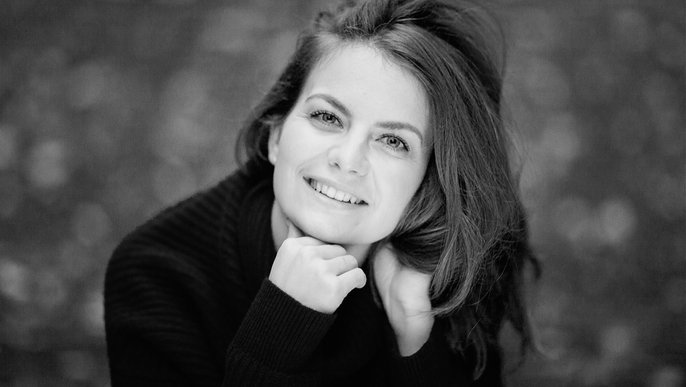 Central was violinist Veronika Eberle, an internationally sought-after soloist. This work was written for her several years ago, which gave the performance a personal charge. Her playing departed from an almost weightless tone production, in which the sound did not impose itself but unfolded gradually. She maintained that line consistently, with restrained and breathing phrasing and long lines that grew organically.
Hosokawa builds dramatic arcs that are rather energetic than thematic: the build-up occurs through density, register and colour. In concentrated passages, Eberle allowed her tone to narrow to a fragile thread, while in more intense moments she allowed the sound to thicken without hardening. The orchestra followed that movement closely. Under Ono's direction, sound layers emerged that slide over each other and dissolve again, resulting in a continuously transforming sound field. Woodwinds functioned as points of light, strings as a breathing mass, percussion as subtle articulation of time. At moments the solo violin seemed literally to light up from the orchestral texture and disappear back into it.
Thus the work received its full meaning: not a narrative, but a process – music that continues to reinvent itself in the moment. After the performance, the audience reacted with warm and exuberant applause, a sign of the strong impact the contemporary composition had on the audience.
As an encore, Eberle played the second part from the solo sonata of Sergei Prokofiev with poignant beauty.
The art of dosing
After the interval came the Second Symphony of Sergei Rachmaninov – a different universe, in which melody and harmony form the material. Where Takemitsu and Hosokawa depart from silence, with Rachmaninov that space grows into a world of lyricism and movement. The contrast could hardly be greater: Japanese aesthetics versus lush romanticism. Yet the whole felt like one dramatic arc – a striking illustration of "les extrêmes se touchent".
The symphony is cyclically constructed: motifs return, transform and link the four movements into an organic whole. Ono emphasized long dramatic arcs, whereby the architecture came clearly to the fore without getting lost in detail. Striking was how the audience allowed itself to be carried along: after the first and third movements, spontaneous applause sounded – a direct response to the convincing build-up of tension.
The slow introduction of the first movement immediately set the tone: darkly coloured, with a gradual build-up in which the thematic material developed beneath the surface. In the Allegro, a broad symphonic movement unfolded in which lyricism and momentum were in balance. Ono kept the line taut, with relatively flowing tempi and controlled rubato, whereby the tension grew organically. The scherzo brought contrast, but remained firmly anchored in the same thematic world. Rhythmic sharpness and motor energy found their place without transparency being lost. Even in the more driven passages, the orchestra retained its sound beauty.
In the Adagio, Rachmaninov's lyricism came into full bloom. The clarinet melody functioned as a moment of stillness and as a structural anchor point. The strings wove a warm, constantly moving harmonic field around it, allowing the melody to breathe. Ono's sense of balance became clear here: every phrase was carried without being spun out.
The finale brought release, yet remained firmly anchored in the thematic and rhythmic logic of the work. Ono kept the texture clear, ensuring the wealth of voices never faded into massiveness. The dynamics developed in broad waves, with a natural build towards the final climax. His interpretation opted for tonal beauty and inner tension: intense without exaggeration, compelling without effect-seeking. The orchestra followed that approach with visible pleasure in playing.
From Within to Without
What made this evening special was the underlying movement that connected the three works. Takemitsu departed from silence, Hosokawa let sound emerge from it, and Rachmaninov filled that space with melodic and harmonic richness.
The result was a trajectory from suggestion to expression. Brussels Philharmonic followed Kazushi Ono, who was visibly enjoying himself, in that development with great coherence, with both detail and form coming fully into their own. What began as an exploration of silence ended in a full, sustained sound world. Thus the concert evolved into more than a performance: a breathing line that unfolded as an experience in time – music as process, movement and form.