
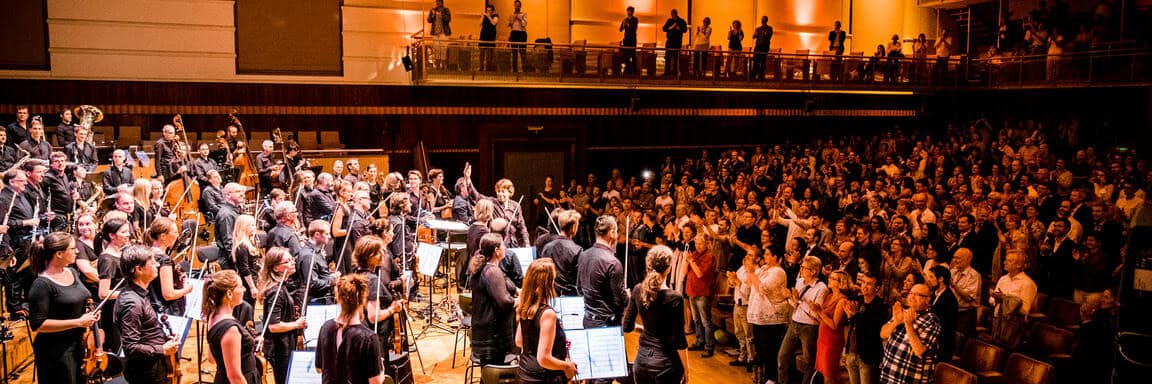
Some concerts begin even before the first note sounds — they breathe anticipation and concentration. Such was the case on Friday, October 24 at Flagey, where the Brussels Philharmonic gathered under the young Felix Mildenberger. The air trembled with promise: Sibelius and Elgar, two composers who do not shy away from conversation with themselves and the world, each searching for a form in which emotion and sound find each other.
Two worlds, one human voice
On the programme were two milestones from the late-romantic repertoire, each deeply rooted in the landscape and personality of its creator. Jean Sibelius (1865-1957) wrote his Violin Concerto in D minor, Op. 47 in 1904, at a time when he had to abandon his dream of becoming a violinist. The work breathes longing and self-examination: virtuosity as self-portrait, music as a mirror of a Finnish soul. Edward Elgar (1857-1934) composed his Enigma Variations, Op. 36, a few years earlier, in 1899: fourteen character portraits of friends and acquaintances, but also a mysterious theme that was never revealed. Where Sibelius remained introspective, Elgar opened the door to the other, friendship as musical form.
The northern light of Sibelius
Sibelius' concerto is music that burns from within. It demands tension, direction and breath — and it was precisely here that this performance remained somewhat cautious. Liza Ferschtman chose for a restrained, carefully constructed reading. Her tone was beautifully focused, sometimes moving in its softness, but the story did not always unfold naturally. The first movement lacked some direction and dramatic dynamism. The underlying restlessness of Sibelius came to life only fragmentarily. In the Adagio di molto the music found better connection: here Ferschtman had more room to resonate, and the tone gained warmth. The finale was lively and technically accomplished, but lacked the demonic fire that makes this concerto inescapable.
Mildenberger accompanied with a light hand, letting the orchestra sound transparent, with beautifully balanced colours in the woodwinds and strings. The orchestral sound was refined, clear, never heavy — but now and then a fraction of uncertainty crept in, as if soloist and orchestra did not always follow the same breath. Thus it became a performance that commanded respect, but did not quite carry the listener away. The audience responded with genuine applause that acknowledged the quality of the performance, though the emotional release was held in reserve for what was still to come.
Elgar and the riddle of friendship
After the interval, the picture turned completely. Elgar's Enigma Variations unfolded like a tapestry of richness, colour and humanity. Here the orchestra sounded liberated. Mildenberger led his musicians with a smile and moulded with his hands the sound he wanted to hear. His enthusiasm was contagious: he did not conduct as an authority, but as a fellow player. This produced an orchestral sound that was rich and layered, without ever becoming heavy. The dynamics remained exemplary across all fourteen variations: each time the music found its balance between lyricism and energy. The conductor carefully measured the emotional register — no overwhelming, but a growing tenderness. Especially 'Nimrod' grew organically, with a dignity that touched the heart without becoming sentimental and provided an emotionally spine-tingling moment.
The Brussels Philharmonic showed its strength here: a warm homogeneous string sound, woodwinds with character, brass that radiated. The musical layers remained audible in their individuality and their unity. Mildenberger, visibly enjoying himself, showed potential: a young conductor with an ear for detail and for breath. Not every gesture was precise, but his intention was clear and his commitment genuine. It is good that the orchestra offers young conductors this opportunity — a learning ground for both, audibly a fruitful experience.
The audience responded enthusiastically, with prolonged applause and multiple recalls of the conductor. Here sounded the warm recognition that only arises when musicians and listeners truly meet each other.
The spirit in the music
What characterised this evening was the contrast between control and surrender. Sibelius received a polished, somewhat detached reading; Elgar, by contrast, blossomed into a human symphony. The orchestral sound remained fine and light throughout the evening, but only in Elgar did it find its natural lustre. It was as if the music could only truly breathe there.
The Brussels Philharmonic proved once again its maturity: refined, balanced, professional — but with an audibly beating heart. And Mildenberger showed that conducting is not merely beating time, but listening with the whole body.
Those who left Flagey did not take with them the perfect performance, but something more valuable: the realisation that music lives in the search and growth. Sometimes it does not fully convince, but it keeps moving — and therein lies its true beauty.