
This production premiered at the Zeeland Nazomerfestival in 2022. During the past Ascension weekend, it was performed four times at deSingel. Each time, full house.
The audience has clearly taken Sidi Larbi Cherkaoui to heart. This outstanding artist realized the total concept with a few Flemish companions. Visual artist Hans Op de Beeck designed the staging, fashion designer Jan-Jan Van Essche created the costumes, and Floris De Rycker composed music for three soloists and two musicians.
In this production, Sidi Larbi Cherkaoui takes his dual nationality as a starting point. Dutch politician Biesheuvel says in one of his writings: "You are born into a history, thrown into an era." Sidi Larbi Cherkaoui affirmed himself in the artistic. The arts in general as compensation, perfection and imperfection, the raw and unrefined, the longing human being for beauty. All this resulted in a richly varied life with sublime splendor. He immediately shot himself into the first division of contemporary dance. His curriculum is now dizzying.
Reflection
A man who has fundamental things to say from an autobiographical, inner drive. A dual descent: Flemish on his mother's side and Moroccan through his father's genes is partly an enrichment, sometimes also two weather fronts that come together and make it storm in your head. He once said in an interview: "As a child of migrants, you immediately have the feeling of being at home and a visitor at the same time." Life is passing on. Knowledge and understanding, but also feelings, warmth and tenderness. He placed his dual nationality in confrontation and dialogue with each other in a cross-pollination.
Life remains grey if you don't color it in. That certainly cannot be said of this artist. Cherkaoui walks the grey zone between local anchoring and intercultural dialogue. He puts the wealth of his multicultural origins in the spotlight and freed himself from clichés. The stage serves as a memory palace where past, present and future meet in an aesthetic and philosophical manifesto.
Staging
When the curtain opens, you see a kind of refined warehouse with metal roof trusses and a dormer window. A shell casing in which rooms have been created. Grey tones dominate. At the front right, a kind of grey, dusty still life has been created with enlarged paraphernalia: a jug, cup, candlestick, a book, a skull...
[embed]https://www.youtube.com/watch?v=KYEIsHYfe_g&t=10s[/embed]
A group of fourteen dancers from all corners of the world (Japan, America, Russia, Ukraine, Congo, Canada, Germany, Israel, Belgium…) appear in black and white with a brush in hand. They draw lines in space to the beautiful sounds of musician and lutenist Floris De Rycker and his ensemble Ratas del Viejo Mundo. The lute, a typically Flemish instrument with the Arabic oud as its predecessor. There is dancing in twos, in groups of three or four, ending in a kind of round dance. In between, a man with an incense censer walks through the house to bless it and banish evil spirits.
'Vlaemsch (chez moi)' has something of pointillism. Briefly and fragmentarily, peculiarities are touched upon, Flanders in the grip of the church, the Jews who found their place in Antwerp, the scouts, Rubens makes his appearance and even recites a poem that strongly reminds one of the style and linguistic skill of Guido Gezelle. Color is gradually brought into the costumes in a variety of characters: a nurse, a butcher, a soldier, a bride, a spicy young girl, a brewery worker…
In a four-poster bed rests the mater familias, portrayed by singer Christine Leboutte. She is the red thread throughout the performance and provides explanation and commentary in French and Dutch. Halfway through the performance, she hoists herself into armor as Dulle Griet from the famous painting by Bruegel. She is joined by cycling tourists and herself pedals hard on a stationary bike. A cross-pollination on multiple fronts.
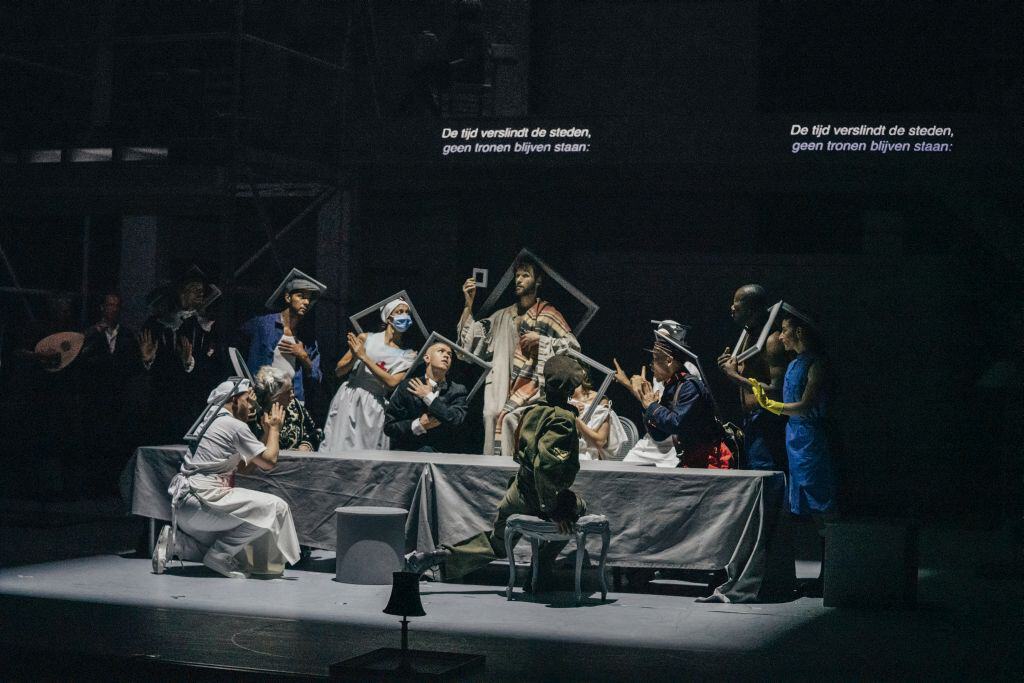
In one, two, three, an enormous table is set. First a square, shortly afterwards it becomes a long, rectangular table. A tableau is created that evokes images of the painting 'The Last Supper'. Sidi Larbi Cherkaoui does not limit himself to impressive choreography alone, but in his productions always works with attributes. Here they are frames. What can be done with them, Sidi Larbi Cherkaoui draws out to the finest detail. He even creates a Wunderkammer with it, with family portraits where the mater familias with pinpricks reveals the true nature of the people.
Sidi Larbi Cherkaoui knows how to enchant and engage the audience in a perfect build-up of serious, lyrical and comic interludes. The dancers show phenomenal things like a rag doll, a Charlie Chaplin imitation, a capoeira fight, there is also a sightseeing tour. He also conveys that meanwhile about 32% of the Belgian population has migration roots or a foreign nationality.
As in many of his productions, he also reaches back here for polyphony, the different voices, soft, powerful, high, ethereal vibrating, twirling around each other. Beautiful Arabic and African sounds ring out that unleash emotions. Tones that vibrate at the same frequency as the hidden places in your soul in a cultural reflection. The richness of other cultures. There is old French music, a mangled Flemish folk song and the beautiful three-part 'Mijn platte land, mijn Vlaandrenland' by Jacques Brel, who had a love-hate relationship with Flanders.
At the end, the dancers don their black/white outfit again, twirl around each other, paint each other in space. The synergy between dance, music and singing is impressive. Sidi Larbi Cherkaoui once again makes the difference between conceptual art and art that simply grips you through its visual power and underlying message.