
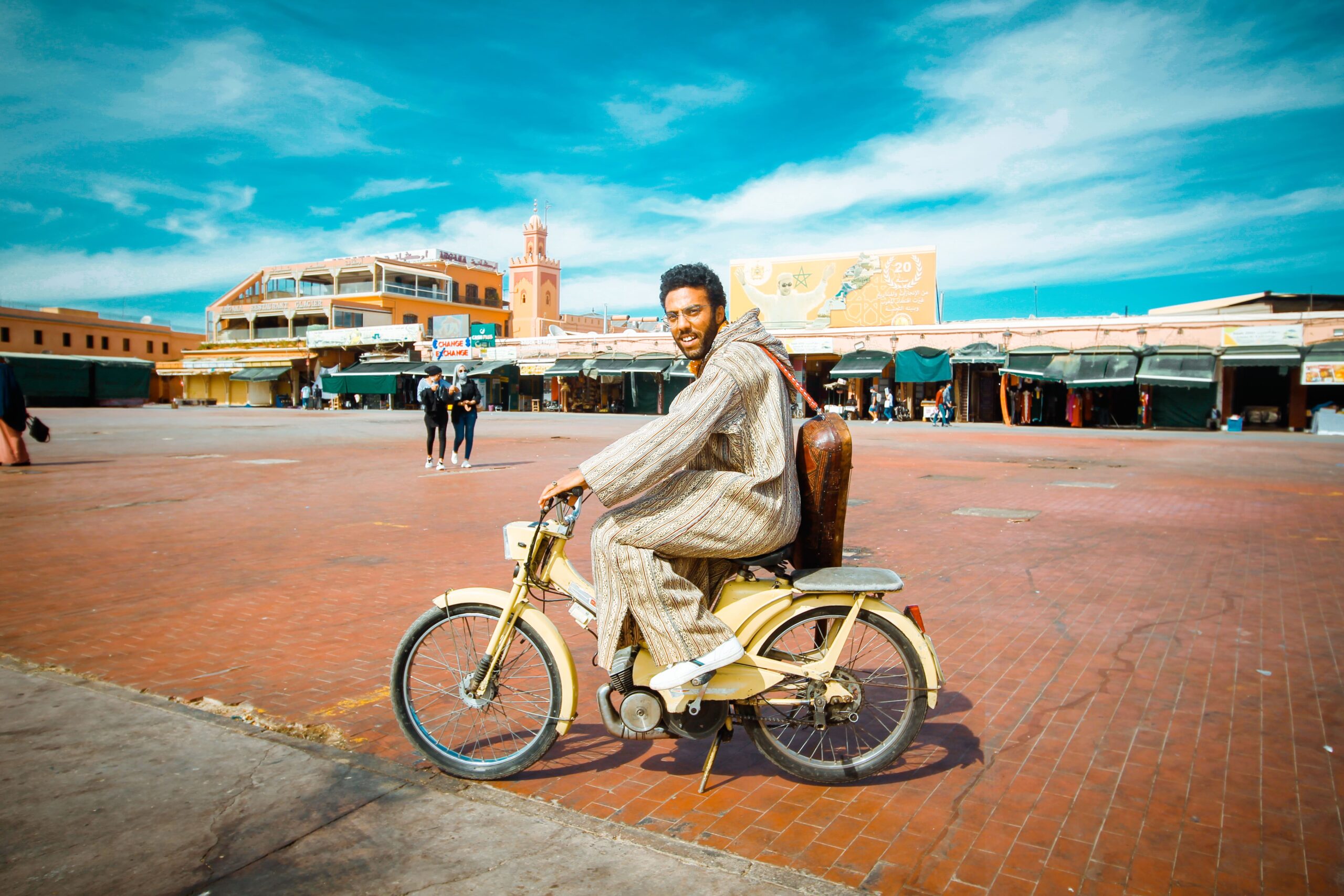
On Saturday, August 8, JISR – BRÜCKE performed in a chamber music ensemble of five musicians from Morocco at Young Euro Classic in the Konzerthaus Berlin, with pieces from the Arab-Andalusian tradition, which dates back more than a thousand years. Because I wanted to learn more about this music, I spoke with bandleader Mohcine Ait Ramdan before the concert. Passionately, he explained to me why Arab-Andalusian music is actually European music – and what a mislabeled channel on a mixing console has to do with it. Because we didn't have enough time, we continued the conversation later. Below is the account of an inspiring and instructive conversation.
It is a small moment, but it is the moment Mohcine Ait Ramdan seizes when you ask him about the core of his work. A soundcheck, somewhere, a sound technician behind his mixing console. On one of the channels it says "hakkebord". On stage, however, there is not a hakkebord, but a qanun, an Arab bowed zither. The technician didn't know the name and reached for the closest word he did know. "To be honest, he wasn't even that far off," Ramdan says. "The qanun and the hakkebord are family to each other. Both bowed zithers. One is plucked, the other is struck." He showed the man the instrument, mentioned the correct name – and the technician, who had been doing the job for decades, was immediately enthusiastic. "That's what I mean," Ramdan says, "when you make music, there's always something new to learn. For everyone."
Precisely that confusion, that casual recognition of kinship, is in small what Ramdan tries to do with his project JISR – Arabic for bridge – on a large scale. For ten years now, the musician who grew up in Marrakech and now lives in Munich has brought musicians from completely different traditions together. By now there are well over seventy, from student to septuagenarian, across genres and generations.
Music that left and came back
For Ramdan, this music is the best example of what JISR stands for. For it does not come, as many assume, "from elsewhere". It "originated in Europe. In al-Andalus, on the Iberian Peninsula," from where it moved to North Africa and has remained there to this day. "So it is European music that left and came back," he says, "but it is at home here. Just as much at home as any other music in Europe."
This is most clearly seen in the instrument: from the al-oud, the European lute was made, and the lute was in the Middle Ages and the Renaissance the central instrument of Europe – the early suites were written for it. "Baroque music originated on an Arab instrument," Ramdan says. With the lute, not only an instrument traveled, but an entire way of thinking about music. The emergence of Baroque music is therefore not only the beginning of a distinct European period, but at the same time a further development of what came from al-Andalus – "as its DNA."
Nostalgia does not drive him. "Preservation doesn't interest me," Ramdan says, "what interests me is what this music can still do today, when it meets a vibraphone, a Chinese pipa, a trautonium."
Listening instead of agreement
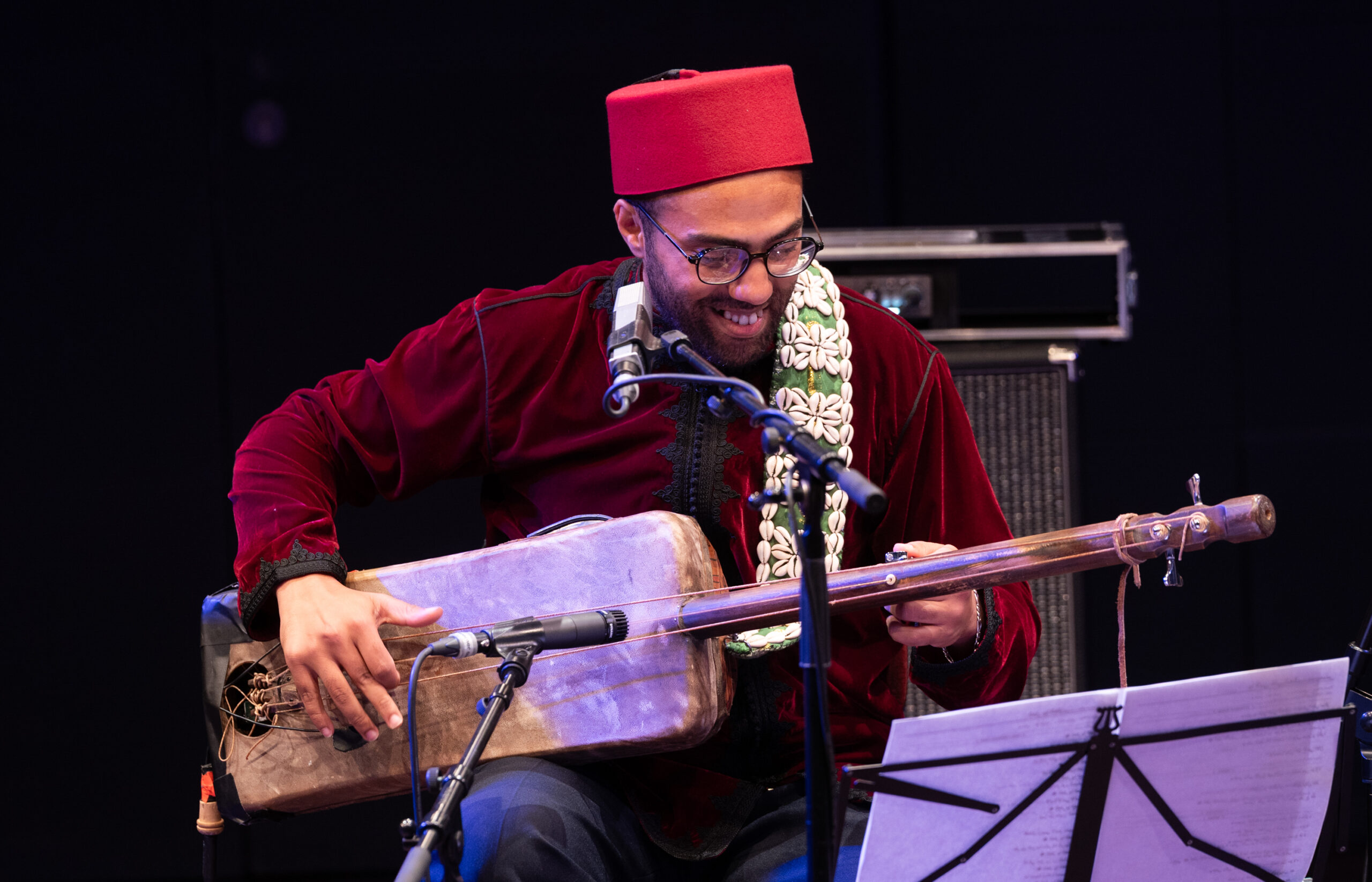
How actual shared music emerges from such different systems is, for Ramdan, not a matter of culture, but of technique. He mentions two examples immediately. The first concerns pitch: while a Western, tempered instrument is fixed at the twelve semitones we know, Arab-Andalusian music works with quarter tones – pitches that lie precisely in between. The second concerns rhythm: while Western music typically thinks in fixed meters of, for example, four beats, this tradition builds on long, cyclical rhythmic patterns of up to ten beats. "That's where the work is," Ramdan says.
The solution is never that someone gives up their own system. Instead, the ensemble deliberately seeks larger common building blocks between the systems – in scale, in rhythm, in the structure of a piece – and builds from there. "That's more laborious," Ramdan says, "but it's the only thing that carries."
Little is explained in the process. "Never by talking. Always by playing," Ramdan says. What still surprises him to this day is the speed at which musicians without a common language find each other – sometimes within a few days. His explanation: "Music doesn't ask for agreement. It only asks for listening." Cultural diversity at JISR is not the subject anyway, but the basis to work from: "The measure is artistic quality, nothing else."
Moreover, there is almost no sheet music during rehearsals – often the most difficult part for classically trained musicians. Ramdan is himself self-taught and never learned to play from notes: "You play, the other plays it back, you listen, you correct, you repeat. What eventually stands there, doesn't stand on paper, it's in the memory." The learning process goes both ways: those from the orchestral world learn to listen without a score; those from an oral tradition learn in turn to work with sheet music.
Ziryab, the nouba and eleven of the twenty-four
The roots of this tradition lead, according to tradition, back to a musician called Ziryab who came from Baghdad to Córdoba in the ninth century. He is credited with numerous innovations, including a fifth string on the lute – but above all the ordering of the nouba, a large cyclical form with a fixed sequence of sections, in which the tempo increases throughout the course. According to legend, there were once twenty-four noubas, one for each hour of the day, each with its own mood and character. "I deliberately say 'according to tradition'," Ramdan emphasizes, "because much of that is story and not proven. But the form itself is real, and old." In Morocco, eleven of the original twenty-four noubas are still preserved today – and that is precisely what is worked with.
This music still thrives in Morocco: orchestras in Fès, Tétouan and Rabat maintain the repertoire, conservatories teach it, but it reaches far beyond the institutions – on the radio, at weddings, during the nights of Ramadan. "As a child in Marrakech, this was not old music for me," Ramdan recalls: "It was just the music that was there. That it was a thousand years old, I didn't understand until much later."
From the living room to Berlin
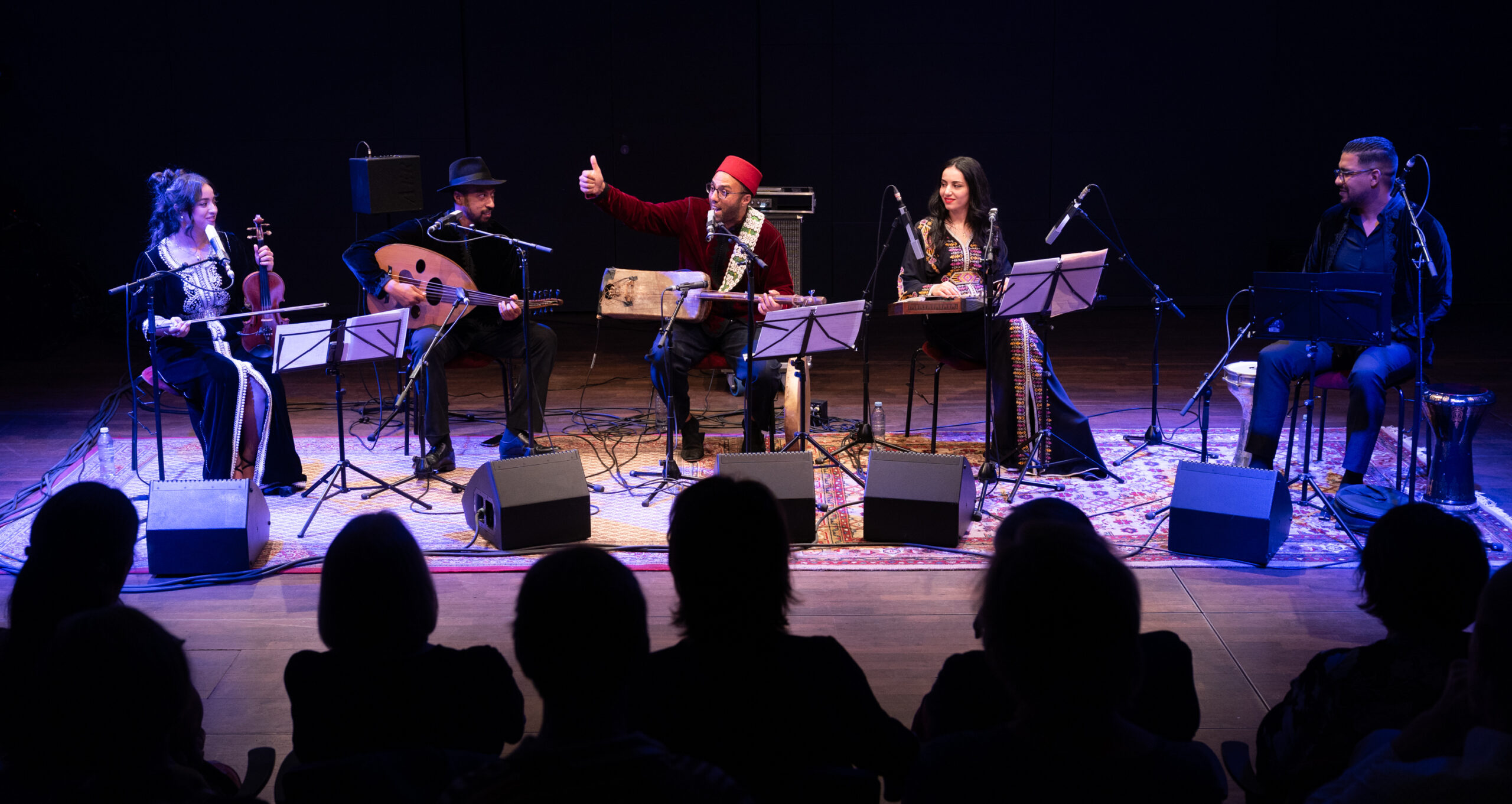
JISR was born without any plan. It began with two refugee musicians who had come to Munich about ten years ago. "We played together because it was obvious," Ramdan says. "There was no concept, no application, no subsidy, no name. We had a room and instruments." Over ten years, this grew into what now includes well over seventy musicians – always through personal recommendations: one brings someone along, the other knows a harpist. Ramdan's lesson from this: "The music comes first, the theme comes after. Whoever starts with the theme gets a project. Whoever starts with the music sometimes gets something that lasts." There is no fixed ensemble – for each project, a new constellation forms from the group of over seventy, depending on what the piece requires: one time gimbri, trautonium and strings, another time oud, pipa, vibraphone and harp.
For the performance at Young Euro Classic, this had a special significance. The festival poses the question of what European music will be in the future – "and that is precisely our question," Ramdan says: "Al-Andalus was Europe, Córdoba was a European city. For me, the question is not whether we are allowed to play. It is: what do we actually mean when we say European music? Which sounds do we count in, and which have we at some point stopped counting in?" On stage in Berlin, therefore, stood young musicians from Morocco – "not as guests from outside, but as participants."
At the end of the conversation, one point remained for Ramdan: such encounters do not happen by themselves: "Projects provide events, but continuity is provided only by institutions." If sound bridges like this are to be no exception, they must get into the concert halls, into the programming, into the education – a requirement that in May the Deutsche Musikrat also made in a position paper on the occasion of UNESCO's World Day for Cultural Diversity. What JISR does on stage is now in black and white there.
Back to that soundcheck, to the channel labeled "hakkebord". It was a mistake, but a telling one: someone who named the unfamiliar with what he already knew, and thereby accidentally came closer to the truth than he suspected. Perhaps that is ultimately what JISR did with this concert on Saturday afternoon in the Werner-Otto-Saal – not explain that two musical worlds are related, but simply let it be heard, and let the audience fill in the rest. You don't build a bridge by proving to both shores that they are the same. You build it by letting people walk across it.