
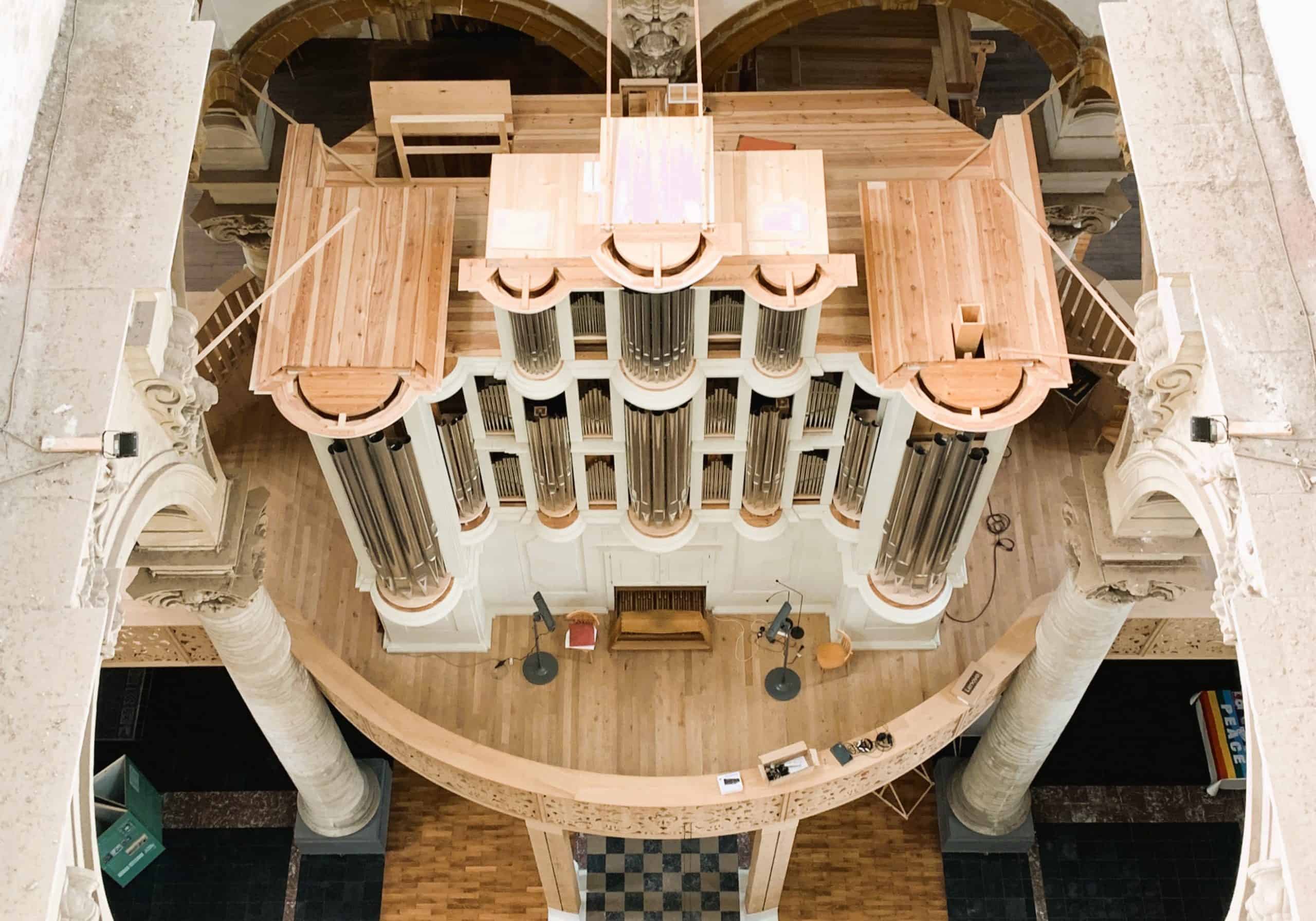
On Tuesday, June 17 at 8:30 pm, the Sint-Michiel Vredeskerk in Leuven will be the setting for an exceptional musical encounter. Under the motto Bach & Mozart: double mastery, organists Jean-Philippe Merckaert and Megumi Tokuoka pay tribute to two of the greatest composers in Western musical history. But this concert is more than a homage: it is an exploration of musical tradition, innovation and imagination. What if Mozart, like Bach, had left behind a considerable organ repertoire?
an imaginary Mozart
Wolfgang Amadeus Mozart (1756–1791) once affectionately called the organ "the queen of instruments". Yet he left behind only a handful of works in which the organ plays a prominent role. What if he had grown older and fulfilled his position as kapellmeister of the Vienna Stephansdom for decades? Would we then not have known a full corpus of organ music, as we do with Johann Sebastian Bach (1685–1750)?
It is a thought experiment that inspires this concert. Not Mozart at the fortepiano, but at the organ keyboard. Not an opera house or concert hall, but the subdued atmosphere of a church space. Not an audience that applauds, but a sacred silence that resonates with every note.
the organ as a historical barometer
Wim Winters, titular organist of the Contiusorgel in the Sint-Michielskerk and member of the Artistic Board of the Contius Foundation, and organ builder Joris Potvlieghe place the confrontation between Bach and Mozart in a broader historical context. In Bach's time, the organ was the pivot of musical life. "The organist and kapellmeister were the key figures within the musical landscape of the 18th century," according to Potvlieghe. "But with the rise of Mozart, that world began to shift."
In late eighteenth-century Europe, the church lost its monopoly on music production. Composers increasingly began writing for the bourgeois concert audience. Artists such as Mozart and later Beethoven became independent entrepreneurs rather than court or church officials. The organ, once the beating heart of musical life, became a curiosity: grand in stature, but sidelined in the new bourgeois music culture.
a historical encounter
Yet there are moments when the worlds of Bach and Mozart almost tangibly touch each other. Winters tells of a fascinating incident during Mozart's visit to Leipzig in 1789. There he met a student of Bach who challenged him to an improvisatory duel. Mozart responded with a fugue that, according to witnesses, was even more complex than what the student himself had presented. That was no accident, but testified to a thorough mastery of counterpoint.
Another memorable moment occurred when Mozart heard a performance of a cantata by Bach. He was so impressed that he wanted to see the score, copied it in its entirety and loudly wondered that he could still learn something from it himself. A nice proof that Mozart, even in his later years, remained open to the depth and structure of Bach's oeuvre. His Fantasia in f and double fugue testify to that late-blooming fascination with polyphony and organ style.
renaissance of an instrument
After Mozart's death, the organ remained in the background for centuries. The public and the concert halls had shifted their attention to the symphony, the opera and the virtuosic solo concerto. Only in closed circles was Bach's music further cherished, often in the form of handwritten copies. Mozart gained access to such manuscripts through Count Gottfried van Swieten, including Das wohltemperierte Klavier.
It was only with Felix Mendelssohn-Bartholdy's legendary performance of Matthäuspassion (1829) that Bach's music found broad circulation again. This led not only to a reappraisal of Bach's compositions, but also to a renewed interest in the organ as an expressive instrument. The rediscovery of the Baroque organ went hand in hand with a broader historical awareness of musical traditions. And today, thanks to performers such as Jean-Philippe Merckaert and Megumi Tokuoka, that spirit remains very much alive.
two masters, one stage
The concert Bach & Mozart: double mastery thus promises more than a musical performance. It is an evocation of two worlds: one rooted in the Lutheran Northern Germany of the 18th century, the other in the vibrant, cosmopolitan Vienna. Bach stands for profound theological symbolism and structural perfection; Mozart for the emotional power and melodic suppleness of the Enlightenment. Together they embody a bridge between spirituality and humanism.
That the performance takes place on the Contiusorgel in the Sint-Michiel Vredeskerk is no accident. This instrument, built according to historical examples, is a tribute to the Baroque sound ideal and at the same time offers a fresh perspective on the potential of the organ within a modern concert context. Merckaert and Tokuoka know the instrument inside and out and are able to fully exploit both the technical refinement and the emotional depth of the repertoire.