
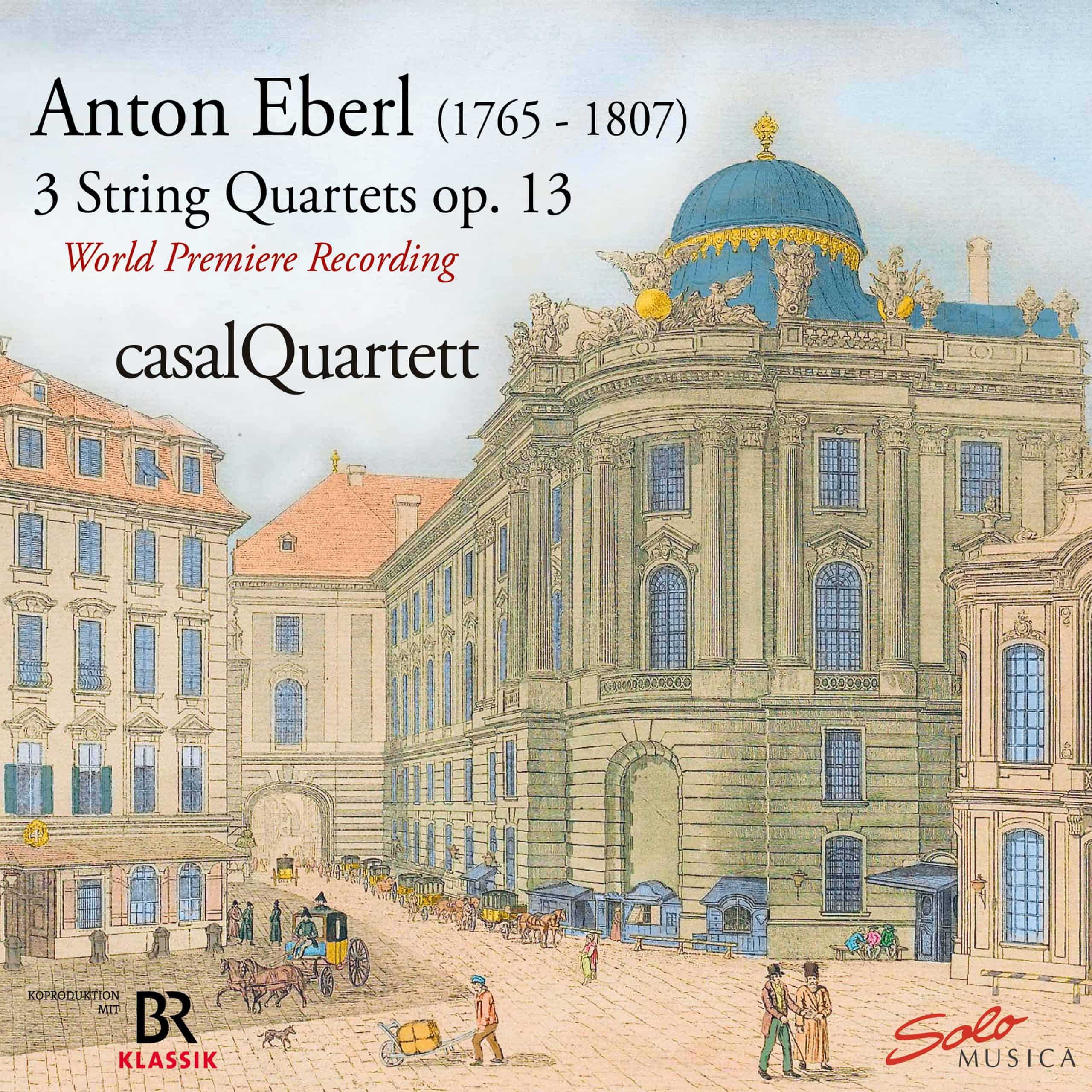
On a treasure hunt: Hardly any chamber ensemble has contributed to the history of its craft with as much verve, flair and interpretative mastery as the CasalQuartett. In addition to the core repertoire and contemporary music, the multiple award-winning Swiss ensemble consistently shines with valuable discoveries. Not least with its two most recent projects - the five-part production Beethoven's World 1799-1851 and Ballades & Quintets, which it recorded together with composer and pianist Fazıl Say, the cQ has proven that it is "one of the best ensembles in the German-speaking world" (Klassik Heute).
With its most recent project ReDiscovered, the cQ dedicates itself to the Viennese composer Anton Eberl (1765-1807) and his three String Quartets Op. 13.
As an outstanding pianist and composer, Eberl achieved great popularity and sometimes even enjoyed more prominent admirers than Beethoven. His life ended unexpectedly at the height of his success. Eberl's music often surprises with its modernity and a personal style, independent of his famous contemporaries. Like the late works of Mozart and those of the new Beethoven, Eberl's compositions foretell the revolutionary dawn of the expressive worlds of Romanticism.
NO-TE: Who was Anton Eberl and why should he be "Rediscovered"?
cQ: Anton Eberl was one of the most prominent pianists of his time and an outstanding composer of piano works and symphonies. He even challenged Beethoven's fame by winning the competition for public appreciation with his Symphony No. 3 against Beethoven's third, the Eroica, which were being performed at the same moment. To this day, his best-known works lead a shadowy existence; his string quartets have received no attention recently.
NO-TE: How did you come into contact with him?
cQ: As part of the research for our last CD project, Beethoven's World. Eberl would have fit perfectly, but we decided to publish his three quartets all at once rather than just one and then the other two at a later date.
NO-TE: How can Eberl's work be classified from today's perspective?
cQ: In the transition between Viennese Classicism in the stamp of Haydn, especially Mozart, and early Romanticism. Despite the stylistic affinity with Mozart, under whose name even some of Eberl's works were published, and later with Beethoven, his music is unmistakably his own. It is harmonically extremely versatile and full of surprises.
NO-TE: What is the appeal of his music for you?
cQ: With Anton Eberl we have a composer who is unknown not because of a lack of quality, but in our view mainly because he died suddenly during his meteoric rise. The amount of masterworks is thus manageable, but absolutely worth taking a closer look at.
NO-TE: And what fascinates you about the string quartets you recorded?
cQ: That they challenge the quartet formation as a whole - especially the first violin - and make a great, extremely lasting impression in concert. People are simply excited by these works: they are always musically gripping, they are narrative and rousing, but also melodically very charming and moving.
*If you make a purchase through the above link, we receive a small fee. This allows us to continue providing you with reviews and articles. By purchasing something through our link, you support us in writing new articles. Products will never be more expensive for you when you use our links.