
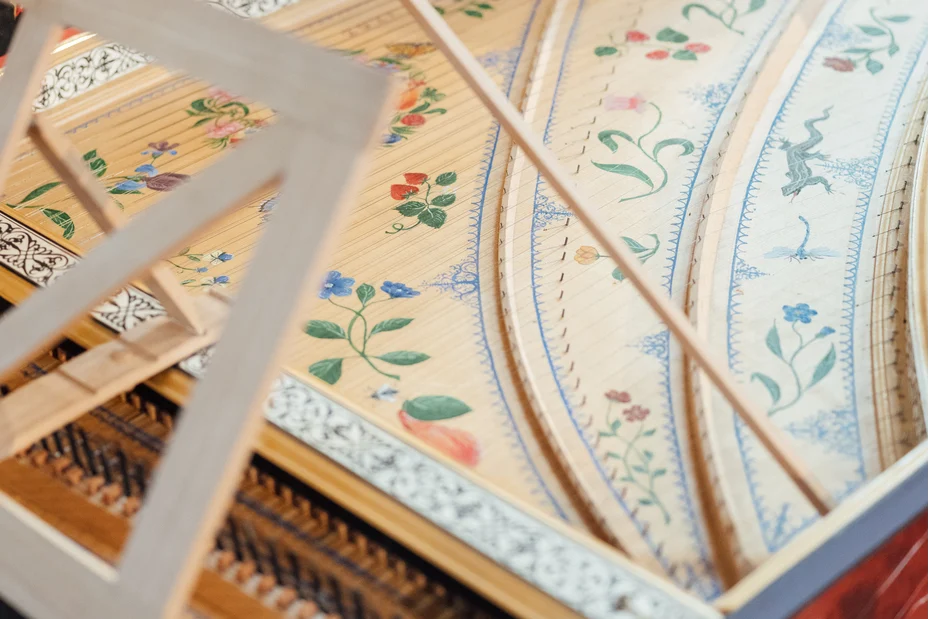
With the start of the first round, the MA Competition for Harpsichord 2026 officially kicked off on Friday. The competition, linked to the MA Festival Brugge, has been regarded for decades as one of the most important international springboards for young specialists in early music. Names such as Jean Rondeau (MA 2012), Christophe Rousset (MA 1983) and Justin Taylor (MA 2015) illustrate how decisive this competition can be for an international career.
As in the previous edition, the first round takes place entirely online. Candidates from different countries submit pre-recorded videos, which are streamed over three days for both jury and audience. What was once a practical solution has meanwhile become a fully-fledged and recognizable part of the competition.
The repertoire choice immediately sets a solid artistic standard. Each participant combines a mandatory Canzoni alla Francese by Girolamo Frescobaldi with a counterpoint from Bach's Die Kunst der Fuge, preceded by a prelude - whether improvised or not. The result is a compelling tension between rhetorical freedom and intellectual rigor.
Young generation, international profile
The first competition day immediately brings together a broad and remarkably young cohort. The birth dates in the program are situated mainly between 1997 and 2002, with outliers to 1994 and even 2005, which places the average age around 26 to 27 years.
Stylistic richness - and clear preferences
What stands out most on this first day is not only the interpretive variation, but also the programmatic choices outside the mandatory repertoire.
Domenico Scarlatti dominates with a striking number of sonatas. François Couperin and Jean-Philippe Rameau remain steady values. Carl Philipp Emanuel Bach and Fischer also return regularly.
Béla Bartók appears only once. Less common names such as Birck, Rychlík or Seixas crop up sporadically. Several candidates opt for their own preludes or improvisations.
That balance between established repertoire and personal statement makes the first round particularly lively.
When "live" becomes relative
The online format simultaneously adds an extra, sometimes unexpected dimension. Because recordings need not happen in one take, but are often spread over a longer period, almost surreal effects sometimes arise. There was, for instance, the candidate who appeared in one passage with a closely cropped hairstyle, only to be sitting behind the harpsichord a few minutes later, in the same program, with noticeably wavy hair.
Also the - sometimes surprisingly swift - changes of scenery and outfit betray how constructed these performances are (and occasionally let themselves be noted with a discrete wink). It makes clear that "livestreaming" in this context is relative: not only the performance itself, but also the way it is staged, edited and presented plays an underestimated role in how music is experienced on screen.
First impression: between admiration and restraint
As a layperson in the harpsichord repertoire, I do not wish to venture into ranking candidates - certainly not while such an eminent jury is watching. But what does immediately stand out are those participants who play from memory.
Whether that by definition leads to a more convincing musical performance is difficult to say. Perhaps it is mere perception - but it seems as though something extra happens right there, a certain freedom or naturalness. Or perhaps it is simply my sheer admiration: for the torrent of notes, ornaments and rhetorical turns that seem to pour effortlessly from the wrist.
Keep watching
This was only the first of three competition days. If you still want to tune in: by all means do as I do, and put the competition somewhere on a second screen in the background. There is a good chance you will get hooked - and that you will catch yourself listening a bit more attentively.
Who knows, you might be among the first to hear and see a future top name in the harpsichord repertoire. But who that will be remains to be seen - until the results of this first round and, ultimately, the actual final this summer in Brugge.