
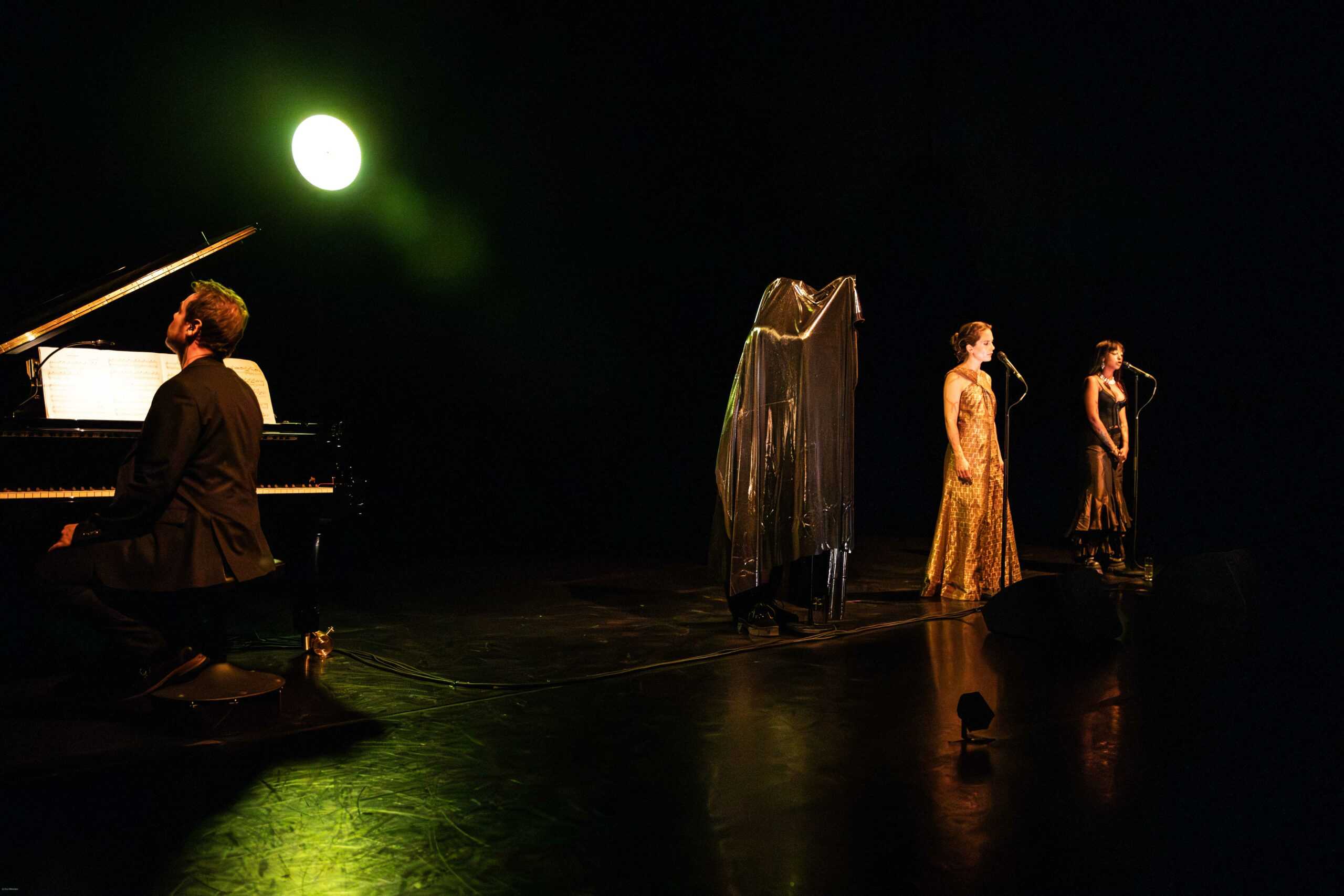
Transit (Festival 20·21) is an established name when it comes to contemporary classical music and world premieres. This weekend brings surprising new compositions every year. Frederik Croene's Counterforces, something I can only describe as a manifestation of the female voice – in all its diversity – is one of them. Together with Amina Osmanu, Lore Binon and IKRAAAN, the composer brought forth a vocally layered composition that invited analysis. Was it a concert, a vocal protest, or a bit of both?
Vocal variations
The most inviting aspect of this composition was the promise of three vocally highly varied female voices. Whether this was truly successful is something I'll leave aside here, but it was certainly a fresh breeze for the listener who enjoys hearing all facets of the voice. Combining those different singing and expression styles ultimately creates new dimensions. Osmanu, Binon and IKRAAAN are each, at their peak, three different voices (more on this later). Bringing them together as different (temporal) characters, in sound and image, is an appealing concept. Voices, and vocal techniques, can ultimately be as different as art and drawing styles. The fact that they formed a visual sound exhibition together – regardless of whether you as a listener agree with the idea of a feminist manifesto or not – is the most attractive aspect.
The feminist present, past and future
The history of Betty Friedan's The Feminine Mystique (1963) – a deconstruction of the stereotype of women as eternal mothers bound to home and hearth – is not as far in the past as we might think. The idea of something as current as the feminist voice thus appealed to me. Apart from that, this review is primarily a musical analysis, but I do want to give Croene credit here for a composition that is grounded in the here and now (something I sometimes miss in contemporary music, but that is of course a matter of taste).
The piano – which clearly made thorough use of pentatonic sounds and chromatic colorings – sometimes felt like a fourth voice. The male voice? That's how it's indicated in the explanation. The additional thudding dystopian sounds seemed to form an image of worlds as in Ridley Scott's Blade Runner (1982). Vangelis (the composer) contributed greatly to the sound idea of the futuristic soundcloud. This, based on a work by science fiction author Philip K. Dick from 1969, reminds us that dystopia and futurism are cyclical themes. A striking detail: the composition begins and ends with the male voice (piano). This is telling.
[caption id="attachment_51427" align="alignleft" width="386"]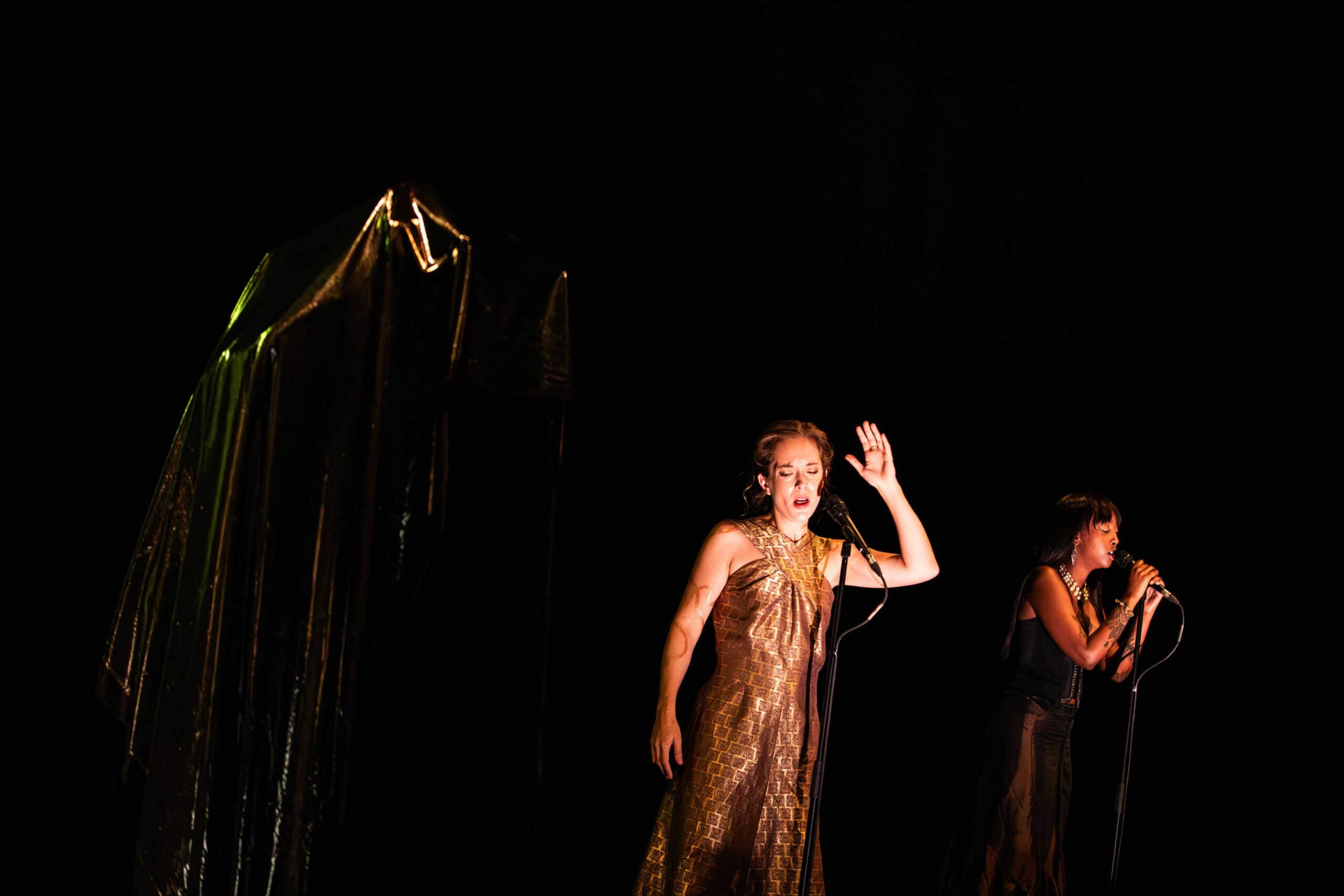 © Evy Ottermans[/caption]
Returning to the three female voices: the differences worked best when they came together in the music. Osmanu's vocal refinement stood out. This was not so much to do with quality, but with what the composer gave the other two singers. In this case, this reviewer believes that Osmanu was given the greatest opportunity to show how fine her high notes were – like a silver thread you try to thread through a fine needle – and how strong and emphasized her phrases were. Binon and IKRAAAN, in their respective roles, got beautiful snapshots. Familiar with Binon's opera voice and having made a separate listening analysis of IKRAAAN's fragile, syllabic monotony (certainly recommended), it can be said that they stood strongest together in their singing. Was it the intention that the vocally symbolic primordial mother (Osmanu) came out most dominantly? Possibly. Perhaps my taste, as a singer and music reviewer, is simply that with each singing voice in a composition one should push to the limit of its boundaries. I wanted to hear Osmanu float, Binon should shine with her sharp expressive operatic power, and IKRAAAN is strongest here as a fragile storyteller. I wished this distinction had been more pronounced. This is how you create musical individuality at its strongest.
Nevertheless, I want to conclude with the fact that it is certainly a composition worth listening to and viewing. The concept is contemporary, the composition of the voices refreshing and unique, it feels like an intimate, societal reflection. So it is certainly an interesting listening experience!
WHAT: Counterforces (2023) by Frederik Croene.
WHO: Frederik Croene (composer and piano), Amina Osmanu (vocals), Lore Binon (vocals), IKRAAAN (vocals), Dominique De Groen (scenario).
WHERE: Transit (Festival 20·21), Leuven.
WHEN: Saturday, October 21, 2023.