
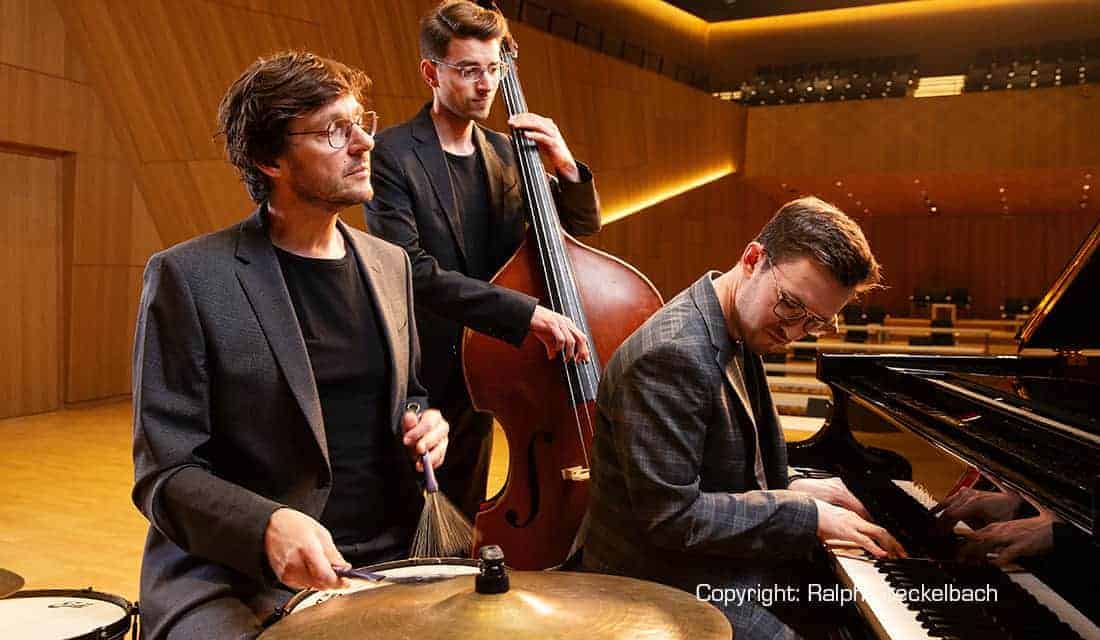
Kapoestin's compositional style is characterized by optimistic energy. Here classical virtuosity goes hand in hand with written-out jazz improvisations. The music hovers on the edge of classical and jazz and features rhythmic magic, intriguing melodies and charisma. On this cd the jazzy atmosphere takes the upper hand with lively arrangements for jazz trio.
The Russian composer and pianist Nikolai Kapoestin (1937-2020) built an impressive reputation in the jazz scene of the Soviet Union at a young age. While Kapoestin was still studying at the Moscow Conservatory, he was already known outside as a jazz pianist, arranger and composer. However, he has always denied the latter: "I have never been a jazz musician. I never tried to be a real jazz pianist, but I had to do that to compose. I am not interested in improvisation — and what is a jazz musician without improvisation? All my improvisation is written out and because of that it became much better." (Fanfare Magazine, 2000)
Kapoestin's classical training comes to the fore in the structure of his compositions. Moving Classics TV describes his style as "the old traditional glasses of 'classical form' filled with expensive champagne with an intoxicating effect". A poetic way of describing how Kapoestin integrates jazz idioms into formal classical structures. Several improvisations take the form of baroque examples such as partitas and suites.

Previous
Next
The fusion of jazz and classical is perhaps most clearly heard in Kapoestin's two collections of 24 preludes: 24 Preludes in Jazz Style for Piano opus 53 (1989) and 24 Preludes and Fugues for Piano opus 82 (1997). Both collections contain compositions in all minor and major keys. In doing so, he follows a tradition of classical composers, including Bach (Das wohltemperierte Klavier BWV 846-893, 1740-1742), Chopin (Préludes op. 28, 1835-1839), Scriabin (24 Preludes op. 11, 1888-1896) and Shostakovich (24 Preludes and Fugues op. 87, 1951). A selection of Kapoestin's opus 53 can be heard on this cd (track 9-20) and in this arrangement for jazz trio the jazzy character really comes into its own.
Prelude No. 1 in C Major (track 9) sets the tone for the preludes that follow. The work contains a kind of nonchalant humor and Kapoestin's characteristic optimistic energetic pulses. Prelude No. 2 is skipped but the start of No. 3 in G Major (track 10) reveals that the Russian composer follows not the baroque but romantic sequence of keys, as demonstrated by fellow countrymen Scriabin, Rachmaninoff and Shostakovich. In contrast to the fast tempo of No. 1, Prelude No. 3 has a smoldering, slow tempo and besides jazz there are also blues influences to be heard. The last prelude on this cd is No. 23 (track 20). It is a search for a melody that, along a path of continuous tempo changes, always seems just out of reach.
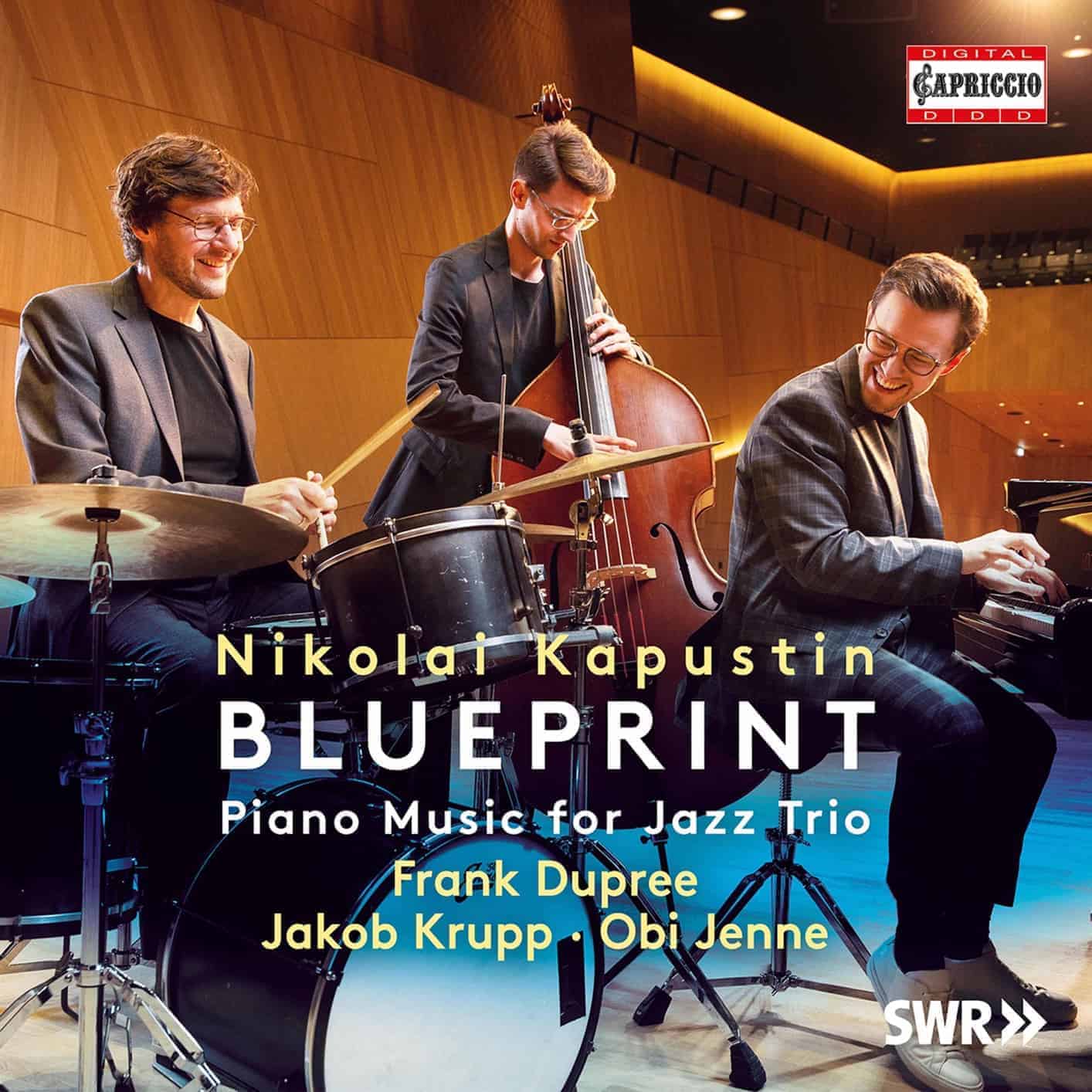
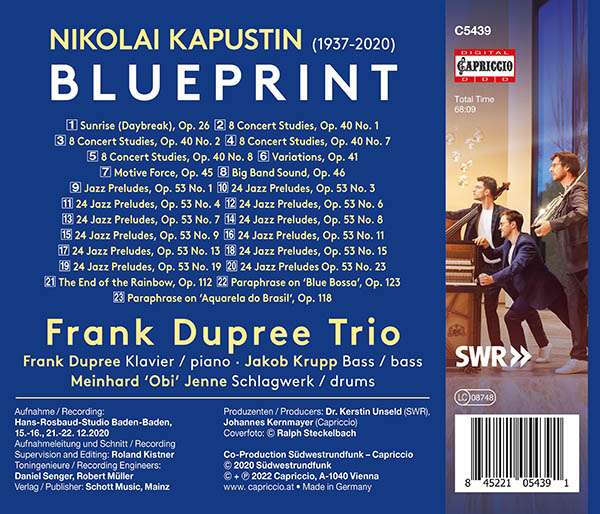
The preludes form the core of this cd but other pearls such as Variations op.41 (1984, track 6) and Paraphrase On "Blue Bossa" by Kenny Dorham Op. 123 (2004) are definitely worth discovering. There are few composers who blend the classical and jazz worlds as well as Nikolai Kapoestin demonstrates here. Where does one begin and where does the other stop? It is an unnecessary question because this music speaks for itself.
3.8/5
Kapustin: Blueprint
- WHO: Frank Dupree Trio (Frank Dupree [piano], Jakob Krupp [double bass] and Meinhard 'Obi' Jenne [percussion])
- WHAT: Blueprint
- RELEASE: Capriccio C5439
- ORDER: JPC