
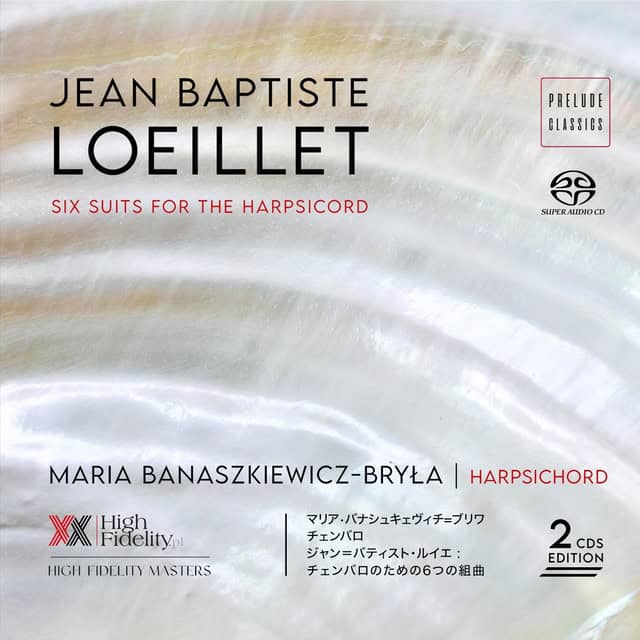
It can be extremely confusing: identical first and last names within one family. This happened to the brothers Jean-Baptiste Loeillet, who would go down in music history as John of London and Jean de Gant (or Jan van Gent) respectively. They also came from Gent, as did their other brother: Jacques or Jacob.
From a music history perspective, however, it is not that complicated, because the London Jean-Baptiste was the only one who also wrote keyboard music. At least that distinction exists. He died in London in 1730 and left behind two collections of harpsichord works, the first of which in 1712, still clearly indebted to the London-based John Blow and Henry Purcell. Only in the second collection, also published in London in 1723, does a more personal style emerge, interwoven with much French-tinged grandeur, grace, Italian élan and lightness of touch.
The six suites from 1723 recorded on this double CD (áll repeats are performed!) are not only a telling example of this, but they have also never before been recorded in SACD format. In that sense, then, a premiere, although this technically also applies to the already mentioned repeats (the usefulness or effect of which is certainly open to debate). On the earlier album by harpsichordist Jan Devlieger on the Belgian Phaedra label, the repeats are disregarded (click here for the review), which certainly has its merits too. Moreover: unlike in live performances, the repeats are usually simply (digitally) copied.
Maria Banaszkiewicz-Bryla's playing, alongside historically informed rhetoric, displays great panache, she is technically highly skilled and interprets with utmost style, but also - equally fitting for this music - varying, rhythmically pulsing, finely articulated, with much refinement and expression. Those who might miss more freedom of expression, registration and articulation should bear in mind that these suites were not designed from a fascination with the stylus phantasticus, but rather were meant to serve as a 'teaching model': Six suites de leçons pour le clavecin ou l'épinette dans la plupart des tonalités avec une variété de pass ages et de variations tout au long de l'ouvrage.
Unlike Händel in his technically extraordinarily demanding harpsichord suites, also published in 1723, Loeillet chose a different path by designing his suites especially for talented but technically less virtuosic performers (possibly also students), who had not yet sufficiently mastered the art of phrasing and ornamentation, registration and articulation. This may also explain the sparse performance instructions in the scores. As it also explains that the approaches of the already mentioned Devlieger and Banaszkiewicz-Bryla - however musically both manifest themselves - are of a different nature. This also applies to the tempi, because despite the Baroque dance forms, they - fortunately! - have a certain degree of variation.
The harpsichord used for this recording was built by Reinhard von Nagel after an instrument from 1730 by Nicolas and François Blanchet. Both came from a family of instrument makers who held high standing in France. For example, François Couperin owned a large harpsichord made by the Blanchets.
Then the recording, whose antecedents are extensively explained in the CD booklet by Wojciech Pacula, Phd, High Fidelity editor-in-chief, where I linger somewhat longer this time.
The recordings were made in a villa located on Henryka Wieniawskiegostraat no. 3 in the Polish Poznan, which also houses the Department of Historical Performance Practice of the local conservatory. A room on the upper floor was chosen, considered large enough to be able to capture the atmosphere of the location. The main principle: that the suites were intended to be performed in - I quote - 'in precisely such a space'. Was that really the case? According to the harpsichordist, yes, but I have no idea what she has based her claim on. However, I am happy to take her word for it, as she is highly expert in her field.
An equally important requirement was to use recording equipment (DXD - 352.8 kHz, 32-bit) with which the instrument could be positioned as precisely as possible in the overall sound picture. Additional factors were the shortest possible signal path and minimal distortion. In that sense, the sound image is entirely convincing: detailed, airy, balanced and subtle, yet substantial and perfectly in balance.
The reverb present in the recording, which Pacula says renders the instrument 'large and tangible', may or may not be appreciated by some. The principle was that the harpsichord on the recording should sound as it does in reality (the villa in Poznan), in the corner of a medium-sized room with a high ceiling and curtains on both sides, with the listener only a few meters from the instrument.
However, it should be noted that the acoustic conditions and also the playback equipment at the music lover's home can disturb the image pursued (or realized) by the recording technician. In a reasonably damped room and listened to with the help of high-end equipment, the sound image in stereo was certainly impressive. On electrostatic headphones (Stax Lambda Pro) this was explicitly confirmed once more, with the completely natural-sounding character of the harpsichord sound as a common thread. Listened to on average equipment, the characteristic sound properties of the instrument came to life less well and the reverb effect was also more pronounced (which suggests that one is related to the other).
It is not dogmatic, but in the nature of things that as the recording equipment improves and the associated technique is applied with the utmost care, higher demands must be placed on what is on the other side of the spectrum, usually 'far from home': the playback equipment and the acoustics as a given. The reverb present in the recording is only further amplified in a reverberant room (for example in a random living room with parquet, lots of glass, no further flooring and little to no curtains). However, in a 'dry' room, the reverb present in the recording can even be advantageous (although it is certainly not a hard and fast rule). You can read more about the various phenomena here.
I conducted another test: the decay of the harpsichord sound and thus the acoustics at the end. The better the recording and playback equipment, the 'cleaner' it is. This proved to be most impressive on electrostats in an otherwise completely silent room. I felt very close to the 'analog' effect here...