
I write 1988: that is by now simply the previous century. I was then still a cathedral singer, fully immersed in my journey of discovery through the literature, and – I'll admit it freely – a rather fanatical early music geek. I was in the middle of my Monteverdi period and borrowed cd's from the library with religious zeal only to copy them onto cassette. The goal was as simple as it was obsessive: to build as complete a collection of my own as possible.
And then came this recording of Pergolesi's Stabat Mater.
Michael Chance and Gillian Fisher. To this day, this remains for me the reference performance of the work. Perhaps that's not entirely fair to all the performances I've heard since, but some recordings embed themselves so deeply in your musical memory that they become indelible. What Chance, Fisher and The King's Consort achieved here is literally etched into my mind.
The accompaniment by The King's Consort is just as important. This was still the undisputed period of Robert King, when the ensemble rightly counted as one of the absolute reference points within historical performance practice. Transparent, stylish, elegant and at the same time warm: exactly what makes this music exciting.
That's why all praise to Hyperion for making this recording available again. And here comes the small surprise: I'm not reviewing a cd, but a vinyl reissue.
That of course immediately raises a question. Why would someone today buy a vinyl record when the same recording can be streamed and is also available on cd, with extra music included (In Caelestibus Regnis)?
Looked at objectively, it doesn't seem particularly logical.
But perhaps therein lies the essence of music appreciation.
Putting on a record is a conscious action. Listening becomes an activity again instead of background noise. Halfway through you have to get up to flip the record. That sounds banal, but that physical involvement changes something fundamental. You choose to listen. Not to have music float through the room like wallpaper while you do twenty other things at the same time.
Don't get me wrong: I'm a big fan of streaming. Over the past years it has given me countless discoveries. But vinyl offers something different. It invites slowness, attention and concentration. And those are precisely the qualities that good music deserves.
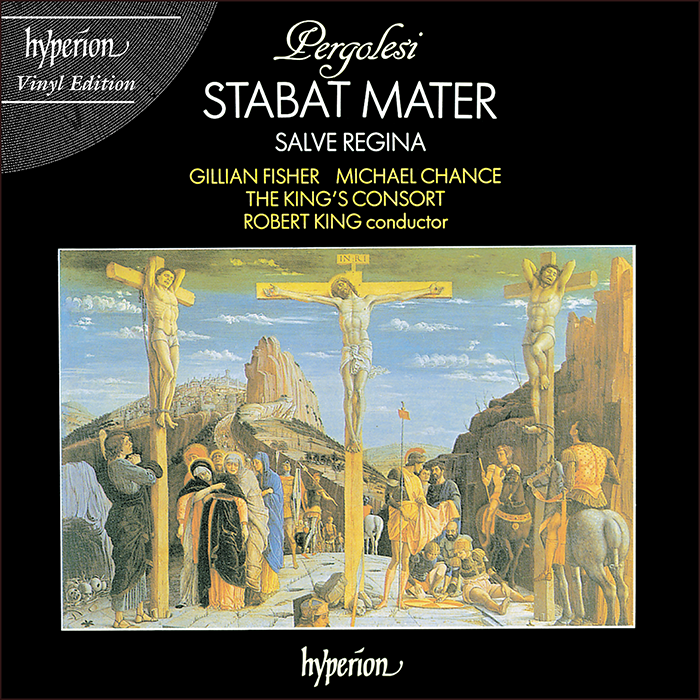 Moreover, there's another argument. That beautiful cover.
Let's be honest: when the cd took over, we lost something too. The small plastic boxes were practical, but rarely objects to fall in love with. A beautiful lp sleeve, on the other hand, deserves to be seen. That's something you put ostentatiously on the shelf. Hyperion has always had a reputation for tasteful design, and that's part of the appeal here as well.
But enough about the medium. Ultimately it's about the music. And it remains phenomenal.
I won't repeat what reviewers wrote forty years ago. I'll keep it simple: for me this remains the reference. Every part of Pergolesi's masterwork is sung with a rare combination of lightness and gravitas. Where necessary there is drama, where possible elegance. The Italian embellishments sound natural and never forced.
And may I commit a small heresy? For me the combination of soprano and countertenor simply works better than two sopranos, two mezzo-sopranos or two male voices. The encounter between the female soprano sound of Gillian Fisher and the ethereal colour of Michael Chance creates a wealth of contrasts that perfectly matches the emotional world of the Stabat Mater. The result possesses a depth and tonal colouring that I find in few other recordings or performances.
It helps of course that both soloists are absolute top musicians.
Gillian Fisher was particularly active in the nineties and early noughties. In recent years it has been strikingly quiet around her name. At the blessed age of now 76, she hopefully enjoys a peaceful, melomaniac old age. Yet I'm curious. So, dear reader: do you know how she is doing? Feel free to leave something in the comments.
And then Michael Chance. For years I have followed his career, along with that of the late James Bowman. Both belong to that great generation of countertenors who built on the pioneering work of Alfred Deller. Chance possesses a unique combination of technical mastery, intelligence and musicality, qualities that are audible at every moment in this recording.
Today he is no longer active as a singer, but as a teacher, mentor and organiser of among other things The Grange Festival and vocal training courses in Italy. A nice detail: musical talent appears to be hereditary. His son Alex Chance is now making a name for himself as a countertenor and sings with the equally legendary ensemble The Gesualdo Six.
So, dear reader and fellow melomaniac, grant yourself a small moment of musical deceleration. Return to this recording. Stream it by all means, if that's your preference. But perhaps this is just the kind of release that calls for a vinyl record. Out of nostalgia. Out of conviction. For the beautiful artwork. Because Hyperion remains a label that breathes love for music. Or simply because you want to withdraw into your armchair for an hour, shut out the world for a moment and consciously listen to a performance that has passed the test of time with flying colours. You can purchase the record (51 minutes) from 18 September.
https://www.hyperion-records.co.uk/dc.asp?dc=D_LPA66294
recording: 1987
location: St Jude-on-the-Hill, Hampstead Garden Suburb, London