
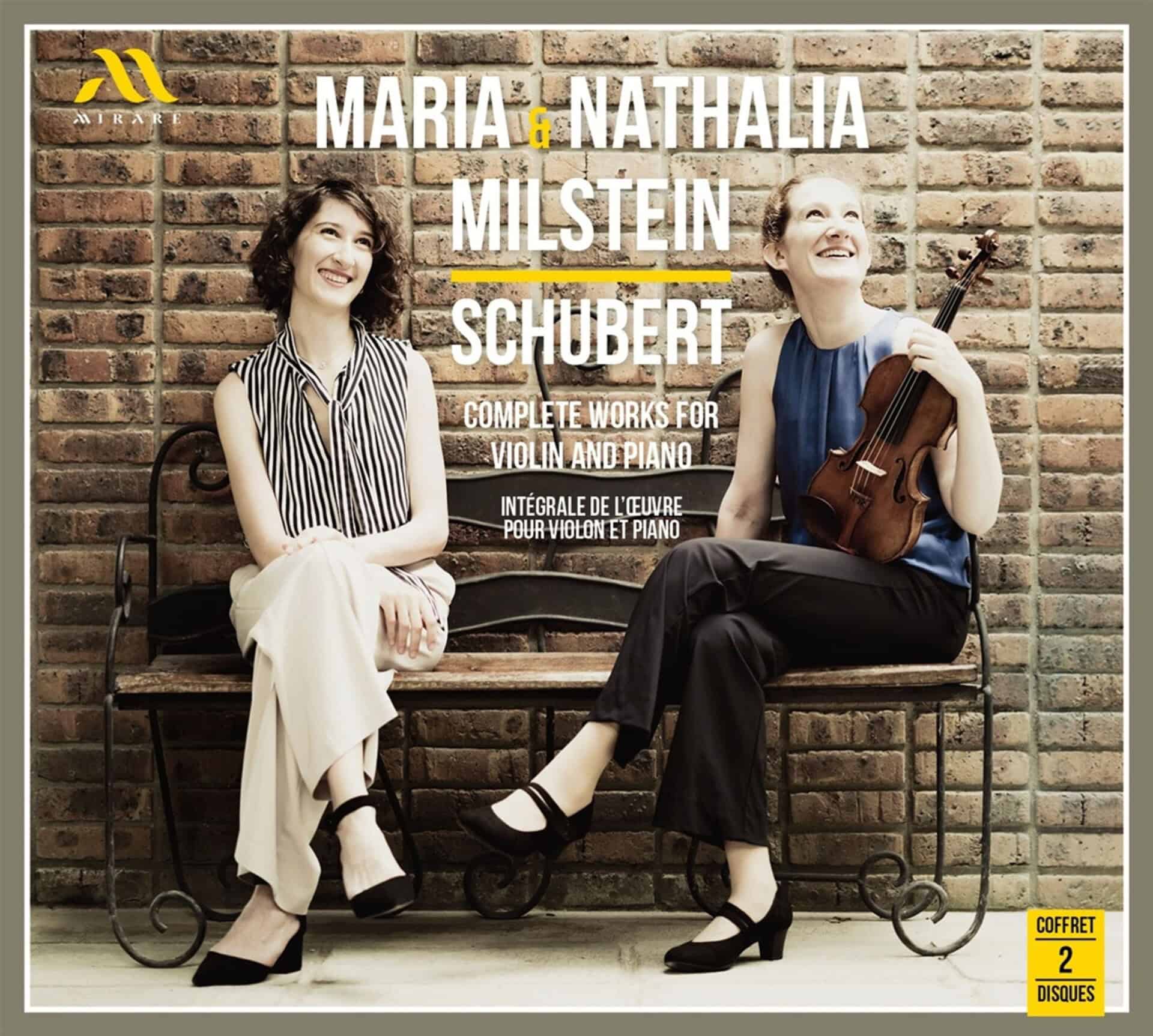
The interpretation of Schubert's 'early' violin sonatas demands in expression a certain degree of innocence and especially joy in playing: these are works that demand this first and foremost.
A year later, with the advent of the sonata (designated as Grand Duo, in A, D 574 (not to be confused with the Grand Duo D 812) in 1817, a more profound tone is struck and thereby the essential distinction between the sonatinas is marked.
In the manuscript Schubert consistently designated the violin works as 'sonata', but due to their small scale the music publisher felt compelled to characterize them as 'sonatina' in 1836, published no less than nearly eight years after the composer's death under opus number 137.
These 'sonatinas' indeed have few pretensions: on average they belong to the domain of more pleasant listening music. In D 574, however, the cards are already dealt quite differently, the execution displays a considerable increase in scale and Beethoven's shadow is never far away. It is also remarkable that the Scherzo (also in the manuscript) directly follows the opening section.
In 1826, almost a decade later – an 'eternity' for a composer who was not to live beyond his early thirties – the Rondo brilliant in the dark key of B minor came into being, as did the Fantasia dating from 1827, composed for the 20-year-old Czech violinist Josef Slavik (who also premiered both works, in Vienna, together with his compatriot, the pianist Carl Maria von Bocklet).
There is no doubt that in particular the four-movement Fantasia completed in December 1827, with a playing time of almost half an hour, was intended primarily to give full rein to the virtuosic feats that Slavik was considered capable of (I suspect the violinist specifically asked for it). The pianist Nikolai Lugansky (Moscow, 1972) remarked on it that in his view the piece belonged to the most difficult music ever written for the piano, even 'more difficult than all of Rachmaninov's piano concertos combined.' That may well be true, but on closer examination it is nonetheless merely the exterior, for in terms of content the expressive means employed by this 'late' Schubert are again of particular caliber, which certainly applies not only to the Andantino, which is both lyrical and extremely varied (there are unmistakable reminiscences of An die Musik, which curiously remains unmentioned in the CD booklet).
The two sisters Milstein display the musical character of the early works in a most engaging manner, and in doing so they dispose of the notion that these sonatinas have no more value or significance than that of pure domestic music, as it were 'between the sliding doors'. In this sense they have followed in the footsteps of Isabelle Faust and Alexander Melnikov (Harmonia Mundi).
It is also positive that the virtuosic qualities of this music in their interpretations do not form a world unto themselves, but are part of the expressive value and meaning to which this music is indeed rich.
In the later works, especially the deeper layered, unforced expressive power of their interpretations strikes one, provided with much color and refinement. The innocence seems rightly abandoned, agogics, accentuation and tempi sound entirely natural (logical), spirituality holds sway and the rhetorical force of the argument is equally impressive.
It is interesting what Nathalia Milstein remarked in the booklet about the choice of piano. That a tonal world was sought that came closest to her and Maria's idea of Schubert's. This of course meant trying out nineteenth-century instruments. Thus the Blüthner from 1857 used for this recording came into view, 2.20 meters long and in exceptionally good condition. The instrument is part of the piano collection of Andriessen. The soundboard is still in its original state and Maria is convinced that the sound is still exactly the same as it was over 150 years ago.
Maria Milstein: 'The intimacy and almost fragile sensitivity expressed in Schubert's musical language becomes even clearer [...] through the singing tone of this Blüthner with its parallel stringing, a sound that is both rich and warm as well as remarkably clear.'
This is how it comes across on this unvarnished recording, with the tonal relationships and balance between violin and piano leaving nothing to be desired and the often subtle character of the music truly coming to its full value. Maria: 'We fell in love with this piano as soon as we heard it, and we felt that it would enable us to create a very individual approach to the Schubert sound, an approach which we hope will take the listener on a similar journey of discovery.' Need I say more than yes indeed!