
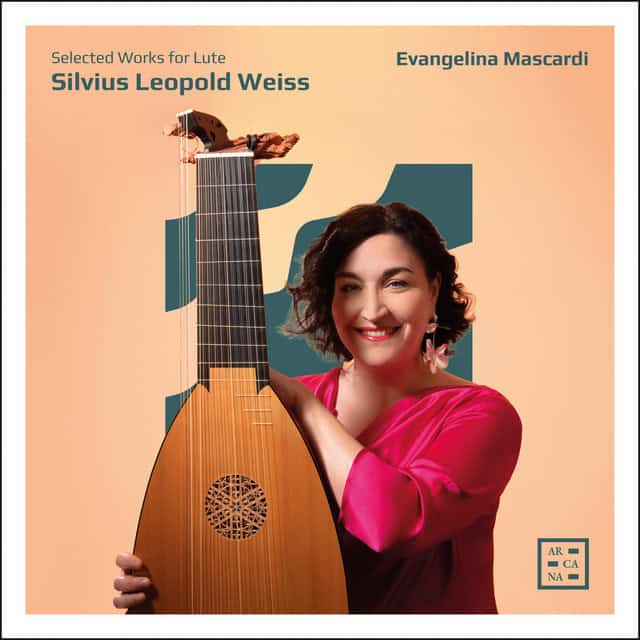
In the cd booklet, Frédéric Zigante, guitarist, lutenist, musicologist and teacher at the Milan conservatory, notes that of more than three centuries of lute literature, counted from the middle of the fifteenth to the end of the eighteenth century, only a modest number of composers have found their way to the twenty-first century. Among them the lute works of Francesco da Milano, John Dowland and Silvius Leopold Weiss.
Famous and forgotten
Fame during one's lifetime usually quickly turns into transience and oblivion after death. We don't even need to go far back in time to encounter this phenomenon, to fully grasp its consequences, for who speaks today of conductors like Herbert von Karajan or Claudio Abbado? Even the name of Nikolaus Harnoncourt seems to have been buried by now. Composers face a similar fate. Whereas, unlike in many earlier times, the transience of fame cannot be attributed to a lack of sound carriers. One could thus say that the phenomenon is timeless and will probably remain so.
The fame during the lifetime of the musician in the Baroque era was of course based on what he achieved. When that came to an end, through illness or death, his reputation quickly faded. Just as composers were similarly 'sacrificed'. Even the music of Johann Sebastian Bach had to wait: the Matthäus-Passion only came in 1829, no less than 79 years after the death of the Thomascantor, thanks to Felix Mendelssohn-Bartholdy at the lecterns of the Berlin Singakademie. In 1841 it was Mendelssohn again, this time in Leipzig, with the orchestra of the Gewandhaus and an adapted role for the evangelist and the soloists. For this occasion the work was shortened by nearly a third...
Challenge
For lute music, even during the Baroque era, the use of tablature itself posed a considerable challenge and moreover was only accessible to musicians who could handle it. That old script in which only the finger positions and thus not the notes were recorded. Only the instrumentalist in question could make sense of it.
Little published
It seems a miracle that the lute music of Weiss has managed to survive through the centuries. For however virtuosic and admired in his time, it didn't need to go much further for Weiss. He did not concern himself with what should or would happen to his compositions after his death, as evidenced by the small portion of them that was published during his lifetime (an initiative that of course had to come from the composer himself).
Now follows the explanation of Weiss's life and work given by Zigante, partly shortened and adapted by me.
Talented
Silvius Leopold Weiss was born on October 12, 1687 in Grottkau, located near Breslau (present-day Wroclaw). His father, Johann Jacob, was a lutenist of some repute and was probably the one who undertook the musical training of this talented offspring. This must have progressed rapidly, for Silvius was still only a teenager when he already presented himself as a violist at the courts of Breslau and Innsbruck.
Traveling hither and thither
This would determine the rest of his life: his role as an instrumentalist and composer. He traveled hither and thither, maintained a complicated travel schedule and fulfilled his role as a performing musician (he performed as a soloist and as a member of the most diverse ensembles) with verve.
Rome and Dresden
Two important periods stand out: his stay in Rome from 1710 to 1714 and in Dresden from 1718 to 1750. In Rome he had joined the entourage of Polish prince Aleksander Soebieski, who resided in the Palazzo Zuccari. There Weiss became acquainted with, among others, Arcangelo Corelli and father (Alessandro) and son (Domenico) Scarlatti. That his stay in Rome was relatively short was probably due to the death of the prince. The lack of income and other security led Weiss to decide to travel to among others Kassel, Düsseldorf, Prague and Vienna to make music there, before settling in Dresden in 1718, the city which was so rich in music and could boast the finest opera houses and musical chapels. There, at court, Weiss managed to raise his already established name to even greater heights. He soon became the highest-paid court musician and was moreover able to draw inspiration from such luminaries as Quantz, Veracini, Pisendel and Buffadin. The circumstances, opportunities and securities must have been so favorable for Weiss in Dresden that he even spontaneously refused an offer from the Vienna imperial court to come to the music metropolis in 1736 at double his salary.
Homage
For almost his entire working life, Weiss enjoyed the support that came to him especially from aristocratic circles. Among the patrons was the then well-known count Johann Anton Losy von Losinthal (ca. 1650-1721), also known under the Frenchified name Comte de Logi, whom Weiss had met in 1717 during a trip to Prague. The count was a lutenist of not inconsiderable talent who also composed and whose name in music history would be immortalized by Weiss thanks to the 'Tombeau sur la morte de M: Comte d'Logÿ arrivée 1721', the musical homage to the deceased count that has remained an important repertoire piece to this day for many lutenists and guitarists.
To Berlin
In 1728 Frederick William II, King of Prussia, invited Weiss and three colleagues from Dresden: the violinist Johann Georg Pisendel and the flutists Pierre-Gabriel Buffardin and Johann Joachim Quantz, to come to the court in Berlin. We do not know exactly how that visit went, but we do know that Weiss stayed there for three months and certainly made a good impression on the king's daughter, Wilhelmine, who had also become skilled in lute playing. She recorded her memories in her memoirs: 'of the famous Weiss, who excels so much on the lute that nothing like it has ever been seen, and that everyone who comes after him can only have the honor of imitating him'.
To Leipzig
In the summer of 1739 Weiss traveled to Leipzig together with his student Johann Kropfgans. He was to accompany Wilhelm Friedemann Bach on a visit to his illustrious father, the great Johann Sebastian. A brief account of this survives from Johann Elias Bach, composer, teacher and first cousin of the Thomascantor: 'We enjoyed very fine music when my cousin from Dresden (W.F. Bach, AvdW) played at our home several times in the company of the two famous lute players Herr Weiss and Herr Kropfgans'.
Advice
Weiss also contributed to the technical evolution of the lute through his advice to lute makers Martin and Johann Christian Hoffmann in Leipzig and Thomas Edlinger II in Prague. He added two courses to the 11-course French lute, tuned in d minor. He designed a lute that may have been inspired by the Italian archlutecharmer and theorbes. This lute had a long, curved neck, also known as a 'swan neck', which extended the lower register string. This design produced a stronger and more pronounced sound and was therefore more suitable for chamber music and basso continuo.
Impoverished
Silvius Leopold Weiss died on 16 October 1750 in Dresden, leaving behind his wife Elisabeth and seven children. Despite his extraordinary merits, he left his family virtually impoverished due to the high costs associated with his position as court musician.
Weiss' music represents the most impressive legacy that can be attributed to a single composer in the entire lute literature: as many as 650 pieces for solo lute have been preserved, in addition to some chamber music compositions.
Tablature
The tablature in printed form advocated by Weiss originated from a well-known example: that of Georg Philipp Telemann's Der getreue Music-Meister (Hamburg, 1728). The remaining compositions are only available in (tablature) manuscript, of which the two most important collections are in Dresden and London, but besides that many other collections, mostly fragmentarily preserved, are scattered around the world. Most of the compositions are grouped around shared keys, but there are also exceptions, such as on this album the Tombeau sur la Mort de M: Cajetan Baron d'Hartig arrivée le 25 Mars 1719 and the aforementioned Tombeau sur la mort de M: Comte d'Logÿ arrivée 1721. The work titles of such groupings were often called 'sonatas' at the time, sometimes also 'partitas', or otherwise without any designation.
Engaging Selection
The selection compiled by Argentine lutenist, guitarist and theorbo player Evangelina Mascardi (1977, Buenos Aires) from this rich oeuvre is certainly not a compilation of Weiss' (most) well-known pieces. The only two compositions included in this selection that enjoy some recognition today are the Fantasia in c and the Tombeau sur la mort de M: Comte d'Logÿ arrivée 1721. The second Tombeau sur la Mort de M: Cajetan Baron D'Hartig arrivée le 25 mars 1719 (the baron, one of the many patrons, died at the age of 33 after an unfortunate fall from his horse) has, in my opinion, unjustly received far less attention despite the intense character of the piece.
Mascardi deliberately chose unique and varied pieces, also from Weiss' own repertoire. While Weiss had a tendency to repeat the same patterns, especially in the allemandes, correntes and gigues, this selection features notably many different elements. Another important factor is the variety of keys. The 13-course lute has the property of producing very different timbres depending on the key. This characteristic has been completely lost with modern instruments through equal temperament tuning.
Surprising
The last aspect taken into account in the selection is related to historical accounts showing that Weiss must have had exceptional improvisational skills. Of course, improvisation itself cannot be conveyed through written music, but many of the pieces on the album contain surprising and idiosyncratic elements that will certainly surprise the listener. Ornaments have been added to these based on Mascardi's knowledge and experience of the (also historicizing) craft. Does her playing recall what Princess Wilhelmine recorded in her memoirs? 'That everyone who comes after him (Weiss, AvdW) can only have the honor of imitating him'. I can only add: sublime!