
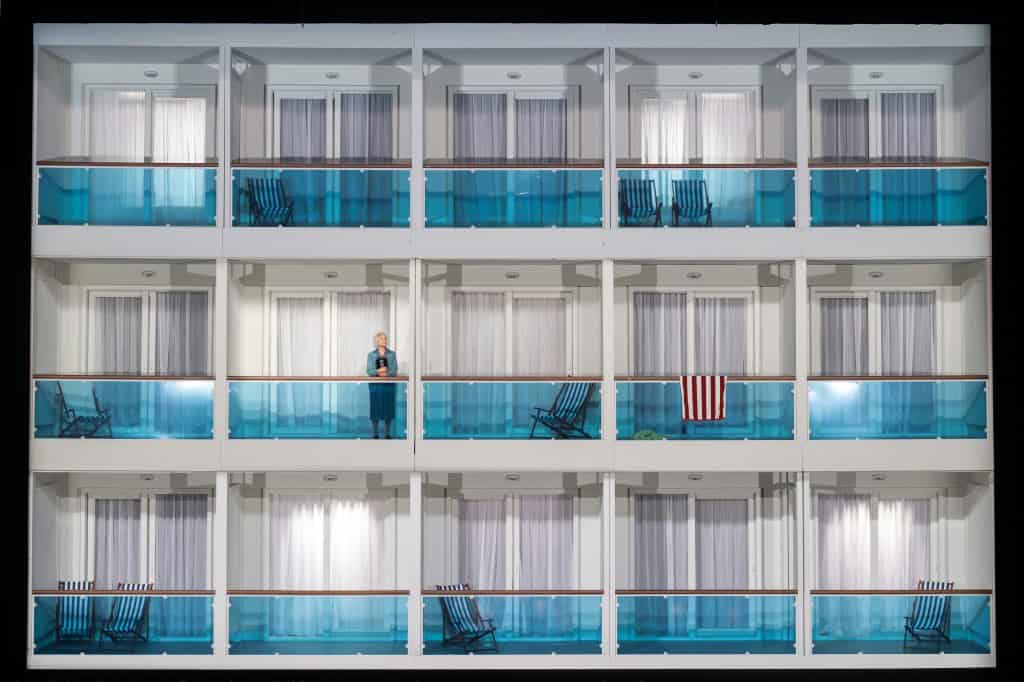
With Lisa, it is the perpetrator who is in uncertainty. Moreover, it is not so much remorse that obsesses her as the idea that her past could endanger her future. Her husband is furious but also not least because he can probably forget his career as a diplomat if everything were to come out.
The story of the original author, Zofia Posmysz, is based on her own experience, which in turn bears a closer resemblance to the plot of It was just an accident. At age 19, she was arrested by the Gestapo for distributing anti-Nazi pamphlets and deported to Auschwitz. Years later, when she visited Paris as a journalist, she heard a woman speaking German with a voice reminiscent of an Auschwitz camp commandant. That woman turned out not to be the person in question. In Die Passagierin too, and presumably also in Zofia Posmysz's original story, it remains unclear whether the woman Lisa sees is really Marta. The staging is by Tobias Kratzer at the Bayerische Staatsoper in Munich; a charged city, of course, given German history. In Bayreuth I saw an innovative Tannhäuser directed by Kratzer, and he is currently working on a Ring in Munich; Die Walküre has just been released. I'm curious what he will do at the end of Die Götterdämmerung with the Rhine, which according to the libretto overflows its banks and washes away all worries and suffering. Will it be as vast an ocean as the one he presents in Die Passagierin, and which some passengers aboard the ship hope might perhaps wash away all worries and suffering? After we see undulating water as far as the eye can see on a front curtain during the opening measures, the set of the first act comes into view: the side of a gigantic cruise ship. Passengers sit in their cabins or walk on the decks. First, an old woman appears, representing a third narrative thread, one in which Lisa, in the present, at an advanced age, travels back to Europe and sees herself aboard the ship as she once traveled away from Europe. We see how the older Lisa is startled when she sees her 'self' from 1960 coming out of her cabin. The 1960 Lisa then sees on a deck below her the woman who is or resembles Marta. Lisa is particularly startled because, as far as she knows, Marta had been transferred in Auschwitz to the 'death block'. Her husband joins her, preparing himself for a dinner and a dance party. When Lisa reveals what troubles her, he becomes furious; as mentioned, not so much out of moral indignation as because he is afraid for their career prospects in their new homeland Brazil. At the end of the first act we see the old woman climbing over the ship's railing and disappearing from view. Now an underwater film projection is shown on the front curtain of a struggling and thrashing woman. Did the old woman we saw before commit suicide, or are these nightmares that cannot be washed away above the surface, but also lurk beneath the sea level? Lady Macbeth in thousands or millions. In this context, the design of the ship is also interesting. David Hockney-like, bright colors, an ideal image of a 'clean' ordered society, which Hockney presented as an illusion. Two striking elements in the image are a red-and-white striped bath towel hanging over the railing and a red-and-white striped deck chair. Director Tobias Kratzer said in an interview that he did not want to show barracks and striped camp clothing as we know only too well from the photographs. The red stripes are perhaps still references to camp imagery; but then 'implausibly' cleaned up.This also means that Auschwitz sometimes recedes from view in this staging. In the first part, the transition from the scenes taking place aboard the cruise ship to the scenes in the concentration camp is often quite unclear. Yes, the libretto jumps very quickly from 1960 to 1944 and vice versa; perhaps the cuts in this shortened version are to blame here – half an hour has been cut from the original version, including a prominent character, Katja, a young Russian partisan.
Why would those cuts have been made? I don't know the original version (although there are meanwhile already two performances on CD and a DVD of the first fully staged version from the Bregenzer Festspiele 2010), but I can imagine that the team that made these cuts, the director, the dramaturg and the Russian-Jewish conductor Vladimir Jurowski hesitated over a narrative element that was in line with the then general anti-German Soviet propaganda, knowing how things stood in Russia itself, including regarding the composer himself. Is this staging not only a reflection of a general need to wash away the past, but also a mirror of it? Typical is that during Marta's closing monologue with the text: "If one day your voices fall silent, then we will perish", a text in Polish is projected in the set (the same text?), against a background of a undulating ocean, the same undulating ocean we saw in the opening image. Interesting: by projecting the text that calls for Auschwitz not to be forgotten in Polish, justice is done to the 'Polishness' of the entire opera, the nationality of Marta and of the original author of the story, Zofia Posmysz, the fact that Auschwitz is in Poland and the original nationality of Weinberg. But at the same time the message is also concealed in a sense; almost no one in the audience reads Polish. Is the director suggesting that we still don't want to hear the message? The text of the closing monologue is of course visible in the surtitles. One cannot say, however, that Die Passagierin has not been performed dozens of times in Germany and Austria, in large and small opera houses. There is no lack of interest and recognition. This second act indeed takes place in Auschwitz, alternating between the barracks and the dining hall of the SS staff, during the preparations for a grand party. Here too the director alludes rather indirectly to the concentration camp. On stage we see about fifteen tables arranged across the width and towards the back, in a way reminiscent of the arrangement of the concrete blocks of Daniel Eisenman's Berlin Holocaust Memorial, but in this scene they are neatly covered with white tablecloths because of the upcoming dinner; the director has the characters conceal the true nature of the location again, but in a sense does so himself as well. Lisa, herself only 22 years old, tries to get the three-year-younger Marta in her power, or to involve her in SS practices, or out of pure sadism, or, as this staging seems to suggest, for erotic motives. She does this by offering to arrange meetings between Marta and her fiancé Tadeusz. Both refuse, however. A meeting does take place when Tadeusz, who is a violinist, is given the task of coming to play the camp commandant's favorite waltz music at the party. But while Weinberg writes the party scene largely in three-four time, he now has Tadeusz play the chaconne from Bach's partita in D minor. Whereupon the assembled rabble attacks him, like the Furies in the Orpheus story, and murders him. A stage direction detail: when the crowd takes away Tadeusz' violin, the violinist who plays the Chaconne (young star violinist Niek Baar) continues and completes the Chaconne. In other words, art lives (briefly) on. Just before the final image, a character comes forward from behind the stage pushing a cart in front of him with a sixties-model television on which black-and-white film images are shown that look like images from Nazi camps, or perhaps they are images from the Polish film that was made from Zofia Posmysz' original story. And so we do see after all - directly or indirectly - camp images. After the image of the ocean fades, a black curtain descends. After the final measure of the first act, there was first a solemn silence, now loud applause broke out immediately. It is striking that conductor Adam Hickox has not looked in the direction of the audience from his entry at the beginning to the end, and thus, for example, also held back the usual welcoming applause at the beginning of the two acts each time, which reinforced the solemn character of the performance. Hickox also shows deep respect for the score, which he conducts beautifully tightly, allowing for a great sense of contrast between the satirical and lyrical passages, by a virtuously playing orchestra Nederlands Philharmonisch Orkest, and a strong choir and soloists ensemble. Lisa is Jenny Carlstedt and Marta is Sylvia D'Eramo, both vocally and characterologically equal to their roles. Lisa has in a sense the traditional mezzo role of the older woman with the questionable character, Marta is the younger and more sympathetic lyrical soprano. The two male leading roles are also beautifully performed, tenor Nikolai Schukoff (Lohengrin at DNO in 2014) as the deliberately somewhat superficial and also in the libretto superficially kept husband of Lisa, and Gyula Oredt in the more characterful role of Tadeusz, Marta's fiancé. The singers of the six minor solo roles are all dressed the same as Marta. Jet black, as Marta's alter egos or as a squadron of angels of death. At the same time, however, this eliminates the possibility of characterizing different characters. [embed]https://www.youtube.com/watch?v=RBOfm83xgoM[/embed]Die Passagierin can still be seen on 20, 23, 26 (matinee) and 29 April and on 2 May.
On May 2, the opera will be heard live from Muziektheater on NPOKlassiek. On May 4, De Nationale Opera organizes, in the context of the Nationale Dodenherdenking as part of the Theater na de Dam program, Perpetrators and Memory in Studio Boekman, with a panel discussion featuring Alette Smeulers, Stijn Reurs and Chris van der Heijden, and songs by Weinberg performed by mezzo-soprano Eva Kroon and pianist Jan-Paul Grijpink. Start time 21.00.
Basia Jaworski wrote her own review of a DVD of the 2010 performance in Bregenz.